How Much Does Junk Removal Cost?
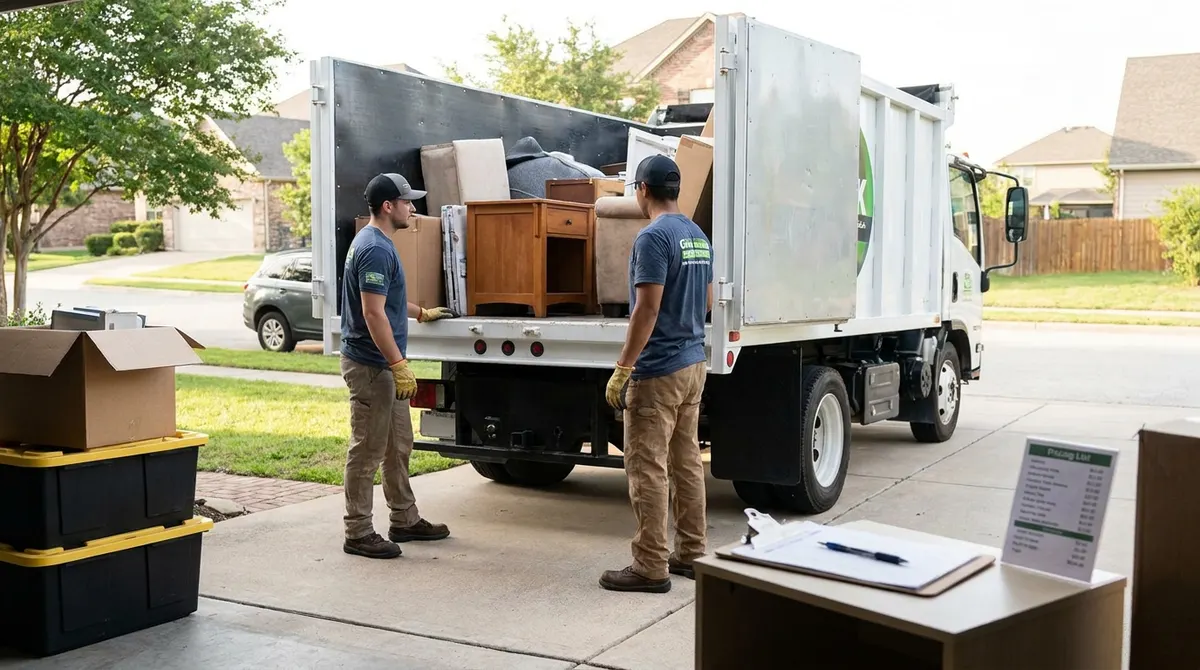
Junk removal generally runs $100 to $175 at the minimum and $450 to $700 for a full truck, with the crew doing all lifting and hauling. Our local junk removal team confirms the exact figure on a free on-site look, since access, weight and drive distance all shift the number.
| Load size / job type | Typical price range |
|---|---|
| Single item (mattress, sofa, recliner) | $75 – $150 |
| Single appliance (washer, dryer, fridge) | $75 – $175 |
| Minimum load (about 1/8 truck) | $100 – $175 |
| Quarter truck (about 4 cubic yards) | $150 – $300 |
| Half truck (about 8 cubic yards) | $300 – $450 |
| Three-quarter truck (about 12 cubic yards) | $400 – $550 |
| Full truck (15–18 cubic yards) | $450 – $700 |
| Full garage or basement cleanout | $400 – $900 |
| Hot tub removal (cut and haul) | $300 – $700 |
| Piano or safe removal | $200 – $600 |
| Heavy debris by weight (dirt, concrete, shingles) | Quoted per ton on site |
Typical full-service junk removal price ranges by load size (crew labor, loading and disposal included)
Junk removal is priced by the truck space a load fills, not by the hour
Full-service junk removal is volume-based. The crew looks at the pile, quotes the fraction of the truck bed it will occupy, and that quote includes labor, loading, driving and disposal. A standard junk removal truck holds roughly 15 to 18 cubic yards, which is about the volume of six to eight pickup truck beds. Because the price is tied to space rather than time, a slow, awkward carry down two flights does not run the clock up on the customer. Hourly billing appears mainly on labor-only jobs where nothing leaves the property.
Junk removal minimum charges cover the first eighth to quarter of the truck
Nearly every junk removal company sets a minimum, commonly $100 to $175, and that minimum covers the first eighth to quarter of the truck. The minimum exists because the truck, fuel, insurance and two-person crew cost the same whether they haul one chair or twelve. Practical consequence: two nightstands and a single box often cost the same as five pieces of furniture. Customers with only one or two small items generally get the best value by adding whatever else has been sitting in the garage before the truck arrives.
Single-item junk pickups cost more per piece than a combined load
A single mattress or sofa pickup usually falls between $75 and $150, and an appliance between $75 and $175. Per cubic yard, that is the most expensive way to buy junk removal. Certain items carry their own line-item fees because of where they must go: refrigerators and window air conditioners contain refrigerant that requires certified recovery, mattresses often carry a per-unit recycling charge at the transfer station, and tube televisions hold leaded glass handled as e-waste. Combining several items into one visit spreads the trip cost across the whole load.
Junk removal disposal fees rise with weight, not just volume
Transfer stations and landfills bill by the ton, so weight is the second half of the pricing math. Household junk averages roughly 200 to 400 pounds per cubic yard, and a full truck of ordinary furniture and boxes typically weighs 1.5 to 3 tons. Dense material breaks the volume rule entirely. Dirt, sod, concrete, brick, tile and roofing shingles are quoted by weight because a quarter truck of concrete can outweigh a full truck of couches. Construction debris, yard waste and clean fill often route to separate facilities with their own tipping rates.
Junk removal quotes shift with stairs, carry distance and drive time
Access is the most common reason two identical piles get different quotes. Items staged in a driveway or garage load fastest and price at the low end of the range. A third-floor walk-up, a narrow basement stairwell, a long backyard carry, or a downtown building with a single service elevator all add crew time and move the quote up. Drive distance matters too — addresses far from the nearest transfer station absorb more fuel and windshield time. Same-day and weekend slots may carry a modest premium when the schedule is already tight.
Junk removal versus a rented dumpster: the cost comparison depends on who loads it
A 10-to-20-yard roll-off dumpster commonly rents for $300 to $600 for a week, plus overage charges if it exceeds the included tonnage, and the customer does every bit of the lifting. Full-service junk removal at $300 to $700 for a comparable volume includes the labor, and the truck is gone the same day with no permit to arrange and no driveway sitting under a steel box. Dumpsters make sense for multi-week renovations that generate debris steadily. One-time cleanouts, estate clear-outs and single heavy items are almost always cheaper and faster as a hauled job.
Junk removal quotes are confirmed on site because photos hide weight and access
Reputable haulers give a ballpark by phone or photo and confirm the firm number on arrival, before any work begins. Photos flatten a pile and never show whether the bottom layer is particleboard or solid oak, nor whether the basement stairs turn. An on-site walkthrough takes a few minutes, costs nothing, and produces a number the customer can accept or decline with the truck still in the driveway. Any quote presented as an exact price sight-unseen should be treated with caution, since the adjustment usually happens later.
Reddit threads on junk removal pricing point to the same two surprises
Paraphrasing a recurring complaint in r/junkremoval: people are startled that a couple of small items still triggers a full minimum charge. The spec behind it is the minimum load of $100 to $175 covering the first eighth to quarter of the truck — the trip, not the item count, is what is being paid for. A second thread theme, paraphrased from r/HomeImprovement, is homeowners underestimating tonnage on demo debris. Tile, plaster and shingles are billed by weight, and a quarter-truck of that material can weigh more than a full truck of furniture.