Junk Removal vs Dumpster Rental: Which Should You Choose?
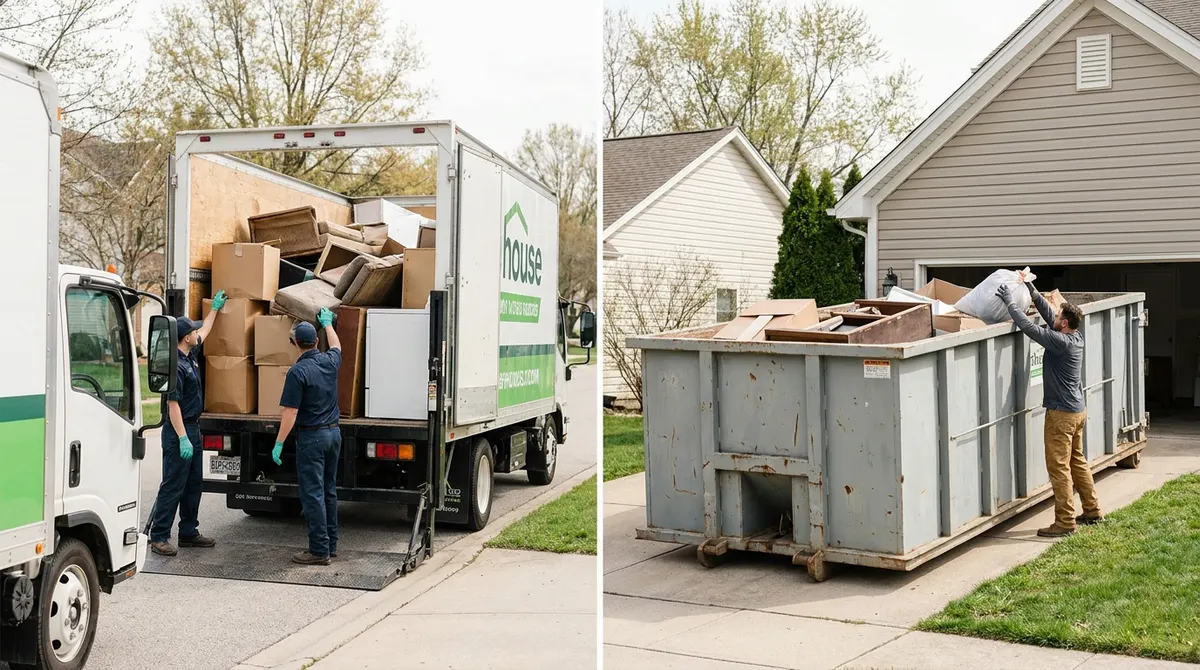
Junk removal is the done-for-you option at roughly $150-$800 per load; dumpster rental is cheaper per cubic yard only if the customer loads it. Our local crew handles the lifting, stair carries, and haul-off, and confirms the exact price on site before work begins.
| Factor | Full-Service Junk Removal | Roll-Off Dumpster Rental |
|---|---|---|
| Typical price range | $150-$800 per load (volume-based) | $300-$750 per 7-14 day rental |
| Who loads it | Two-person crew loads and sweeps up | Customer loads all material |
| Time on property | Usually 30 minutes to 2 hours | Container stays 3-14 days |
| Common sizes | Quarter, half, or full truck (approx. 4-16 cu yd) | 10, 20, or 30 cubic yards |
| Driveway footprint | Truck parks curbside, leaves same visit | Container occupies 20-22 ft of driveway or street |
| Permit needs | None in most residential situations | Often required for street or right-of-way placement |
| Extra fee risk | Quoted volume price, heavy-item surcharges disclosed up front | Weight overage commonly $50-$100 per extra ton |
| Best fit | Cleanouts, furniture, appliances, hoarding, estate jobs | Renovations, roofing, siding, demolition over several days |
Junk removal vs roll-off dumpster rental: cost, labor, and timeline at a glance
Junk removal pricing is based on truck volume, not rental days
Full-service junk removal is priced by how much space the load occupies in the truck. A single bulky item such as a sofa or refrigerator generally falls in the $100-$200 range. A quarter-truck load typically runs $150-$300, a half-truck load $300-$450, and a full truck $500-$800 in most residential markets. Labor, stair carries, sweep-up, and disposal fees are included in that quoted number. Because the charge is tied to volume rather than calendar time, a two-hour garage cleanout and a slow all-day sort cost the same amount.
Dumpster rental costs less per cubic yard but adds permits and weight limits
Roll-off dumpster rental commonly runs $300-$500 for a 10-yard container, $400-$600 for a 20-yard, and $500-$750 for a 30-yard on a standard 7-14 day rental. Each rental includes a tonnage allowance, usually 1-3 tons, and material past that allowance is billed at roughly $50-$100 per additional ton. Concrete, dirt, brick, and shingles hit weight caps quickly and are the most frequent source of overage bills. A permit is often required when the container sits on a public street rather than a private driveway.
Junk removal finishes most household cleanouts inside one visit
A crew-loaded job removes the debris and the project in the same appointment. Garage cleanouts, basement clear-outs, single-room furniture removal, appliance haul-off, and estate cleanouts are usually complete in 30 minutes to 2 hours. Nothing stays on the property overnight, no container blocks parking, and there is no second phone call to schedule a pickup. Same-day and next-day slots are frequently available for these jobs. For sellers on a closing deadline or renters facing a move-out date, the single-visit timeline is the deciding factor more often than price.
Dumpster rental is the stronger fit for renovation debris produced over days
A roll-off container earns its keep when debris appears gradually. Kitchen and bathroom gut jobs, roofing tear-offs, siding replacement, deck demolition, and flooring removal generate material across a week or more, and a container on site absorbs it as the work happens. Contractors already staffed for loading get more value per dollar from a dumpster than from repeated crew visits. The trade-off is honest: the customer or the trade crew supplies every bit of the labor, and the container occupies the driveway for the entire rental period.
Junk removal avoids the driveway space and surface-damage question entirely
A 20-yard roll-off needs roughly 22 feet of straight length, about 8 feet of width, and 23 feet of overhead clearance for the delivery truck to tilt the box off. Short driveways, sharp aprons, low branches, and overhead utility lines rule out placement at many homes. Delivery drivers typically place wood planks under the rails to protect asphalt and pavers, though pressure marks on sealcoated or older asphalt remain a real risk. Junk removal sidesteps the issue because the truck parks at the curb and leaves with the load.
Prohibited-item rules push certain loads toward full-service junk removal
Dumpster rental agreements almost universally exclude paint, solvents, motor oil, propane tanks, tires, batteries, and refrigerant-containing appliances, and contamination fees apply when those items turn up during the tip. Full-service crews sort at the truck and route items to the correct facility, including scrap metal yards, appliance recyclers, and household hazardous waste drop-offs. Mattresses, e-waste, and tires commonly carry a per-item disposal surcharge in either scenario, disclosed before loading. Mixed household loads with a few restricted items are usually simpler and cheaper handled by a crew.
Junk removal versus dumpster rental: the choice comes down to who supplies the labor
Choose full-service junk removal when the items are heavy, stairs are involved, the timeline is a single day, or nobody on site wants to load a container. Choose a dumpster rental when a work crew is already loading, the debris arrives over multiple days, and there is 22 feet of usable driveway. Homeowners who price only the container total sometimes overlook two real costs: several days of their own labor and the overage risk on heavy material. A free on-site estimate makes the comparison concrete.