What Will Junk Removal Companies Not Take?
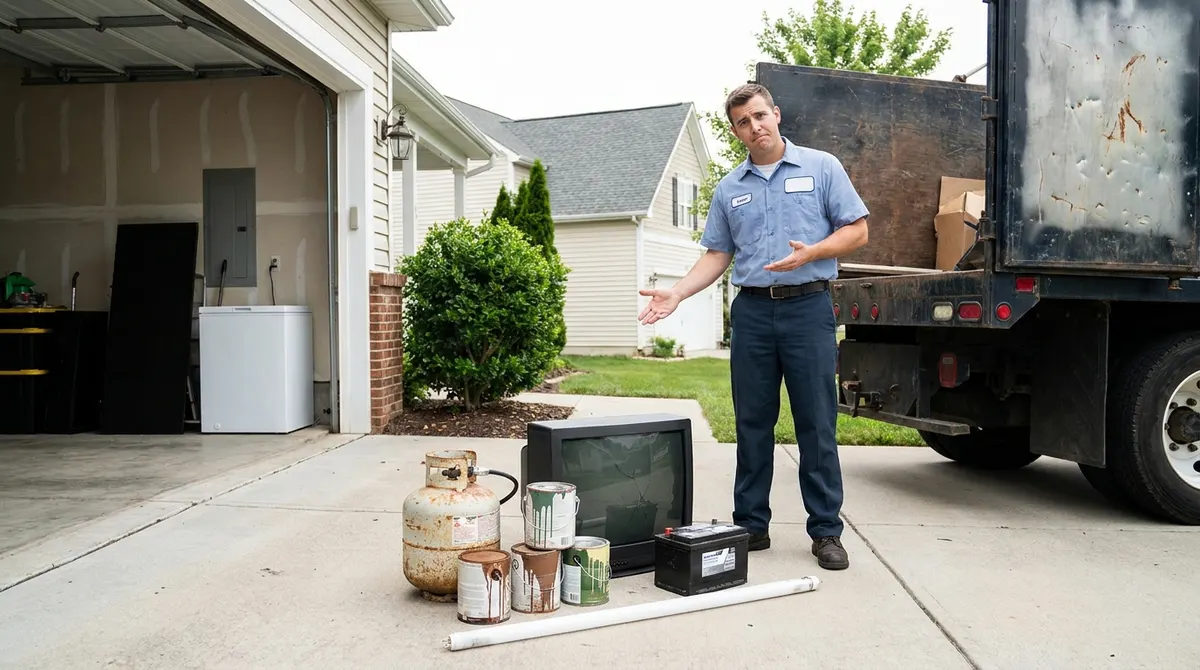
Junk removal companies refuse hazardous waste, asbestos, pressurized tanks, ammunition and medical sharps, and charge extra for tires, mattresses and freon appliances. Our crew hauls the rest — furniture, appliances, debris, whole-property cleanouts — and does all the lifting and loading.
| Item | Status with junk removal crews | Correct disposal route |
|---|---|---|
| Liquid paint, stain, thinner | Refused as liquid; accepted once fully dried or solidified | Household hazardous waste (HHW) drop-off event or permanent HHW facility |
| Motor oil, antifreeze, gasoline | Refused | Auto parts store take-back or HHW facility; gasoline must be in an approved container |
| Pesticides, herbicides, pool chemicals | Refused | HHW facility only — never the curb or a storm drain |
| Asbestos siding, pipe wrap, popcorn ceiling debris | Refused | Licensed asbestos abatement contractor; regulated disposal manifest required |
| Refrigerators, freezers, window AC, dehumidifiers | Accepted with a refrigerant (freon) recovery fee, typically $25–$60 per unit | EPA Section 608 certified technician recovers refrigerant, then metal recycling |
| Tires | Accepted with a per-tire fee, commonly $5–$15 each | Tire recycler or county transfer station scrap tire program |
| Propane tanks, oxygen cylinders, fire extinguishers | Refused (pressurized) | Propane exchange cage, gas supplier, or HHW facility |
| Ammunition, flares, black powder, fireworks | Refused | Police department or sheriff non-emergency line for surrender/pickup |
| Needles, sharps, biohazard bags, prescription drugs | Refused | Pharmacy sharps kiosk, medical waste mail-back kit, drug take-back box |
| Mattresses and box springs | Accepted with a recycling fee, commonly $20–$50 each | Mattress recycler or landfill mattress line |
| Televisions, monitors, computers | Accepted with an e-waste fee, commonly $20–$60 per screen | Certified electronics recycler |
| Railroad ties, creosote timbers, treated lumber | Often refused or surcharged | Special-waste landfill cell that accepts treated wood |
| Dirt, concrete, brick, roofing shingles | Accepted separately by weight, not by volume | Construction and demolition (C&D) recycling facility |
Commonly refused and restricted items, and the legal disposal route for each
Junk removal companies refuse liquid paint because landfills only accept it solidified
Liquid latex or oil-based paint is the single most common refusal at the truck. Landfills will not accept free liquids, so a hauler cannot legally put a sloshing can in the load. Latex paint can be legally disposed of once it is hardened: remove the lid and let a half-empty can air-dry, or stir in kitty litter, sawdust or a commercial paint hardener until it holds a firm shape, then set the open can out with the trash where local rules allow. Oil-based paint, stain, lacquer and thinner never qualify for that method and must go to a household hazardous waste facility. Fully dried cans are loaded with the rest of a garage cleanout at no special charge.
Refrigerators and freezers need certified refrigerant recovery before a junk removal crew hauls them
Appliances that contain refrigerant — refrigerators, freezers, chest coolers, window air conditioners, dehumidifiers and water coolers — are accepted, but they are handled on a separate track. EPA Section 608 requires that refrigerant be recovered by a certified technician before the metal is scrapped, which is why a fridge usually adds a $25–$60 recovery fee on top of the load price. Scrap yards refuse units with the tag missing or the line cut. Homeowners who already had the refrigerant evacuated should keep the technician's tag on the unit, because that documentation removes the fee.
Asbestos and suspected asbestos material requires a licensed abatement contractor, not a junk removal truck
No standard junk removal company will take asbestos. Friable asbestos generates airborne fibers during handling and disposal is regulated under state and federal rules requiring wetting, sealed and labeled containment, trained handlers, and a manifested disposal cell. Materials in homes built before roughly 1985 that commonly test positive include 9x9 floor tile and its black mastic, boiler and pipe insulation wrap, cement siding shingles, textured popcorn ceilings, and some vermiculite attic insulation. The correct sequence is a certified inspector's sample test, then a licensed abatement contractor. Once the abatement is cleared and documented, a junk removal crew can haul the remaining non-regulated debris, drywall and framing.
Tires, mattresses and electronics are accepted by junk removal crews but priced per item
These are restricted, not prohibited — a distinction that prevents most surprise refusals. Disposal facilities charge haulers a specific gate fee for each one, so the fee passes through: roughly $5–$15 per tire, $20–$50 per mattress or box spring, and $20–$60 per television or monitor depending on screen size and type. Rim-on tires often cost more than bare tires. Counting these items out loud during the quote is the fastest way to keep the final number identical to the estimate, which is why an on-site look beats a phone guess.
Pressurized tanks, ammunition and medical sharps route through hazmat and law-enforcement programs instead of junk haulers
Propane cylinders, oxygen tanks, CO2 canisters and fire extinguishers are refused because a pressurized vessel can rupture inside a compacting truck or a landfill face. Empty 20 lb grill tanks go back to a propane exchange cage or a gas supplier; larger tanks are picked up by the supplier. Ammunition, old flares, black powder and fireworks are handled by a police or sheriff non-emergency line, and many departments accept surrendered rounds directly. Needles and sharps belong in a rigid container taken to a pharmacy kiosk or a mail-back kit, and leftover prescriptions go in a take-back box. None of these belong in a household trash bag.