What Are the Most Common Junk Removal Mistakes to Avoid?
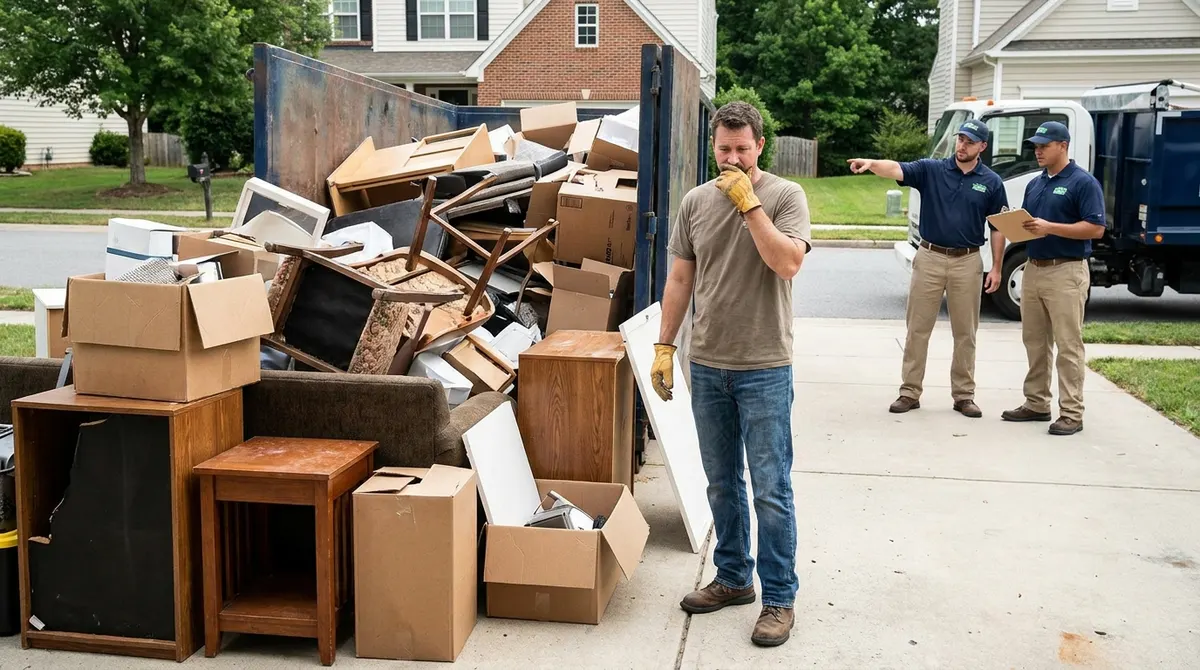
Most junk removal problems trace back to five avoidable errors: unverified quotes, unlicensed haulers, hazardous items, blocked access, and hidden disposal fees. Our hauling team quotes on site, confirms local transfer-station charges up front, and handles the lifting.
| Mistake | Correct approach and typical cost impact |
|---|---|
| Accepting a price over the phone with no visual estimate | Request a free on-site look or clear photos; phone guesses commonly land 20 to 40 percent under the real volume, and the gap shows up on arrival |
| Hiring an unlicensed or unverified hauler | Ask for business licensing and the name of the transfer station or landfill used; illegal dumping fines are typically assessed against the property owner, not the hauler |
| Leaving paint, fuel, propane tanks, or batteries in the pile | Set hazardous items aside for a household hazardous waste event; most general loads legally cannot accept them and the crew will leave them behind |
| Not clearing driveway, hallway, and doorway access | Move vehicles and clear a 3-foot path; blocked access adds labor time and can push a job to a second visit |
| Assuming labor and dump fees are extra | Confirm one all-in price covering labor, hauling, and disposal; mixed-load tipping fees commonly run about $40 to $80 per ton in most markets |
| Booking a full-truck job for two small items | Single-item and curbside pickups usually price around $100 to $200, well below a quarter-truck minimum |
| Skipping a walkthrough before the truck leaves | Point out the garage corner, side yard, and shed; items never identified are items never loaded |
Common junk removal mistakes, the fix, and the typical cost impact
Junk Removal Quotes Are Accurate Only After a Visual Volume Estimate
Junk removal is priced by the volume the load occupies in the truck, measured in cubic yards, not by item count. A standard junk removal truck holds roughly 15 to 20 cubic yards, which is why a quarter load, a half load, and a full load carry different prices. Verbal descriptions such as "a garage full" or "a few boxes" are not measurable, so an over-the-phone number is a guess. **A free on-site visual estimate is the only way to lock a price before work starts.** Clear photos of every pile, taken from a few feet back, are the next best option for smaller jobs. Heavy debris such as dirt, concrete, roofing shingles, or brick is priced differently because weight limits are reached long before the truck fills.
Junk Removal Haulers Should Name the Transfer Station or Landfill They Use
Illegal dumping is the single most expensive mistake in this category because liability often follows the waste back to whoever generated it. A legitimate hauler can state where a load goes: a permitted county transfer station, a licensed landfill, a metal scrapyard, or a donation center. Ask for a business license number and confirm the company operates under its own name on the truck and the invoice. Cash-only haulers with no written estimate, no company markings, and no answer about disposal are the pattern behind most dumped-in-a-ditch news stories. **A legitimate junk removal company provides a written estimate and a receipt.** Requesting the disposal destination takes one sentence and removes nearly all of the risk.
Junk Removal Loads Cannot Legally Include Paint, Fuel, Propane, or Batteries
Hazardous household waste is banned from general municipal solid waste loads under state and federal rules. The commonly excluded items are liquid paint and solvents, gasoline and motor oil, propane tanks, pesticides and pool chemicals, car batteries, fluorescent tubes, and medical sharps. Sorting these out before the truck arrives prevents a partial job. Latex paint can often be dried out with kitty litter or a paint hardener and then disposed of as regular waste once solid. Propane tanks are usually accepted by exchange cages at hardware stores and fuel retailers. Tires, refrigerators, freezers, and air conditioners are handled but usually carry a per-item surcharge, since refrigerant recovery and tire recycling are separately regulated. Naming these items during the estimate keeps the quote honest.
Junk Removal Crews Need Confirmed Truck, Doorway, and Stair Access
Access drives labor time, and labor time drives the price. The details worth confirming before the appointment: where the truck can legally park, whether a gate or alley is wide enough, how many flights of stairs are involved, and whether an elevator needs to be reserved in a condo or apartment building. A cleared 3-foot walking path from the pile to the door speeds loading considerably. Long carries over 100 feet, tight basement stairwells, and second-floor removals legitimately add time, and a reputable hauler will say so during the estimate rather than after loading begins. **Parked cars in the driveway are the most frequent avoidable delay on residential jobs.**