How Do You Clean Out a House After a Death or Estate Sale?
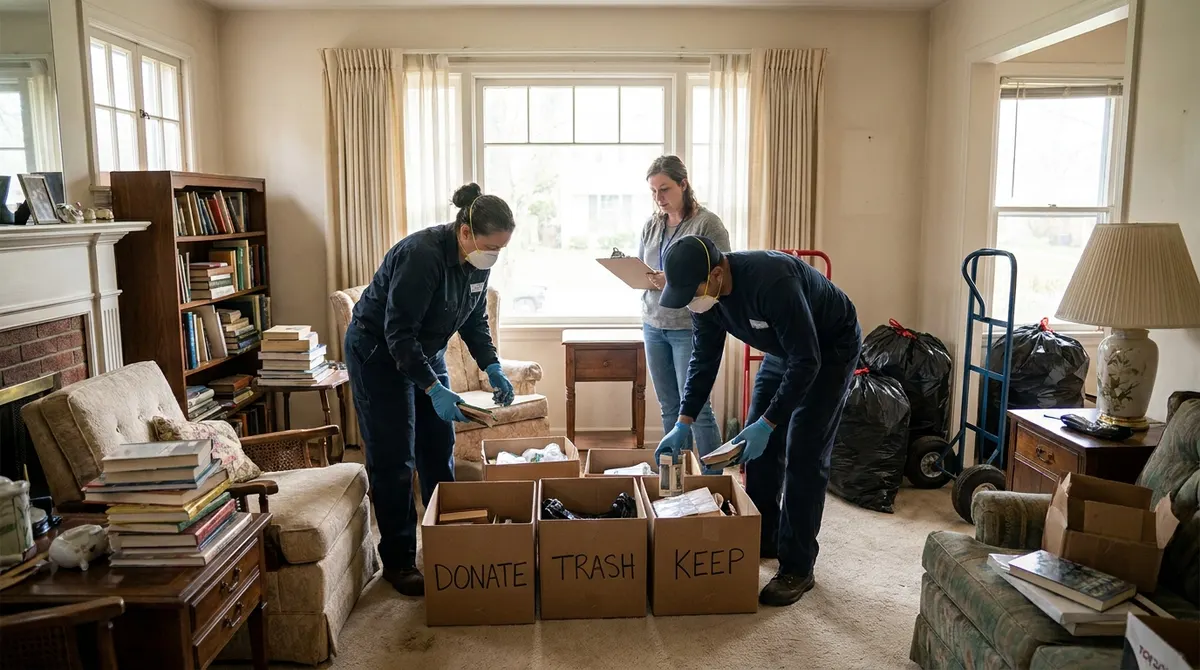
Clean out an estate in one order: documents and valuables first, room-by-room sorting second, estate sale third, hauling last. Our crew handles the final load-out — furniture, appliances, garage and attic contents — after the family has taken what it wants, on local closing timelines.
| Cleanout scope | Approximate volume | Typical cost range | Usual crew time |
|---|---|---|---|
| One room or a few furniture pieces | 1/4 truck (4–5 cu yd) | $250–$400 | 1 hour |
| Bedroom set, mattresses, boxed clothing | 1/2 truck (8–10 cu yd) | $400–$600 | 1–2 hours |
| Garage or basement contents | 3/4 truck (12–15 cu yd) | $550–$750 | 2 hours |
| Post-estate-sale leftovers, small home | Full truck (15–20 cu yd) | $600–$900 | 2–3 hours |
| Whole 3-bedroom house, lightly furnished | 2 truckloads | $1,200–$1,800 | Half day |
| Whole house with garage, attic and shed | 3–5 truckloads | $1,800–$4,500 | 1–2 days |
| Heavy-accumulation or hoarding-condition estate | 5+ truckloads | Quoted on site | 2+ days |
Estate cleanout scope, truck volume and typical market cost ranges
Estate cleanouts begin with a documents-and-valuables sweep before anything leaves the house
The first pass is not sorting — it is searching. Wills, deeds, titles, insurance policies, savings bonds, military discharge papers, tax returns, safe-deposit keys and checkbooks are commonly stored in dresser drawers, filing cabinets, freezers, closet shoeboxes, taped envelopes behind headboards and inside books. Cash and jewelry are frequently found in coat pockets, purses, coffee cans and mattress seams. Pull every drawer and check every pocket before a donation box or a truck is loaded. Collect the paperwork into one labeled bin that leaves with the executor the same day. Photograph rooms before disturbing them if more than one heir is involved — photos settle disputes about what was in the house. Only after this sweep should any item be classified as trash.
Estate cleanout sorting works fastest room by room with four fixed categories
Use four categories in every room: keep, sell or appraise, donate, and discard. Work one room at a time and finish it before opening the next — mixing rooms is the main reason cleanouts stall for weeks. A practical order runs bedrooms and closets, then bathrooms and the kitchen, then living and dining rooms, then the basement, then the garage, then the attic last, because attics and garages hold the bulkiest low-value items and are demoralizing to start with. Label each room's boxes with painter's tape and a marker. Kitchens produce the most volume per square foot: expired food, small appliances, cookware and decades of dishware. Bathrooms are quick and almost entirely discard, aside from unopened supplies and prescription medications, which go to a pharmacy or police take-back rather than the trash.
Estate cleanout timing follows probate authority, not the funeral date
Nothing of value should be sold, donated or hauled until someone holds legal authority to act — usually letters testamentary or letters of administration issued by the county probate court, or authority under a trust. That paperwork commonly takes several weeks after filing. Perishables, spoiled food, soiled bedding and obvious trash can be removed immediately for health and pest reasons. Everything else waits. Executors working ahead of authority create liability with heirs and beneficiaries. Practical middle ground: use the waiting period for the documents sweep, photographs, an inventory list and appraisal appointments, then schedule the estate sale and the hauling once authority is in hand.
Estate sale companies leave the leftovers, and that leftover load is the hauling job
Estate sale operators typically take a commission in the 30–50% range and sell the marketable 20–40% of a home's contents. What remains after the last sale day is the real cleanout: worn upholstered furniture, particleboard shelving, mattresses, exercise equipment, paint cans, old electronics, curtains, half-used cleaning chemicals, garage shelving and boxes of paper. Book the haul for the day after the sale closes so the house is empty and broom-ready for photos or a walkthrough. If an estate sale is not worth holding — common when contents are dated or damaged — a single full-service cleanout skips the middle step entirely and empties the house in one or two visits.
Estate cleanout pricing is driven by truck volume and access, not by the number of rooms
Junk removal is priced by how much space the load occupies in the truck, plus labor factors. A full 15-to-20-cubic-yard truckload runs about $600 to $900 in most markets; a whole-house estate at $1,200 to $4,500 reflects multiple loads. Cost climbs with stair carries, long walks from door to driveway, narrow basement stairwells, and heavy items such as pianos, safes, hot tubs, riding mowers and appliances containing refrigerant. Cost drops when items are already staged in the garage or driveway. Estimates given over the phone are ballparks; an exact figure is confirmed during a free on-site walkthrough before any loading starts, so the executor approves the number in writing first.
Estate cleanout crews route donations and recycling instead of sending everything to the landfill
A large share of an average estate is still usable. Serviceable furniture, small appliances, tools, housewares, books and unopened supplies go to local charity resale outlets and building-material reuse centers; scrap metal, appliances and e-waste are separated for recycling. Items that cannot be donated include stained mattresses, broken pressboard furniture and anything with pest activity. A donation receipt for the estate's tax records can be requested at pickup. Hazardous materials — paint, solvents, motor oil, pesticides, propane cylinders, ammunition and asbestos-containing materials — are excluded from standard hauling and go to a household hazardous waste facility or a licensed specialist.
Estate cleanout scheduling protects realtor listing and closing deadlines
Vacant estates are usually sold, and listing photography needs an empty, broom-clean house. Build the schedule backward from the photo date: sale or donation pickup first, hauling next, then cleaning and any repairs. Crews commonly clear a lightly furnished three-bedroom house in a half day and a heavily loaded one in one to two days. Same-day and next-day service is often available when the house is already sorted, which matters when a buyer's walkthrough, an as-is closing or a cash-offer deadline is days away. Out-of-state executors can authorize a cleanout remotely with photos, an approved estimate and a lockbox or key handoff arranged with the crew.