How Much Does Garage Cleanout Junk Removal Cost?
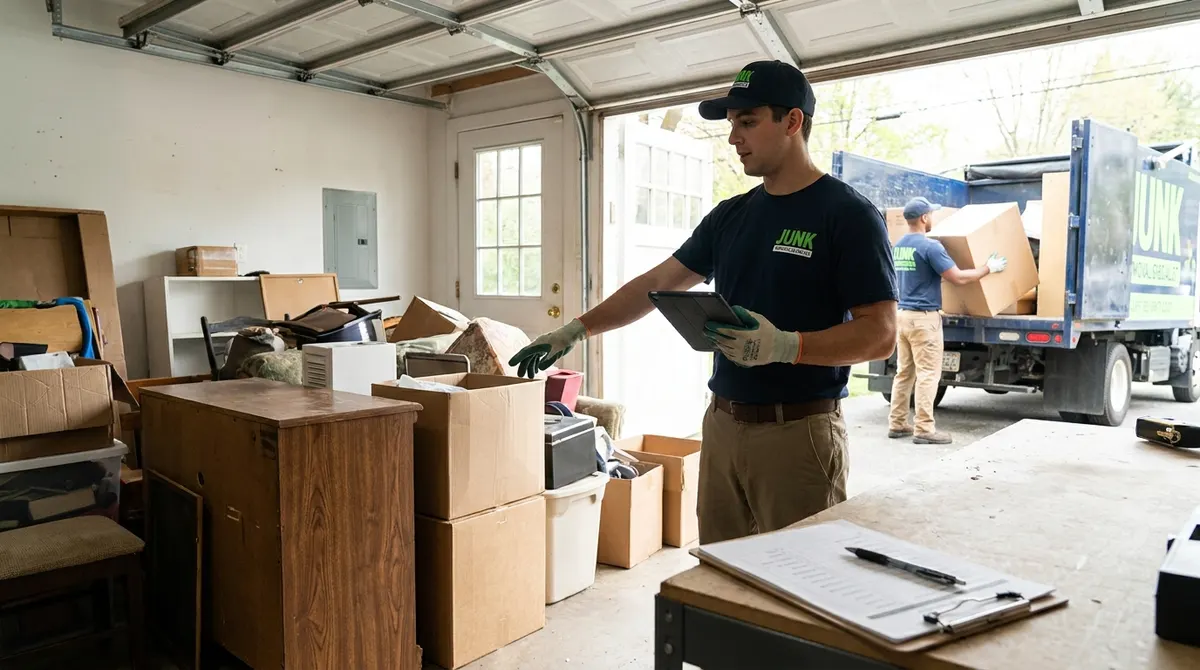
Most garage cleanouts land between $250 and $1,200 depending on truck volume and heavy items. Our crew does all the lifting, sweeps the slab, and hauls in one trip — including the rafter storage and the back corner nobody has touched in a decade.
| Garage size / fill level | Approximate load volume | Typical price range |
|---|---|---|
| Single bay, partial clear-out (a few boxes, one appliance) | Minimum load to 1/8 truck | $125 - $250 |
| One-car garage, moderately full | 1/4 to 1/2 truck (3-8 cu yd) | $250 - $500 |
| Two-car garage, walls and shelves loaded | 1/2 to 3/4 truck (8-12 cu yd) | $400 - $750 |
| Three-car garage or full estate clear-out | 1 full truck or more (14-16+ cu yd) | $650 - $1,200 |
| Detached garage with rafter storage and workbench | 3/4 truck plus surcharge items | $550 - $900 |
| Heavy debris only (concrete, brick, tile, dirt) | Weight-capped partial load | $300 - $600 |
Typical garage cleanout junk removal cost by garage size and load volume
Garage cleanout pricing is set by truck volume, not by the hour
Junk removal for garages is priced by the fraction of the truck a load fills, not by an hourly labor rate. A standard junk removal truck holds roughly 12 to 16 cubic yards — about the volume of six to eight pickup truck beds. The quoted price includes two crew members, all lifting and carry-out, transport, and transfer-station disposal fees. Volume pricing protects the customer when a job runs long: a garage that takes three hours to empty costs the same as one that takes ninety minutes if the load volume matches. Most residential garage cleanouts are finished in one to three hours.
Two-car garage cleanouts usually fill a half to three-quarter truck
A typical two-car garage cleanout fills between 8 and 12 cubic yards and prices at $400 to $750. That volume covers the common inventory: collapsed cardboard, plastic storage totes, bicycles, lawn chairs, a broken push mower, scrap lumber, and two or three pieces of dead furniture that migrated out of the house. Garages with built-in shelving or overhead racks often surprise homeowners — vertical storage adds volume that is invisible from the driveway. A walkthrough with the door open is the fastest way to size the load accurately before a crew is dispatched.
Paint, tires, and fitness equipment carry separate disposal surcharges
Certain garage staples cost extra because facilities charge extra to accept them. Latex and oil-based paint commonly adds $5 to $10 per gallon, since wet paint is routed to household hazardous waste rather than the landfill. Passenger tires typically add $5 to $15 each; tires on rims cost more. Refrigerators, freezers, and window air conditioners containing refrigerant add roughly $30 to $50 for certified recovery. Old fitness equipment is a labor item more than a volume item — a treadmill or multi-station home gym often needs partial disassembly to clear the door, which can add $50 to $150. Propane tanks, car batteries, motor oil, and pesticides are handled case by case and sometimes must be routed to a hazardous waste event instead.
Garage cleanout quotes drop when access is clear and items are pre-sorted
Three things lower a garage cleanout quote. First, a clear driveway that lets the truck back within twenty feet of the garage door cuts carry distance and load time. Second, staging keepers on one side of the slab so the crew never has to ask what stays. Third, keeping metal separate — scrap steel, aluminum, and appliances have recycling value that can offset part of a load. Costs rise with stairs, long carries from a detached garage at the back of a lot, water-damaged or mouse-infested contents, and heavy inert debris like concrete or tile, which is weight-capped well before the truck looks full.
Garage cleanout crews handle rafter storage, workbenches, and the slab sweep
Full-service garage cleanout includes the parts homeowners dread: overhead plywood platforms, rafter-stored lumber and screens, bolted-down workbenches, and pegboard walls. Crews bring dollies, hand tools, and appliance straps, so bolted shelving and heavy benches come out without the homeowner touching a wrench. Standard practice is a broom sweep of the slab after the last load, leaving a parkable, usable garage the same day. Same-day and next-day slots are commonly available for single-truck residential jobs when a call comes in before early afternoon.
Garage cleanout cost compared with a rented dumpster
A 10-to-15-yard roll-off dumpster rental generally runs $350 to $550 for a week in most residential markets, plus overage fees by ton and separate handling for paint, tires, and refrigerant appliances. The dumpster price does not include labor — every item still has to be carried out and lifted over a four-foot wall by the homeowner. Full-service junk removal at $400 to $750 for a two-car garage includes the lifting, the sorting, the recycling runs, and the disposal fees in one number, and it leaves no container sitting in the driveway. Dumpsters make sense for multi-week renovations; garage cleanouts almost always finish in a single visit.
Local market specifics that affect garage cleanout pricing
Local disposal costs drive a meaningful share of any garage cleanout quote. Municipal transfer stations and private landfills bill by the ton, and regional tipping fees commonly range from about $40 to $90 per ton — which is why a load of concrete, tile, or rain-soaked particleboard prices differently from the same volume of empty boxes. Household hazardous waste is the other local variable: paint, solvents, pesticides, and motor oil are usually restricted from regular landfill loads and must go to a designated HHW facility or a scheduled collection event, which is why those items are quoted as line-item surcharges rather than bundled into volume. Tire disposal is regulated separately in most jurisdictions and carries a per-tire fee at the receiving facility. Recycling helps the other direction — scrap metal, appliances, and clean cardboard from a garage are typically diverted rather than landfilled, and metal-heavy loads can price at the lower end of a range. Access also varies by neighborhood: older homes with narrow alley-fed detached garages take longer to load than newer subdivisions with wide attached-garage driveways, and that carry distance shows up in the estimate. All figures here are market ballparks — the exact price is confirmed in person, in writing, at a free on-site walkthrough before any item is loaded.
Related questions
Do junk removal companies take paint from a garage?
Most take latex and oil-based paint as a surcharge item, commonly $5 to $10 per gallon, because wet paint is routed to household hazardous waste rather than the landfill. Fully dried-out latex cans are sometimes accepted with regular load volume.