How Do You Choose a Junk Removal Company You Can Trust?
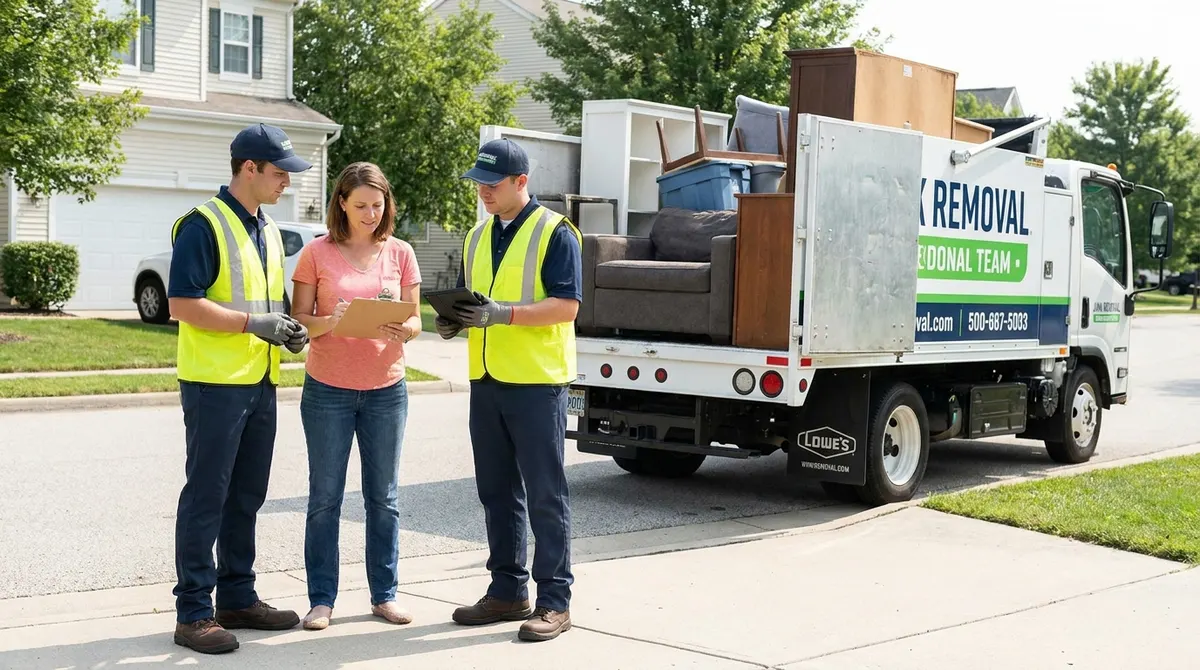
Choosing a junk removal company comes down to a written volume-based quote, verifiable insurance, and documented disposal. Our team confirms load volume and final price on a free on-site look before loading begins, so local homeowners and property managers know the number in advance.
| What to verify | Green flag | Red flag |
|---|---|---|
| Pricing method | Volume-based (fraction of truck) or per-item, given in writing | Vague hourly guess with no cap or written total |
| Estimate process | Free on-site or photo-based look before loading | Price only revealed after the truck is loaded |
| Insurance | General liability coverage the office can confirm on request | Refuses to discuss coverage or 'doesn't need it' |
| Business identity | Registered business name, real address, marked truck | Unmarked truck, personal number only, no paperwork |
| Disposal | Names the transfer station, landfill, or recycler used | Won't say where the load goes |
| Recycling and donation | Sorts metal, e-waste, and usable furniture | Everything goes to one dumpster |
| Payment | Card, check, or invoice with a receipt | Cash-only, paid up front, no receipt |
| Reviews | Steady flow over months, specific job details | Cluster of five-star reviews posted the same week |
Junk removal hauler vetting checklist: green flags vs. red flags
A trustworthy junk removal company quotes by volume in writing before loading starts
Legitimate junk removal is priced by how much space the load takes in the truck, measured as a fraction: eighth, quarter, half, three-quarter, or full. A company worth hiring states that fraction and the dollar figure before a single item moves, either during a free on-site look or from clear photos. Get the total in writing — text, email, or a signed work order all count. Volume pricing also means the customer can see exactly what changes the price: adding a mattress, a hot tub, or a garage full of paint cans is a visible, explainable adjustment rather than a surprise. Hourly quotes with no cap are the weakest arrangement for a homeowner, because the incentive runs the wrong direction.
Licensed junk removal haulers carry general liability coverage and will confirm it on request
Junk removal crews carry heavy furniture down stairs, through doorways, and across finished floors. General liability coverage is the standard protection if a banister, drywall corner, or hardwood plank gets damaged during the carry-out. A reputable company answers the insurance question directly and without hesitation; the request is routine, not insulting. Property managers, real estate agents, and HOA boards often require proof before a crew is allowed on site, so established haulers keep that documentation ready. If a company deflects the question, changes the subject, or claims coverage isn't necessary for hauling, that answer itself is the information a homeowner needs.
Junk removal disposal documentation shows where the load actually goes
Every load leaves the property and ends up somewhere specific: a county transfer station, a permitted landfill, a scrap metal yard, an e-waste processor, or a donation center. A trustworthy junk removal company names those destinations without being pushed and can produce dump receipts or scale tickets when a customer or property manager asks. This matters legally as well as ethically — in most jurisdictions the original owner of the waste can be cited when material is dumped illegally, even if a hired hauler did the dumping. Appliances with refrigerant, electronics, tires, and paint follow separate handling rules, and a real operator can explain how each is routed instead of promising to 'take everything' with no detail.
Junk removal review patterns reveal more than the star average
Read the pattern, not the score. Reviews spread evenly across months and years, written with job-specific detail — a hot tub out of a narrow backyard, a third-floor apartment cleanout, a garage packed to the door — indicate steady real work. A dense cluster of short five-star reviews posted within days of each other is worth discounting. Pay particular attention to how the company answers its critical reviews: a calm, factual response that explains what happened is a stronger trust signal than an unbroken wall of praise. Complaints that repeat the same theme, especially price changing after the truck was loaded, are the ones that predict a bad experience.
Cash-only junk removal offers are the most reported red flag among homeowners
Threads on r/HomeImprovement repeatedly describe the same setup, paraphrased: an unmarked truck, a low phone quote, cash demanded before the work, and no receipt — followed by the load turning up on a rural roadside. On r/junkremoval, working operators make a related point in their own words: legitimate haulers eat real disposal costs, so a bid that undercuts the market by half is usually a bid that skips the landfill entirely. The spec fact behind both concerns is straightforward — transfer station tipping fees commonly run roughly $50–$150 per ton depending on facility and material, which is why a genuine full-truckload price generally lands in the $500–$800 range rather than under $200.
Full-service junk removal includes the labor, the truck, and the disposal fees in one price
The main practical difference between hiring a junk removal company and renting a dumpster is who does the work. Full-service means a crew arrives, carries items out of the basement, attic, garage, or upper floors, loads the truck, sweeps the area, and covers the disposal fees inside the quoted price. Dumpster rental is cheaper on paper but leaves the loading, the permit questions, and the weight overage risk with the homeowner. For estate cleanouts, tenant turnovers, post-renovation debris, and heavy single items like pianos, treadmills, and hot tubs, the done-for-you option is what most customers are actually shopping for once the labor is counted honestly.
Junk removal quotes should be confirmed on site, not guaranteed over the phone
Phone and photo estimates are useful ballparks, and any company that promises an exact final number sight-unseen is guessing. Volume is hard to judge remotely: a pile that looks like a quarter truck in a photo can compress to an eighth or expand to a half once it is actually stacked. The honest sequence is a market-range estimate on the phone, then a free on-site walkthrough where the crew confirms the fraction and the final price before touching anything. The customer keeps the right to decline at that point with no charge. Ask two questions before booking: is the on-site estimate free, and is the confirmed price final unless the scope changes.