What Is the Cheapest Way to Get Rid of Junk?
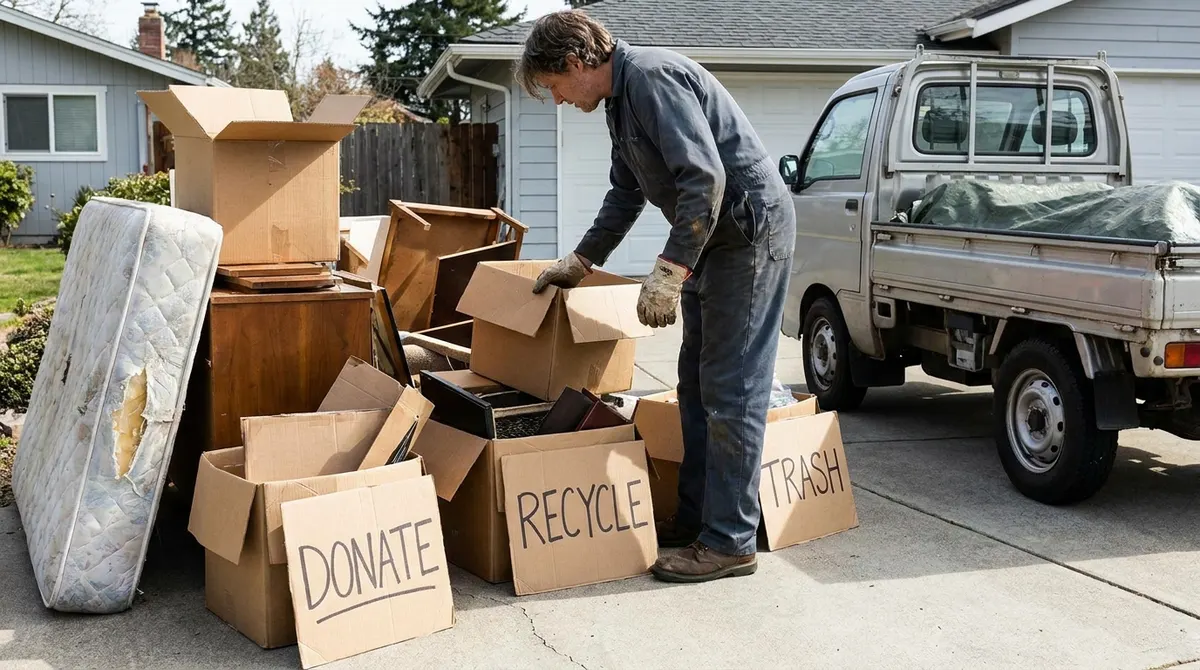
Self-hauling to a transfer station is the lowest-cash option; full-service pickup costs $75–$750 depending on truck space and includes the lifting. Our local junk removal crew quotes flat, all-in pricing after a free on-site look at the pile.
| Method | Typical cost & what it covers |
|---|---|
| Self-haul to transfer station | $40–$95 per ton tipping fee, plus $30–$80 truck/trailer rental and fuel; you load, drive, and unload |
| Municipal bulk trash pickup | Often included with utility billing or $0–$50 per set-out; strict item limits, scheduled dates, curbside only |
| Donation pickup (usable furniture) | No haul fee for resellable items in good condition; charities decline stained, broken, or non-working goods |
| Roll-off dumpster rental | $300–$600 for a 10–20 yard container, 3–7 days, with tonnage caps and overage fees; you still load it |
| Full-service single item | $75–$150 — one couch, mattress, treadmill, or appliance carried out and disposed of |
| Full-service quarter truckload | $150–$250 — a small bedroom, closet, or half a garage bay |
| Full-service half truckload | $300–$450 — a full garage, small apartment, or deck tear-out debris |
| Full-service full truckload | $500–$750 — roughly 15 cubic yards, a whole-house or estate cleanout volume |
Junk disposal methods and typical cost ranges
Junk removal pricing costs more than self-haul because the quote includes labor, fuel, and tipping fees
A full-service junk removal quote bundles four costs a DIY trip splits up: the crew's labor to carry items out, truck fuel and insurance, the landfill or transfer station tipping fee, and any special-handling charges for mattresses, tires, or refrigerant appliances. Self-hauling removes the labor line but keeps the rest. On a half-garage cleanout, a homeowner typically spends $60–$150 in fees and rental plus three hours of work; the same load hauled for them runs $150–$250 flat. **The honest math: DIY is cheaper in dollars, paid pickup is cheaper in time, back strain, and second trips.**
Transfer station self-haul is the lowest-cost junk disposal method for small, light, easy-to-lift loads
Self-haul wins on price when the load is light, dry, and small enough for one trip. Bagged clutter, cardboard, clean scrap wood, and boxed household goods weigh little, so the per-ton tipping fee stays under the $40–$95 minimum charge at most facilities. Self-haul stops being cheap when the load is heavy or awkward: soil, roof shingles, tile, and concrete are priced by weight and can exceed $150 per ton, and a single yard of wet debris can outweigh an entire pickup bed of furniture.
Donation and resale reduce the paid junk removal volume before a truck is ever scheduled
Sorting first is the single most effective way to lower a haul price, because full-service junk removal is billed by the truck space a load occupies. Working appliances, intact dressers, sofas without pet damage, tools, and boxed books often move through charity pickups or online listings at no haul cost. Pulling those items out can drop a job from a half load to a quarter load — a real difference of $150–$200. **Anything broken, soaked, moldy, or mismatched will not be accepted for donation and should stay in the paid pile.**
Dumpster rental beats junk removal on cost only for multi-day renovation and demolition debris
A 10–20 yard roll-off runs $300–$600 for three to seven days, includes a tonnage allowance of one to three tons, and charges overage above that. Dumpster rental makes financial sense for a kitchen gut, a re-roof, or a multi-weekend project where debris accumulates and the container gets filled to capacity. Dumpster rental loses on cost for one-time household cleanouts, because a partially filled container still bills the full rental, needs driveway or street space, and may require a permit for public right-of-way placement.
Junk removal for heavy, oversized, and restricted items avoids the hidden fees DIY hauling triggers
Certain items carry surcharges no matter who transports them. Mattresses and box springs are commonly $15–$50 each at disposal sites, refrigerators and freezers need certified refrigerant recovery, tires are usually $5–$15 apiece, and televisions and monitors are frequently banned from general waste and routed to e-waste handling. Latex paint must be dried or taken to a household hazardous waste event; liquid paint, solvents, propane tanks, and automotive fluids are refused at the gate. A full-service crew absorbs these steps into one flat quote and handles the stairs, tight doorways, and two-person lifts.
Junk removal quotes are based on truck space, so an on-site look produces the accurate number
Volume-based pricing means the fair number depends on how much of a 15-cubic-yard truck bed the load fills after it is compacted, not on an item count read over the phone. Phone estimates are ballparks; the exact figure is confirmed free and on-site before any loading begins, with no obligation to proceed. Access matters too — a second-floor apartment, a long carry from a back yard, or a basement stairwell adds labor time that a walk-through catches and a phone guess misses. Comparable full-service junk removal pricing is quoted the same way market-wide.
Junk removal discussions on Reddit consistently flag two cost traps for DIY haulers
Contributors in r/junkremoval threads have paraphrased a recurring warning: people budget only for the tipping fee and forget the truck rental, fuel, mileage charge, and the second trip, which is how a "$50 dump run" lands near $150. That tracks with published rates — rentals of $30–$80 per day plus per-mile fees stack fast. A separate theme in r/HomeImprovement is homeowners underestimating weight, then getting turned away or surcharged at the scale for shingles, drywall, and concrete billed above $100 per ton. **Both traps disappear with a flat, all-in quote.**