What Happens to Your Junk After It Is Hauled Away? — Complete Guide
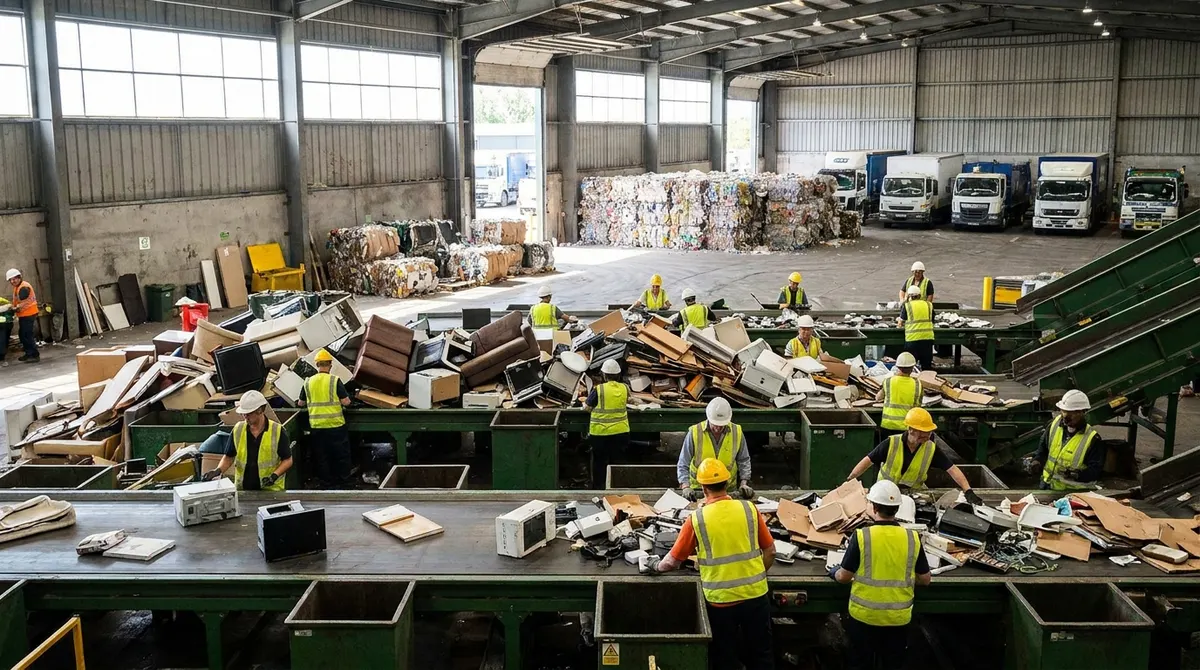
Hauled junk gets sorted into scrap, donation, recycling and landfill streams — usually at a transfer station within hours of pickup. Our local hauling team keeps the scale tickets and donation receipts that prove where each load actually went, and pricing is confirmed on site before any loading starts.
| Material from the load | Typical first destination | Verification to request |
|---|---|---|
| Steel, aluminum, copper, appliance shells | Scrap metal yard (paid by weight) | Scrap yard receipt showing tonnage |
| Working furniture, housewares, décor | Donation partner such as a Habitat ReStore, Goodwill or local thrift | Dated donation receipt with item list |
| Refrigerators, freezers, window A/C units | Appliance recycler that recovers refrigerant before crushing | EPA-compliant refrigerant recovery record |
| TVs, monitors, computers, printers | Certified electronics recycler (R2 or e-Stewards facility) | Certificate of recycling or facility name |
| Lumber, drywall, roofing, concrete | Construction & demolition (C&D) processing facility | Scale ticket showing C&D rate, not MSW rate |
| Mattresses and box springs | Mattress recycler where a program exists; otherwise landfill | Recycler name or itemized mattress fee |
| Tires, paint, fuel, batteries | Household hazardous waste drop-off or licensed handler | HHW facility receipt |
| Soiled, broken, mixed residue | Transfer station, then landfill | Transfer station scale ticket by the ton |
Where each material type typically ends up after a junk removal pickup — and the proof to ask for
Hauled junk moves through a three-to-four stop chain before anything reaches a landfill
A loaded junk removal truck rarely goes to a landfill first. The standard route is scrap yard, then donation drop, then transfer station or C&D facility, with the landfill as the last stop for residue only. Crews sort in the truck bed during loading — metal to one side, donation-grade goods kept clean and dry, mixed debris packed last. That in-truck sorting is what makes diversion possible, because once materials are compacted together with soiled items, most facilities will only accept the load as mixed municipal solid waste.
Junk removal loads are sorted by weight at a transfer station, and weight sets the disposal cost
Transfer stations charge by the ton, not by the item. Typical tipping fees in the United States run roughly $40–$110 per ton for municipal solid waste, with construction and demolition debris often accepted at a lower rate at separate C&D facilities. A full 15-cubic-yard truck of household junk commonly weighs 1.5–3 tons, so disposal alone can represent $60–$300 of the job cost. This is why full-service junk removal pickup is priced by volume and material type rather than by hours worked.
Donation partners accept only resale-grade items from a junk removal load
Donation is the highest and best outcome for hauled junk, but the bar is real. Charity resale operations generally require furniture that is structurally sound, unstained, odor-free and free of pet damage, and most will not accept upholstered pieces from smoking households, cribs, or anything missing hardware. Appliances usually must be tested working. A hauler that promises to donate a water-damaged sofa is describing a landfill trip. Honest crews separate the two on the spot and tell the customer which items qualified.
Scrap metal and appliances give junk removal its largest measurable diversion
Metal is the most reliably recycled material in any junk removal load because it has resale value. Washers, dryers, water heaters, grills, bed frames, filing cabinets and exercise equipment are typically weighed in at a scrap yard the same day. Refrigerators, freezers and air conditioners require refrigerant recovery by a certified technician before the shell can be crushed, which is a federal requirement under the Clean Air Act. Appliances containing refrigerant carry a separate handling fee in most markets, commonly $25–$75 per unit.
Electronics, mattresses, paint and tires follow separate junk removal disposal paths
Restricted items never ride to the landfill with general household junk. Many states ban televisions, monitors and computers from landfill disposal and require drop-off at a certified electronics recycler. Mattresses are landfill-banned in a handful of states and carry recycling fees elsewhere. Latex and oil-based paint, motor oil, fuel, pool chemicals and lead-acid batteries go to household hazardous waste facilities and are usually excluded from standard junk removal pricing. Tires are typically charged per unit, commonly $5–$15 each, because processors bill by the tire.
Junk removal diversion claims are verifiable with scale tickets, receipts and facility names
Any hauler can print "we recycle" on a truck; documentation is what makes the claim checkable. Three requests settle it. Ask which transfer station, scrap yard and donation partner the company used on the most recent comparable job. Ask for a copy of the scale ticket, which shows the facility name, date and net tonnage. Ask whether the quoted diversion figure is measured by weight or estimated by volume — weight-based figures are auditable, volume estimates are not. Reputable operators answer all three without hesitation.