How Do You Dispose of Old Electronics and E-Waste? — Complete Guide
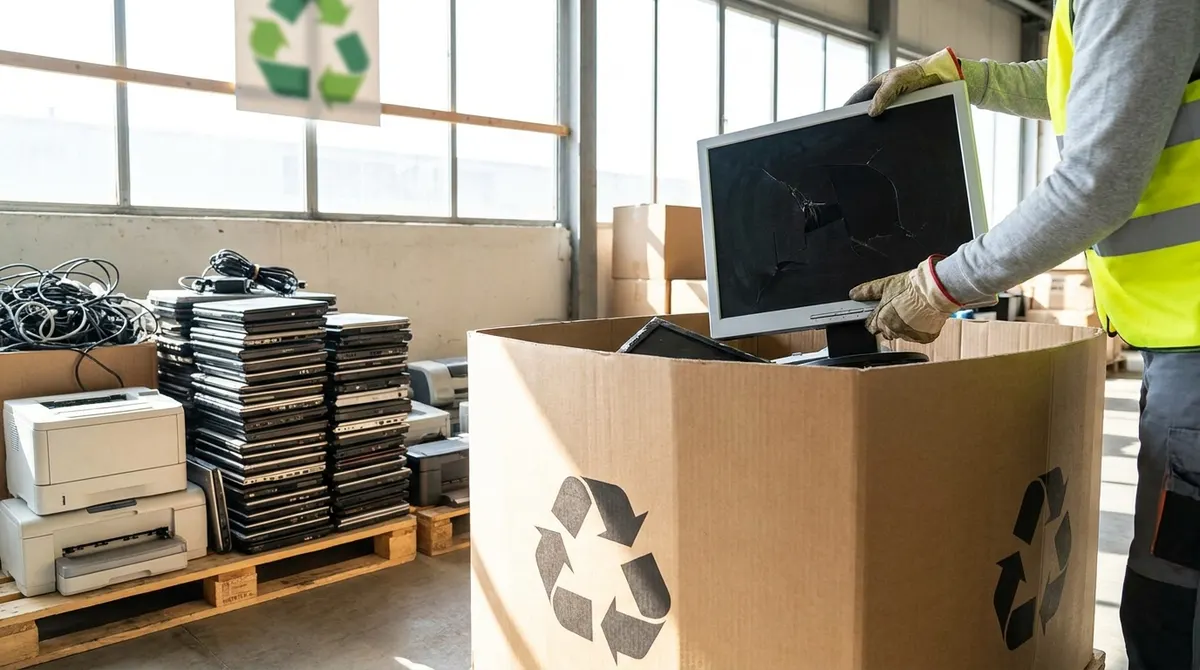
Electronics are disposed of at a certified recycler, a county collection event, or by scheduled pickup — our crew does the lifting and the sorting. Local pricing generally starts at a $95–$175 minimum, with per-unit fees on TVs and monitors confirmed on site.
| Item / load size | Handling note + typical ballpark |
|---|---|
| Single small item (printer, tower, router) | Sorted to an electronics stream; usually falls inside the $95–$175 service minimum |
| Flat-screen TV (under 55") | Recycled whole; commonly $25–$60 per unit within a load |
| CRT tube TV or CRT monitor | Leaded glass requires special processing; commonly $40–$75 per unit |
| Desktop computers / laptops | Drives should be pulled or wiped first; low per-unit cost inside a load |
| Office cleanout, 10–30 devices | Roughly a quarter to half truck: about $180–$450 depending on volume and stairs |
| Full truckload (server room, lab, warehouse) | Roughly $500–$800; heavy racks and UPS batteries priced separately |
| Appliances with electronics (microwave, dehumidifier) | Refrigerant-bearing units need certified handling; ask when booking |
| Loose batteries, bulbs, ballasts | Treated as household hazardous waste; often excluded from standard hauls |
Common e-waste items, handling notes, and ballpark pickup pricing (market ranges — exact price confirmed on site)
E-waste disposal starts with keeping electronics out of the household trash
Electronics contain lead, mercury, cadmium, and lithium, which is why many states and counties prohibit televisions, monitors, and computers in curbside garbage. Most trash haulers will leave a TV at the curb rather than take it. The compliant paths are a certified recycler, a scheduled collection event, a retailer take-back program, or a licensed hauler that delivers to a recycling facility. A load that leaves a home in a truck should end at a recycler or transfer station that accepts electronics — not a random dumpster.
Electronics recycling fees are driven by the screen, not the device count
Screens carry the cost. A CRT tube television holds four to eight pounds of leaded glass, and processors charge by weight to handle it, which is why a single old tube TV can cost more to recycle than five desktop towers. Flat-screens are cheaper but still carry mercury-containing backlights in older models. **Devices without screens — printers, routers, stereo components, cables — are usually the least expensive part of any load.** Expect per-unit surcharges on screens layered on top of the base labor and haul fee.
Full-service e-waste pickup covers the lifting, the sorting, and the disposal receipt
Full-service pickup means a two-person crew carries items from a basement, attic, or third-floor office, loads the truck, sweeps the spot, and delivers the load for recycling. Pricing is by volume in the truck plus per-unit screen fees. Same-day and next-day windows are commonly available when a slot is open. **A free on-site visual estimate is standard before any work begins — the price is confirmed in person, not over the phone.** Businesses that need documentation can request a disposal receipt at the time of booking.
Data security on old computers requires wiping or drive removal before pickup
Data does not disappear when a computer is unplugged. Best practice is to sign out of accounts, factory-reset phones and tablets, and either run a full-disk wipe or physically remove the hard drive and SSD before a hauler arrives. Drives can be kept, drilled, or handed to a service that performs verified destruction. **Removing the drive costs nothing and eliminates the most common regret after a cleanout.** Printers, copiers, and networked scanners also store scanned images and should be reset.
Free drop-off options for electronics work best for one or two small devices
County household hazardous waste facilities, seasonal collection events, and several national retailers accept limited electronics at no charge — usually with quantity caps, resident-only rules, and no TVs. That path fits a single laptop or a box of cables. It stops working for a basement with three tube TVs, a stack of CRT monitors, and an old console stereo, because most free programs cap items per visit and none of them carry anything down stairs. Volume, weight, and stairs are the point at which paid pickup becomes the practical option.
Reddit threads on e-waste flag two recurring issues worth planning around
Paraphrasing a common thread in r/ewaste: people report driving to a listed drop-off site only to learn televisions were excluded that day. That matches how screen fees work — programs cap or drop screens when processing costs spike, so confirming TV acceptance before loading a car saves a wasted trip. A second recurring concern in r/junkremoval, paraphrased: users want proof their equipment was actually recycled rather than dumped. Asking which recycling or transfer facility receives the load, and requesting a receipt, answers that in one question.
Junk removal pricing for e-waste is quoted by volume, access, and screen count
Four factors set the number: how much space the load takes in the truck, how many screens are in it, how far the carry is, and whether stairs or an elevator are involved. A garage-level pile of ten devices prices lower than the same ten devices in a finished basement. **Estimates are ballparks until a crew sees the pile — the on-site look is free and the price is locked before loading.** Combining electronics with other cleanout items in one trip is usually cheaper than booking two separate visits.
Local specifics
Local rules matter more than national averages with e-waste. Many states operate electronics landfill bans or manufacturer-funded recycling programs, and many counties run household hazardous waste facilities with resident-only access, item caps, and seasonal hours — televisions are the item most often restricted. Municipal bulk-item pickup, where it exists, commonly excludes electronics entirely, which is why old TVs sit at curbs for weeks. Practical local checks before scheduling: confirm whether the county HHW site accepts screens and how many per visit, whether a collection event is on the calendar, and whether an apartment or HOA requires a service window or elevator reservation. Older homes with narrow basement stairs and detached garages add carry time, and that carry time is the main reason two identical piles quote differently across the same market.
Related questions
How much does it cost to have an old TV hauled away?
TV haul-away typically runs $25–$75 per unit inside a load, with a service minimum of roughly $95–$175 for a single-item trip. CRT tube sets price at the top of that range because of leaded glass.
Do junk removal companies take computers and printers?
Yes. Computers, monitors, printers, and networking gear are standard accepted items and are separated into an electronics stream. Hard drives should be wiped or removed before pickup.
What items will junk removal not take?
Standard exclusions are wet paint, solvents, pesticides, motor oil, propane tanks, asbestos, medical sharps, and loose batteries. Those go to a household hazardous waste facility instead.
Is same-day junk removal available for a basement cleanout?
Same-day and next-day windows are commonly available when a truck slot is open. Basement loads with stairs are quoted after a free on-site look, since carry distance affects labor.
How much does a full truckload of junk removal cost?
A full truckload generally runs $500–$800 depending on weight, screen count, and access. Quarter loads commonly fall between $180 and $350.