How Do You Dispose of Household Hazardous Waste? — Complete Guide
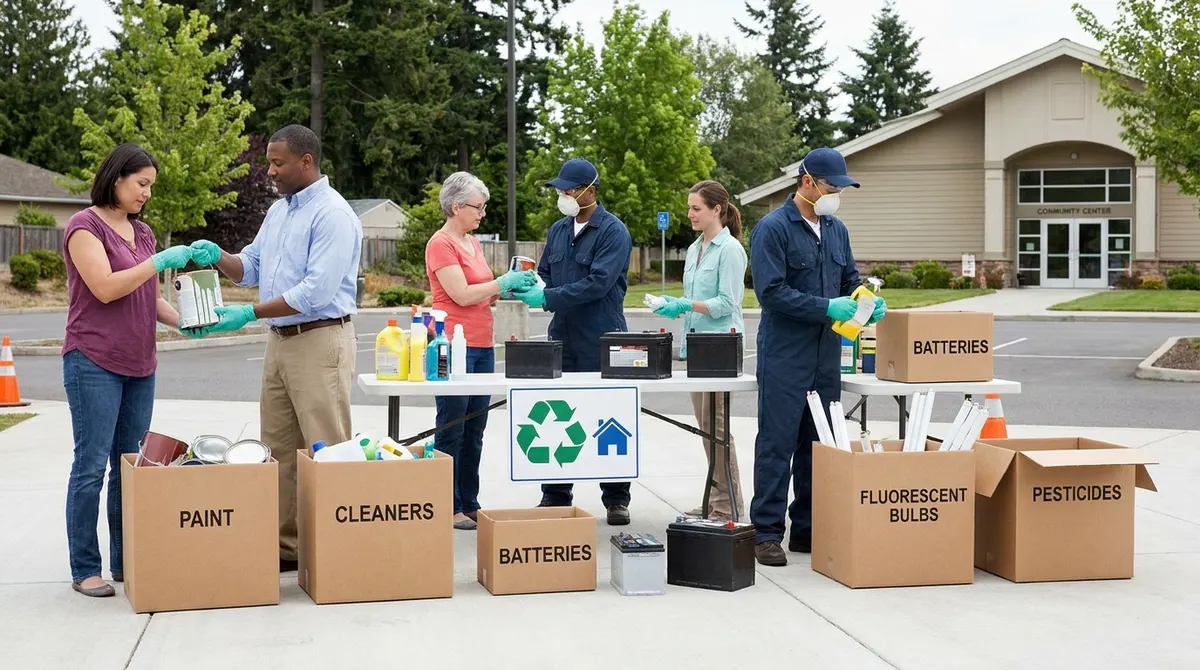
Household hazardous waste goes to a county HHW facility or collection event, not the curb. Our junk removal crew handles the rest of the cleanout — furniture, appliances, e-waste, dried latex paint, empty cans — and separates local recycling and transfer-station loads for you.
| Item | Correct disposal route & typical cost |
|---|---|
| Oil-based paint, stain, varnish | County HHW facility or collection event; usually no charge for residents within posted limits |
| Latex (water-based) paint | Dry it out with paint hardener or kitty litter ($5–$10), then it is generally accepted as regular solid waste and haulable with a junk load |
| Gasoline, kerosene, solvents, thinner | HHW facility only; bring in an approved sealed container, not an open bucket |
| Motor oil, antifreeze, transmission fluid | Many auto-parts stores accept used oil free; HHW facility accepts antifreeze |
| Pesticides, herbicides, pool chemicals | HHW facility only; never mix products in one jug |
| Car batteries | Retail core exchange, often with a $10–$25 credit; also accepted at HHW sites |
| Lithium-ion and rechargeable batteries | Battery drop-off box or HHW site; a known fire cause in trucks and compactors |
| Fluorescent tubes and CFL bulbs | HHW or hardware-store recycling; mercury-containing, so no curbside |
| Propane tanks (20 lb BBQ style) | Exchange cage or HHW site; some haulers accept certified-empty tanks for a $10–$25 fee |
| Appliances with refrigerant (fridge, AC, dehumidifier) | Haulable by junk removal with certified refrigerant recovery; typical add-on $25–$50 per unit |
| Electronics and TVs | E-waste recycling; typical hauler add-on $25–$60 per TV or monitor |
| Asbestos, medical sharps, ammunition, radioactive items | Specialty licensed abatement or law-enforcement program; standard junk removal cannot take these |
| Non-hazardous junk in the same garage or basement | Full-service junk removal, roughly $175–$600 per load by truck volume, labor included |
Common household hazardous items, correct disposal route, and typical cost
Household hazardous waste moves through county drop-off programs, not curbside trash
Every state prohibits household hazardous waste in municipal landfill loads, so the legal route is a permanent county household hazardous waste facility or a scheduled seasonal collection event. Most programs are funded by solid-waste fees and accept HHW from residents at no additional charge, with per-visit limits commonly around 10 gallons of liquid or 50 pounds of material. Proof of residency, such as a driver's license or utility bill, is often requested at the gate. Business, rental-property, and contractor waste is normally excluded from residential HHW programs and requires a licensed hazardous waste transporter instead.
Household hazardous waste is defined by four hazard traits: ignitable, corrosive, reactive, toxic
A product qualifies as household hazardous waste if it is ignitable (gasoline, solvents, oil-based paint), corrosive (drain openers, muriatic acid, battery acid), reactive (pool chlorine, some aerosols, propane), or toxic (pesticides, mercury bulbs, wood preservative). Signal words on the label — DANGER, POISON, WARNING, FLAMMABLE, CORROSIVE — are the fastest field test. Aerosol cans that still spray count as hazardous because of the pressurized propellant; fully emptied cans usually do not. Keeping every product in its original labeled container matters, because unlabeled mystery liquids often have to be handled as unknowns and sometimes get refused.
Latex paint can be dried out and disposed of normally; oil-based paint cannot
Latex and acrylic paint is not classified as hazardous once it is fully solidified. Add commercial paint hardener, kitty litter, or sawdust, leave the lid off until the paint is hard all the way through, then the can travels as ordinary solid waste and a junk removal crew can load it. Oil-based paint, stain, lacquer, and varnish stay hazardous no matter how dry the surface skin looks and must go to an HHW site. A useful benchmark: a gallon of dried latex takes 24 to 48 hours with hardener, longer in humid weather or a cold garage.
Junk removal crews haul the 90 percent of a cleanout that is not hazardous
A typical garage, basement, or estate cleanout contains only a small box of true HHW surrounded by heavy, awkward material that is fully legal to haul: workbenches, shelving, tires, scrap metal, lawn equipment with fluids drained, water heaters, appliances, mattresses, e-waste, and construction debris. Full-service junk removal covers the labor, the truck, the sorting, and the disposal fees, so the homeowner is left with one small load for the HHW facility rather than an entire garage. Crews carry items out of basements and down stairs, which is the part most people underestimate on weight and time.