How Do You Clean Out a Basement Fast? — Complete Guide
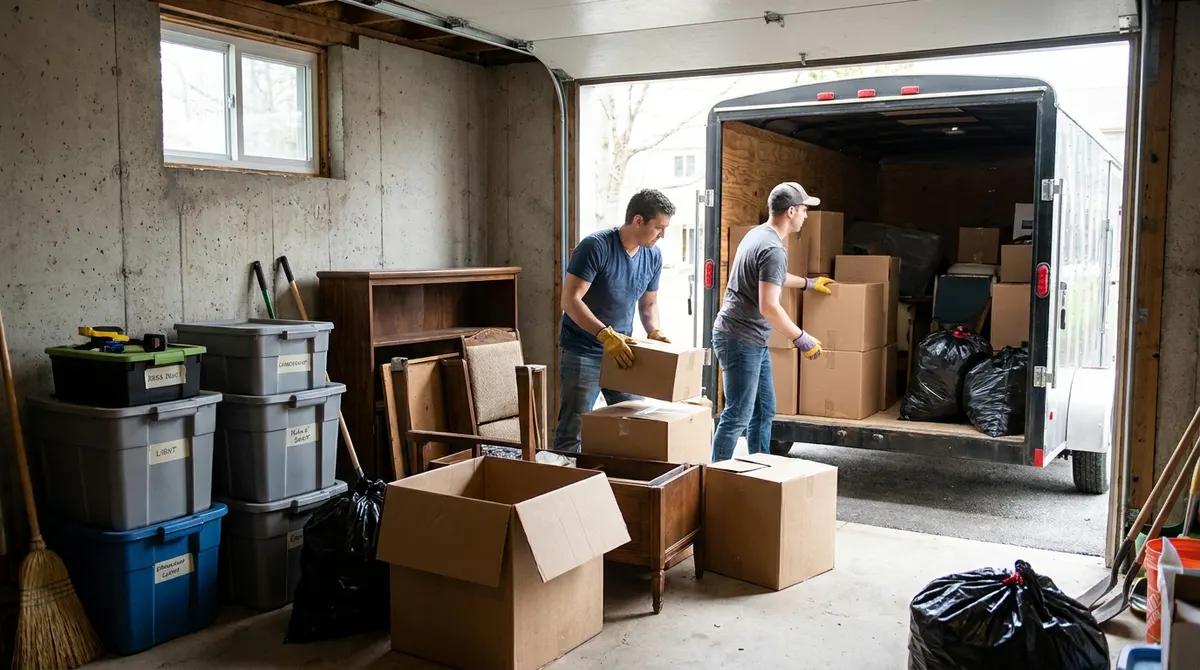
Fastest basement cleanouts are volume-priced hauls — commonly $300–$800, often finished in 2–4 hours by a two-person crew doing all the lifting. Our junk removal team handles the stairs, the loading, and the disposal sorting, then confirms the exact price on-site before work begins.
| Load size (what it looks like) | Typical crew time | Typical market cost range |
|---|---|---|
| 1/4 truck — a corner of boxes, a few bags, one small chair | 30–60 minutes | $150–$300 |
| 1/2 truck — old couch, shelving, 15–25 boxes | 1–2 hours | $300–$450 |
| 3/4 truck — furniture plus years of stored boxes and bins | 2–3 hours | $400–$550 |
| Full truck — a fully packed basement, wall to wall | 3–4 hours | $500–$750 |
| Multi-truck — hoarding-level volume or a whole finished lower level | Half day to full day | Quoted on-site after a walkthrough |
Basement cleanout volume, crew time, and typical market cost ranges
Basement cleanouts move fastest when items are sorted into three staging piles first
Speed comes from deciding once, not twice. Effective basement cleanouts use three piles — keep, donate, and haul away — set up at the bottom of the stairs before anything is carried. Items handled a second time are the main reason a cleanout stretches from one afternoon into a weekend. A practical rule used by crews: if an item has not been opened or used in two years and is not paperwork, sentimental, or seasonal gear, it belongs in the haul pile. Boxes are opened and checked for documents and photos, not emptied item by item. With sorting decided in advance, the physical removal is the short part of the job.
Basement junk removal is priced by truck volume, not by the hour
Volume pricing is the standard model in junk removal, and it protects the customer on a basement job. The quote is based on how much space the load takes in the truck — quarter, half, three-quarter, or full — so a narrow stairwell or a long carry to the driveway does not inflate the bill mid-job. Typical basement cleanouts land between $300 and $800, with small single-item pickups lower and packed or multi-truck basements higher. Labor, loading, dump fees, and cleanup of the emptied area are normally included in that figure. Written or verbal pricing is given before loading starts, after the crew has seen the actual pile.
Basement stair access and doorway width are the two biggest time factors
Access drives the schedule more than volume does. A walk-out basement door or a Bilco-style hatch lets a crew carry straight to the truck and cuts removal time noticeably. Narrow interior stairs with a tight turn at the top mean bulky items — sleeper sofas, oversized desks, treadmills, chest freezers — often need to be disassembled or partially broken down before they clear the opening. Crews plan for floor and railing protection on carpeted stairs. Mentioning stair type, doorway width, and whether the driveway allows a truck within 50 feet lets the quote and the arrival window be set accurately the first time.
Basement cleanout timelines: most average basements are cleared same day
A two-person crew clears an average residential basement in 2–4 hours. Same-day or next-day service is commonly available when the load fits one truck and the request comes in early in the day. Longer timelines apply to heavily packed basements, finished lower levels with built-ins, or estate and hoarding situations, which are often scheduled as a half-day or full-day job with a larger crew. DIY comparison is useful for expectations: the same basement handled alone with a pickup truck usually takes three to five trips across two weekends, plus transfer station fees and fuel.
Basement items that need separate handling: paint, tires, propane, and appliances
Some basement contents are not standard truck load material. Liquid paint, solvents, motor oil, pesticides, and propane tanks are classed as household hazardous waste and generally go to a designated collection site or event rather than a landfill. Tires, car batteries, and refrigerant-containing appliances such as fridges, freezers, and window AC units typically carry a per-item handling fee because of required processing. Fully dried latex paint is often accepted as regular material. Electronics and metal are usually diverted to recycling. Listing these items during the call keeps the on-site quote accurate and avoids surprises when the truck arrives.
Basement cleanout concerns raised on Reddit, answered with the volume numbers
A recurring theme in r/declutter threads is paraphrased as: the sorting is the emotional part, and once boxes are opened people stall for weeks. Crews work around that by having the homeowner make keep-or-go calls at the pile while the crew handles every carry — decision time compresses when the lifting is not also the homeowner's job. A separate concern paraphrased from r/HomeImprovement posts is that people fear an open-ended hourly bill on a basement job. Volume pricing answers it directly: the load size sets the price, and the range for a full truck is roughly $500–$750 in most markets, quoted before work begins.
Local basement cleanout specifics
Local rules shape what a fast basement cleanout actually costs. Most municipalities cap curbside bulk collection at a small number of items per pickup — commonly one to three — with mattresses, appliances, and construction debris either excluded or requiring a paid tag, which is why a decade of basement storage rarely clears through regular trash service. Transfer stations in most areas charge by weight with a posted minimum, so a homeowner making several pickup-truck runs pays that minimum each trip. Basements in humid climates add a moisture factor: cardboard boxes stored on slab floors often arrive damp, mold-spotted, and heavier than expected, and damp upholstered furniture is usually disposal-only rather than donation-eligible. Older homes with a coal-chute or hatch entry often allow the fastest removal path, while post-war split-levels with a turn at the stair top take longer for large furniture. Local dump fees, item surcharges, and access conditions are all factored into the on-site quote, which is provided free before any loading.
Related questions
How much does a full basement cleanout cost?
Most full basement cleanouts fall between $300 and $800, set by how much truck space the load fills. Packed basements and multi-truck jobs are quoted higher after a walkthrough.
What will junk removal not take from a basement?
Liquid paint, solvents, motor oil, pesticides, and propane tanks are household hazardous waste and go to designated collection sites. Tires, car batteries, and refrigerant appliances usually carry a per-item fee.
How long does it take two people to clear a basement?
A two-person crew clears an average residential basement in 2–4 hours, including carry-out, loading, and sweeping the emptied area. Heavily packed basements are scheduled as half-day or full-day jobs.