How Do You Remove and Dispose of a Hot Tub? — Complete Guide
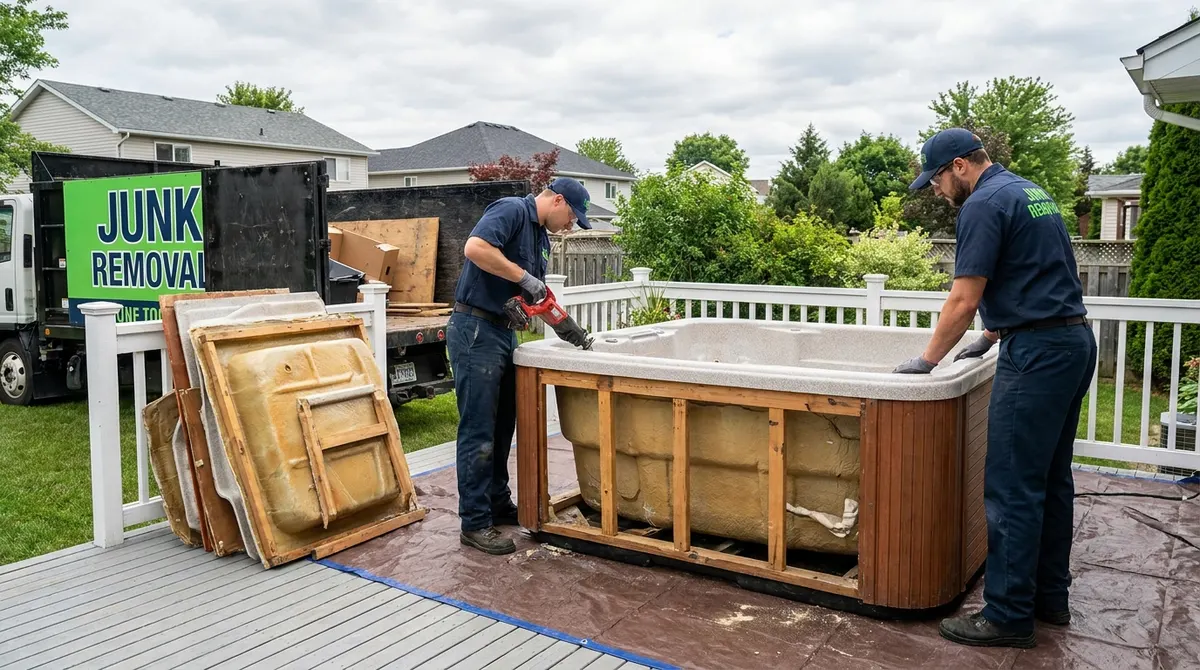
Hot tub removal is a demolition-and-haul job, not a lift-and-carry job: power is disconnected, the shell is cut down, and the debris is split between scrap and landfill. Our team does the cutting, lifting, and hauling, then leaves the pad swept clean.
| Hot tub type and size | Ballpark removal cost and crew time |
|---|---|
| 2–3 person plug-and-play spa (approx. 250 gallons) | $300–$500 · 1–2 hours · 2 crew |
| 4–6 person standard spa (approx. 400 gallons) | $350–$800 · 2–3 hours · 2 crew |
| 7–8 person or large square spa (500–600 gallons) | $500–$1,000 · 3–4 hours · 2–3 crew |
| Swim spa, 12–19 ft (1,500+ gallons) | $900–$1,800 · 4–6 hours · 3–4 crew |
| Spa surrounded by decking or set on a second-story balcony | Typically adds $150–$400 for cut-out and rigging |
| Built-in or in-ground spa shell with concrete surround | Quoted on site after inspecting tile, plumbing, and fill needs |
| Cover, steps, and cover lifter only | Usually folded into the main price at no separate charge |
Hot tub removal — ballpark cost and crew time by spa size (ranges only; the exact price is confirmed during a free on-site look)
Hot tub removal starts at the breaker, not the tub
Nearly every wired spa runs on a 240V circuit protected by a 50–60 amp GFCI disconnect box mounted within sight of the tub. The breaker is switched off first, the disconnect is opened, and the whip is separated from the spa pack before anything is cut. Plug-and-play 110V models simply unplug. Homeowners who want the disconnect box, conduit, and dedicated circuit removed from the wall afterward should have a licensed electrician handle that portion — a removal crew's work stops at safely separating the tub from live wiring.
Hot tub draining moves 300–600 gallons before the shell can be lifted
A standard 4–6 person spa holds 300–500 gallons, and water weighs about 8.34 pounds per gallon, so a full tub can exceed 4,000 pounds. Draining is done with a submersible pump or the built-in drain valve and takes 45–90 minutes depending on pump size. Water should be routed away from foundations, garden beds, and storm drains. Spa water needs 3–7 days without chlorine or bromine additions before it is safe to drain onto a lawn, so many crews schedule the drain a day ahead of the haul.
Hot tub demolition cuts the shell into panel-sized pieces for hand-carry
A drained spa still weighs 500–900 pounds because the acrylic shell is bonded to several inches of closed-cell foam and a wood or steel frame. Crews strip the side cabinet panels, unbolt the equipment bay, then cut the shell with a reciprocating saw and a demolition blade, following the seat seams into four to eight sections. Cut pieces are sized to fit through a standard 36-inch gate. Older tubs hold waterlogged foam that can double the expected weight, which is why a drained tub is rarely dragged out whole.
Hot tub disposal splits the unit across three separate waste streams
An intact hot tub is not accepted in curbside recycling or standard bulk trash pickup in most municipalities. Acrylic or fiberglass shell material and the foam insulation are non-recyclable and go to a landfill or transfer station, where tipping fees commonly run $50–$130 per ton plus bulky-item surcharges. The steel frame, pumps, heater element, jets, and copper wiring are pulled out and sold to a scrap yard. Cedar or redwood skirting is sometimes salvaged. A working spa under roughly ten years old is worth listing for donation or resale instead of demolition.
Hot tub removal access needs a clear 3–4 foot path from the pad to the truck
Crews measure the narrowest point of the route first: gate width, deck stair turns, side-yard clearance, and overhead branches. Cut sections are typically 3–4 feet across, so a 36-inch gate works and a 30-inch side yard usually means smaller cuts and more trips. Fence panels are occasionally removed and reset when there is no other route. Rooftop decks and enclosed sunrooms are the two situations that most often push a job into the higher price band, since every piece is carried by hand down stairs.
Hot tub removal cost is driven by size, access, and disposal weight
Three variables set the price: gallon capacity, the carry distance and obstacles between the pad and the truck, and total debris tonnage at the disposal site. A 2–3 person spa on a driveway is the low end of the range; a swim spa behind a locked gate on a sloped lot is the high end. Deck cut-outs, concrete pad breaking, and electrical box removal are add-ons. Quotes are given as ranges over the phone and confirmed as a firm number on site before any cutting begins.