Do You Have to Be Home for Junk Removal? — Complete Guide
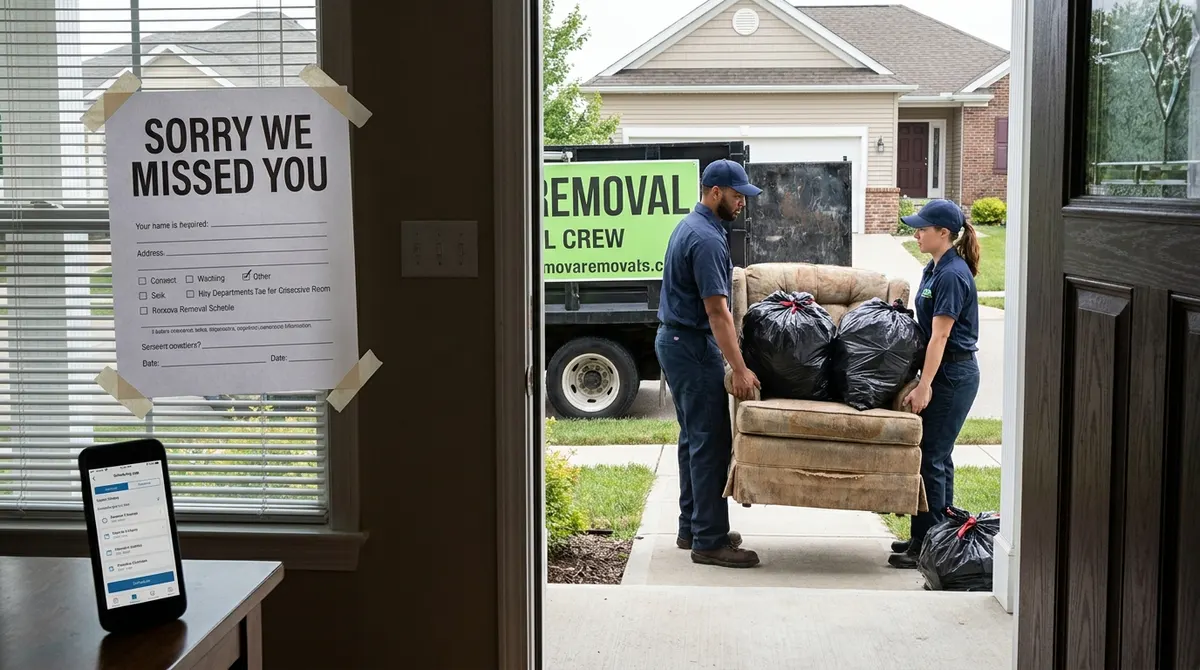
No — you generally do not need to be home for junk removal, as long as access, a photo item list, and payment are arranged in advance. Our team handles unattended driveway, curb, and garage pickups throughout the local service area and schedules interior jobs around your availability.
| Pickup situation | What the crew needs from you |
|---|---|
| Items already in driveway or curbside | Photos, written go-ahead, card on file — no one home required |
| Garage or carport pile | Garage code or unlocked side door plus a photo list |
| Fenced back yard or side alley | Gate left unlocked or gate/lock code; note any dogs |
| Inside the house (furniture, appliances) | Adult 18+ onsite, or a lockbox/key code and written authorization |
| Apartment, condo, or HOA property | Gate code, unit access, elevator or loading-dock reservation if required |
| Rental turnover or estate cleanout | Owner or agent authorization in writing; walkthrough photos |
| Item count uncertain (pile grows day of) | Someone reachable by phone to approve a revised volume price |
Attended vs. unattended junk removal: what each pickup type requires
Junk removal without the homeowner present relies on three confirmations
Unattended junk removal works when three things are settled before the truck rolls: what is being taken, how the crew gets to it, and how the job is paid. Photos or a short video of the pile establish the scope so the volume price is agreed in advance. Access means an unlocked gate, a garage code, or an outside pile in plain view. Payment is normally a card authorized ahead of time or a link sent after loading. With those three items handled, the crew loads, sweeps the spot, and sends time-stamped after-photos as proof of completion.
Junk removal inside the home usually requires an adult onsite
Interior removal is the one scenario where someone typically needs to be there. Crews carrying a sleeper sofa down a stairwell or disconnecting a washer are working inside living space, and most operators require an adult 18 or older present to point at what goes and what stays. The alternative is written authorization plus an entry method — a lockbox code, a property manager letting the crew in, or a real estate agent onsite. Landlords and executors regularly use that route for rental turnovers and estate cleanouts. A clear "take everything in the back bedroom and the garage, leave the shelving" note prevents the single most expensive mistake in this trade: hauling off something that was meant to stay.
Junk removal pricing is set by truck volume, not by whether you are home
Being absent does not change the price. Junk removal is priced by the space the load occupies in the truck, adjusted for weight-heavy material and labor difficulty. Market ranges generally run about $150–$250 for a single item or a small pickup-bed load, $300–$450 around a half truck, and roughly $450–$700 for a full truck. Concrete, dirt, roofing shingles, and heavy tile are usually priced separately because disposal is billed by the ton. Mattresses, tires, and appliances with refrigerant often carry per-item recycling fees. Every figure here is a ballpark — the exact number is confirmed at the property on a free on-site look before any lifting starts.
Junk removal crews handle the lifting, loading, and cleanup as a done-for-you service
The point of hiring out is that nothing is left for you to do. The crew brings the truck, dollies, straps, and gloves, walks the pile, quotes it, and loads it. Items come out of basements, second-floor bedrooms, attics with pull-down ladders, and sheds — no staging at the curb required. The spot gets swept afterward. Reusable furniture and metal are commonly routed to donation partners and scrap yards rather than straight to the landfill, and the rest goes to a permitted transfer station. If you want to sort, drag, and self-haul, a trailer rental and a landfill day is the cheaper path; a full-service haul exists specifically for people who would rather buy the afternoon back.
Junk removal same-day scheduling depends on route timing, not on your presence
Same-day and next-day slots are commonly available when a truck has room left on the route. Arrival windows are typically two to three hours wide because the previous stop can grow — a "few boxes" job turns into a garage. Crews usually call or text 15 to 30 minutes out. If you are at work, that call goes to your cell and the crew proceeds under the pre-approved plan. One practical note for unattended jobs: leave the driveway clear. A truck with a 12 to 15 foot bed needs room to back in, and a blocked driveway is a common reason an unattended stop gets pushed.
Junk removal authorization protects both the property owner and the crew
Written authorization is what makes an unattended pickup safe for everyone. A text or email listing the items, the access method, and the approved price becomes the record if a question comes up later. Tenants should get the landlord's sign-off before scheduling a cleanout of items that are not theirs. Property managers ordering work on a vacant unit should name the unit number and the specific rooms. Anything containing personal documents, firearms, prescriptions, or cash should be pulled out and set aside before the crew arrives — that responsibility stays with the owner, present or not.
Local service area specifics for unattended junk removal
A few local realities shape whether an unattended pickup runs smoothly. Gated communities and HOA neighborhoods need a gate code or a call-box entry name provided when booking, and some associations restrict commercial trucks to daytime hours or prohibit piles sitting at the curb overnight — worth checking your covenants before staging junk outside. Apartment and condo buildings frequently require an elevator or loading-dock reservation with the office, which the crew cannot arrange on your behalf. Narrow alleys, tight townhome driveways, and streets with posted no-parking hours mean the crew may have to dolly items 100 feet or more to the truck, which is factored into the volume quote rather than added as a surprise. Local disposal cost also flows into pricing: transfer stations and county landfills charge by the ton, and heavy items like wet mattresses, plaster, or rain-soaked carpet weigh substantially more than the same volume dry, so covering a staged pile with a tarp before a storm keeps the price where it was quoted. Municipal bulk pickup programs exist in many area jurisdictions but usually cap item counts, exclude construction debris and appliances with refrigerant, and run on a set schedule — which is why cleanouts on a deadline go to a private hauler instead.
Related questions
How much does junk removal cost per truckload?
A full truckload generally runs about $450–$700 in most markets, with half loads around $300–$450 and single items or small loads near $150–$250. Heavy debris such as concrete, dirt, and shingles is priced separately by weight.