How Do You Get an Accurate Junk Removal Quote? — Pricing Guide
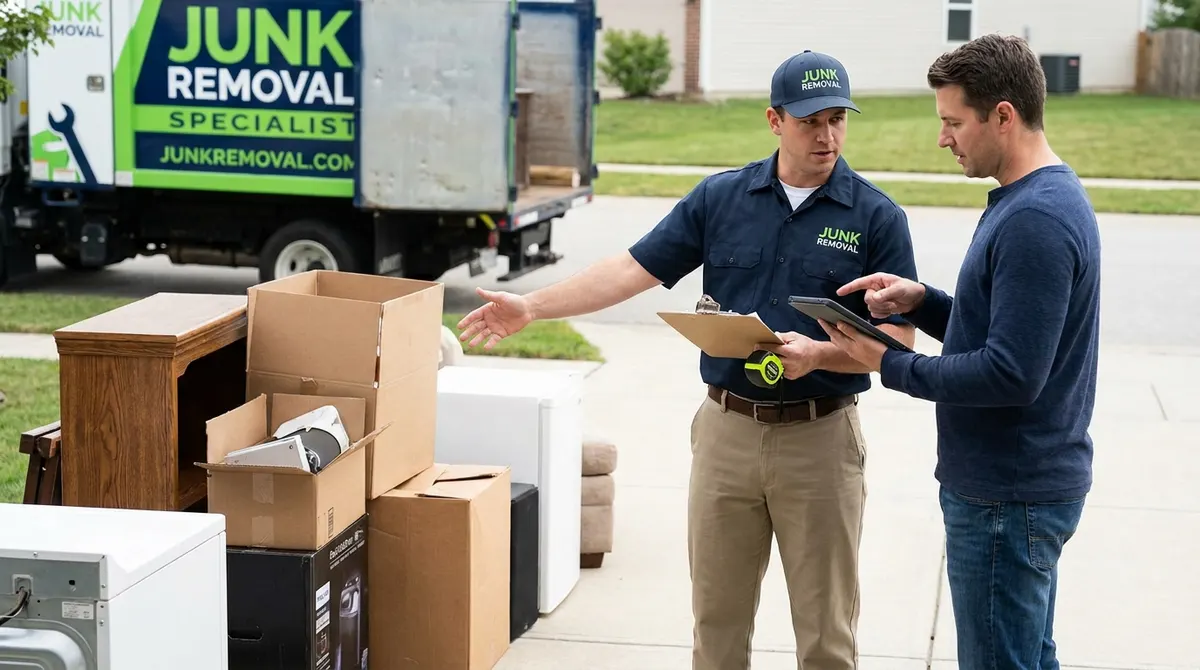
Accurate quotes come from volume plus a look at access, and our team confirms the number in writing on site before anything moves. Photo estimates give a solid ballpark; the free on-site check locks it in for local homes, garages, and rental turnovers.
| Load size (space used in truck) | Typical all-in price range |
|---|---|
| Single item (sofa, mattress, appliance) | $75 – $150 |
| 1/8 truck (a few boxes or a small pile) | $100 – $180 |
| 1/4 truck (about 4 cubic yards) | $150 – $275 |
| 1/2 truck (about 8 cubic yards) | $275 – $450 |
| 3/4 truck (about 12 cubic yards) | $400 – $575 |
| Full truck (15 – 20 cubic yards) | $500 – $750+ |
| Heavy debris (dirt, concrete, roofing, tile) | Priced by weight, often $100 – $200 per ton on top of volume |
Junk removal load sizes and typical all-in price ranges (market ranges, confirmed on site)
Junk removal quotes are priced by truck volume, not by the hour
Volume pricing is the industry standard: the crew quotes based on how much of the truck bed the load will fill, measured in fractions of a full truck. A full truck holds roughly 15 to 20 cubic yards, which is about the contents of a two-car garage packed waist-high. Hourly pricing is rare in residential junk removal because labor time varies wildly with stairs, doorways, and how tightly a pile is packed. Asking for the load fraction and the matching dollar figure is the fastest way to compare two companies honestly. A quote that names a fraction and a price is a real quote; a quote that names only a starting price is a teaser.
Junk removal photo estimates land within about 10 to 20 percent of the final price
Photos and short video walkthroughs are the most efficient way to get a usable number before anyone drives out. Wide shots of the full pile, plus one shot showing the path from the pile to the driveway, let an estimator judge both volume and access. Photo estimates typically come within 10 to 20 percent of the final on-site figure because cameras flatten depth and hide what is stacked behind the front row. Closets, crawlspaces, and attic loads are the usual sources of variance. Anyone quoting an exact, locked price from a single photo is guessing, and the correction arrives on truck day.
On-site junk removal quotes are confirmed in writing before the first item is lifted
The accurate quote happens on site: the crew walks the pile, marks the load fraction, and gives one written all-in price. Nothing gets loaded until that number is approved. A free on-site look-over takes about 10 to 15 minutes and is the only stage where hidden volume, tight stairwells, and heavy items are all visible at once. Homeowners who want a firm figure rather than a ballpark should request the on-site visit and have the entire load in one place beforehand, which usually shaves a load fraction off the price. Written confirmation before loading is the single strongest sign of an accurate quote.
Junk removal all-in quotes include labor, hauling, and disposal in one number
A legitimate all-in quote covers the crew's labor, the carry-out, the truck, the drive, and the tipping or recycling fees at the facility. Customers should not be billed separately for lifting or for landfill weight on a standard household load. Ask directly whether disposal fees are included before agreeing to a price — that one question exposes most lowball quotes. On a full-service job the crew does all of the lifting and carrying, including items in basements, attics, and second-floor bedrooms. Sweep-up of the cleared area is standard practice on residential jobs and belongs in the same quote.
Junk removal surcharges apply to mattresses, appliances, tires, and heavy debris
Certain items carry facility-imposed fees that a quote has to reflect. Mattresses and box springs commonly add $20 to $50 each because they are recycled separately. Refrigerators and air conditioners require refrigerant recovery, usually $25 to $60. Tires, paint, and electronics have their own drop-off charges. Dirt, concrete, brick, roofing shingles, and tile are quoted by weight rather than volume because a half-full truck of masonry outweighs a full truck of furniture. A frequent complaint paraphrased from r/HomeImprovement threads is that the final bill jumped after the truck arrived; the fix is asking upfront which items in the pile carry an item-specific fee. Naming those items during the estimate keeps the written number stable.
Junk removal quote accuracy improves when access and staging are described upfront
Access drives labor, and labor drives the load fraction that gets quoted. Long carries from a backyard, narrow basement stairs, elevator-only buildings, and no-parking street frontage all add crew time. Estimators need three details to be accurate: where the items sit, how far the truck can park from them, and whether stairs are involved. Piling everything in a garage or driveway before the crew arrives is the most reliable way to hold the price at the low end of the quoted range. Discussions in r/CleaningTips repeatedly note that consolidating a load beforehand changes what people are charged — that tracks, because a staged pile is faster to load and easier to measure.
Local specifics
Local quote accuracy is driven mostly by disposal costs at the nearest transfer station. Tipping fees in most markets run roughly $50 to $95 per ton for mixed municipal waste, and any honest quote has that cost baked in rather than added later. Construction and demolition debris, yard waste, and clean fill are usually accepted at separate rates and separate gates, so mixed loads cost more to dispose of than sorted ones. Mattress recycling and appliance refrigerant recovery are handled at designated facilities and carry their own per-item charges. Full-service junk removal generally requires no permit because the truck loads and leaves the same day, unlike a driveway or street dumpster, which in many municipalities needs a right-of-way permit if it sits on the public roadway. Household hazardous waste — paint, solvents, fuel, propane tanks — is excluded from standard hauling and routed to the local household hazardous waste collection event or facility instead. Local crews confirm the final number on site once they have seen the access route, the parking situation, and any restricted items in the pile.