What Hidden Fees Do Junk Removal Companies Charge? — Complete Guide
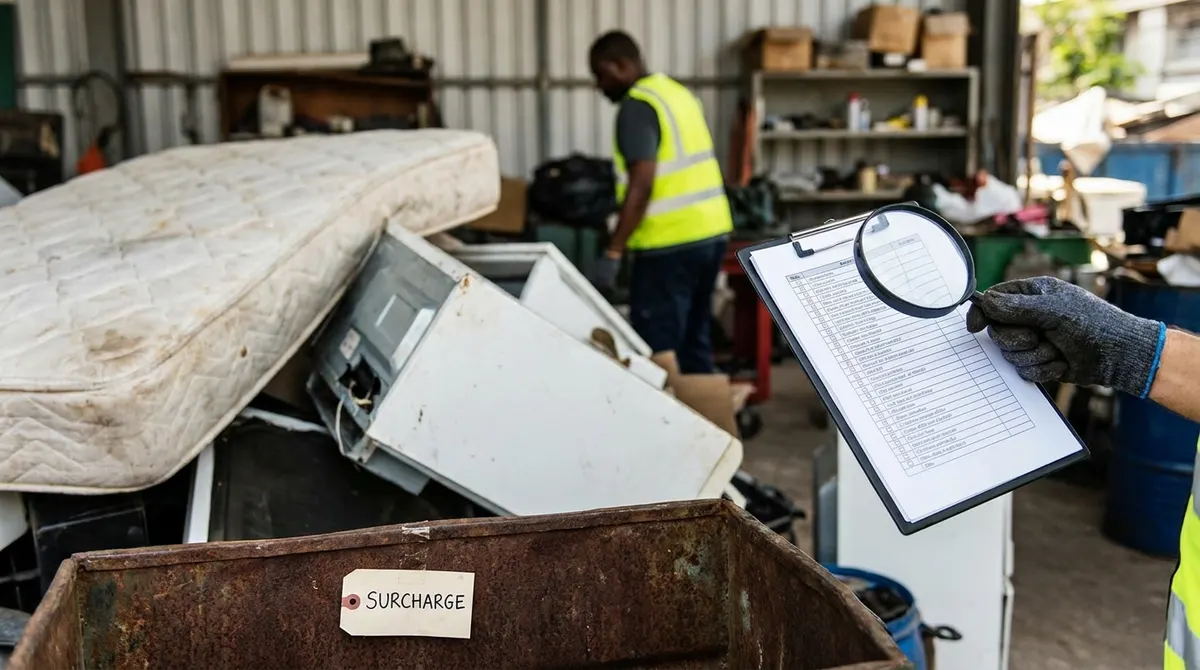
Junk removal add-ons are mostly disposal pass-throughs and access surcharges — mattresses, refrigerant appliances, stairs, and heavy debris over the truck's weight allowance. Our crew quotes those items on site, in writing, before anything gets loaded, so the number you approve is the number you pay.
| Fee or add-on | Typical range | Why it applies |
|---|---|---|
| Truck minimum / single item | $100–$175 | Covers crew time, fuel and the trip to the transfer station regardless of load size |
| Quarter truckload | $150–$250 | Roughly a small bedroom or a garage corner |
| Half truckload | $300–$450 | Typical garage or basement cleanout |
| Full truckload | $500–$700 | Full house cleanout, evictions, large estate jobs |
| Mattress or box spring | $10–$40 each | Most transfer stations charge a per-unit mattress recycling fee |
| Refrigerator, freezer, AC unit | $20–$50 each | Refrigerant must be recovered by a certified technician before scrapping |
| CRT / tube television or monitor | $20–$50 each | Leaded glass e-waste is billed per unit at recycling facilities |
| Tires | $5–$15 each | Tires are banned from most landfills and routed to a separate processor |
| Paint, chemicals, solvents | $5–$15 per container | Household hazardous waste requires a dedicated drop-off site |
| Heavy debris tonnage overage | $50–$100 per ton | Concrete, dirt, roofing and tile exceed the volume-based weight allowance |
| Stairs, elevator or long carry | $25–$75 | Added crew labor for third-floor walk-ups or 100+ ft carries |
| Dismantling (hot tub, shed, playset) | $75–$300 | Labor to cut down and haul in pieces |
| Same-day or weekend scheduling | $0–$50 | Route disruption; many companies waive it when a slot is already open |
Common junk removal fees and typical market ranges (confirmed on site, not over the phone)
Junk removal pricing starts at a truck minimum, not a per-item rate
Every full-service hauler carries a floor price, generally $100–$175, because a two-person crew, a dump-capable truck and a transfer-station trip cost the same whether the load is one couch or six. That minimum is the single most misread line on a quote — customers hear "$95 for a single item" and expect the same math for two items, but the second item usually moves the job into the quarter-load bracket at $150–$250. Volume pricing is measured by how much space the load occupies in the truck bed, typically 12 to 16 cubic yards for a full load. Honest quoting means naming the minimum out loud before the crew is dispatched.
Junk removal recycling fees for mattresses, appliances and TVs are pass-through disposal costs
The fees that surprise people most are not markup — they are what the facility charges the truck at the scale house. Mattresses and box springs carry a per-unit recycling fee at most transfer stations, commonly $10–$40 each. Refrigerators, freezers and window AC units require certified refrigerant recovery under EPA Section 608 before the metal can be scrapped, which adds $20–$50 per unit. Tube televisions and old monitors contain leaded glass and get billed as e-waste, again $20–$50. Tires, paint, solvents, propane tanks and fluorescent tubes each route to their own facility. A reputable company lists these items separately on the estimate rather than burying them in a lump sum.
Junk removal surcharges for stairs, long carries and heavy debris explain most quote gaps
Access changes labor, and labor changes price. A third-floor walk-up, a narrow basement stairwell, a 150-foot carry from a back unit to street parking, or an elevator with a reserved loading window typically adds $25–$75 in crew time. Weight matters separately from volume: concrete, brick, dirt, roofing shingles and tile can hit the truck's legal weight limit at a third of its visual capacity, so haulers apply a tonnage overage around $50–$100 per ton past the included allowance. Hot tubs, sheds, swing sets and built-in cabinetry need dismantling, generally $75–$300 depending on size. All of it is visible before work starts — which is exactly why on-site confirmation beats a phone number.
Junk removal quotes stay fixed once the crew confirms the pile in person
The reliable way to eliminate surprise charges is a free on-site look before loading. A crew standing in the garage can see the mattress count, spot the freezer, notice the second-floor stairs and estimate the concrete weight, then hand over one all-in number covering labor, hauling, dump fees and cleanup of the swept area. Getting that number in writing — text, email or a signed work order — is the single best protection available to a homeowner. Ask three specific questions: is the dump fee included, are mattress and appliance fees itemized, and is the price locked if the pile is what was shown. Full-service pricing means the crew does every bit of the lifting, carrying and loading.
Reddit junk removal threads trace complaints to phone estimates rather than crews
Paraphrasing a recurring theme in r/HomeImprovement: users report the crew and service were fine, but the final invoice ran well above the ballpark quoted over the phone, usually after mattresses or a fridge were counted at the truck. A separate thread in r/moving describes a hot tub job re-priced on arrival once the dismantling labor was visible. Both line up with the spec grid above — mattress recycling at $10–$40 per unit and refrigerant recovery at $20–$50 per appliance are real facility costs that a sight-unseen estimate cannot include. The fix is procedural, not adversarial: have the fee list confirmed on site, in writing, before the first item leaves the house.
Local junk removal fee specifics
Local disposal economics drive local pricing. County transfer stations and private landfills set their own gate rates — most charge by the ton with a posted minimum load fee, and they bill mattresses, tires, refrigerant appliances and e-waste as separate per-unit line items rather than folding them into the tonnage. That is why a hauler's mattress or fridge fee closely tracks whatever the nearest facility posts that year. Distance to the scale house matters too: jobs on the outer edge of a service radius may carry a modest travel surcharge because the round trip burns more crew hours. Municipal bulk-item pickup exists in many areas but is limited, usually to a small number of items per year, scheduled weeks out, curbside only, with construction debris, hazardous materials and refrigerant appliances excluded — which is where paid same-day full-service hauling fills the gap. Renters and HOA residents should also check whether a dumpster placement permit or reserved-parking approval would be required for a container, since a truck-based haul-away typically avoids both. Exact local fees are confirmed on a free on-site visit before any loading begins.