How Much Junk Fits in a Junk Removal Truck? — Complete Guide
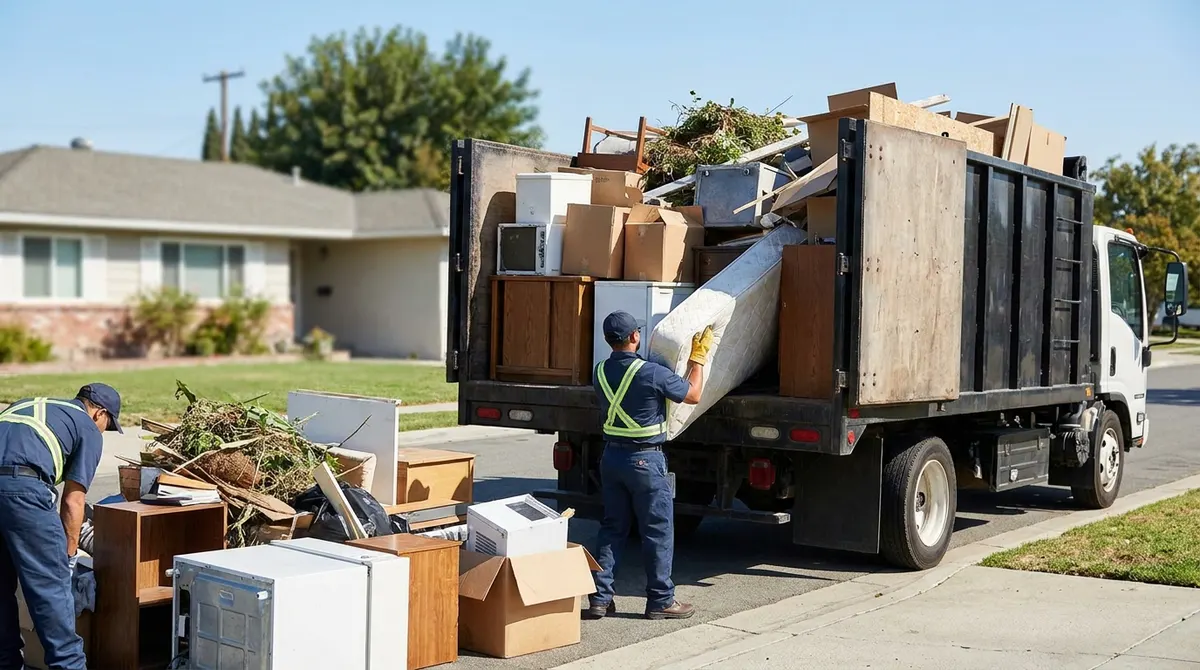
A junk removal truck fits 15-20 cubic yards — about 6-8 pickup loads — with full loads landing near $500-$800 in most markets. Our crew measures the pile on site, does all the lifting and carry-out, and hauls the same day where routing allows.
| Load size | Approx. volume | What typically fits | Typical price range |
|---|---|---|---|
| Minimum load (1/8 truck) | 2-2.5 cubic yards | A mattress and box spring, or 10-15 bags and a few boxes | $100-$175 |
| 1/4 truck | 4-5 cubic yards | Sofa, recliner, coffee table, and 8-10 boxes | $175-$300 |
| 1/2 truck | 8-10 cubic yards | One-bay garage cleanout or a small apartment's furniture | $300-$475 |
| 3/4 truck | 12-15 cubic yards | Two-bay garage, or a bedroom set plus appliances and yard debris | $425-$650 |
| Full truck | 15-20 cubic yards | Full estate or hoarding-room cleanout, or a small deck tear-out | $500-$800+ |
Junk removal truck capacity by load fraction, with typical market price ranges
Junk removal trucks carry 15 to 20 cubic yards in a standard full load
Most junk removal trucks are dump-body or box-style rigs with an interior bed roughly 14 feet long, 8 feet wide, and 4 to 5 feet high. That works out to 15 to 20 cubic yards, or about 400 to 540 cubic feet. One cubic yard equals 27 cubic feet, which is a cube three feet on every side. Larger trailer setups reach 24 cubic yards, but 15-20 is the industry standard for residential curbside and driveway work.
Junk removal truck capacity equals roughly six to eight pickup loads
A standard half-ton pickup bed holds about 2 to 2.5 cubic yards when loaded level with the rails. One full junk removal truck therefore replaces six to eight pickup trips, plus the matching number of trips to a transfer station. Homeowners comparing DIY hauling to a booked service usually find the deciding factor is time and disposal fees, not the vehicle — crews arrive with the truck, the labor, and the dump account already in place.
Junk removal pricing is charged by the fraction of truck space a load fills
Volume-based pricing is the standard model: the crew marks how much of the bed the items occupy after loading, and the price follows that fraction. Minimum loads generally start around $100-$175 and a full truck generally runs $500-$800 in most markets. Labor, driving, and disposal are normally included in that figure. Ranges shift with stair count, long carries, and disposal surcharges, which is why an on-site look beats a phone guess.
Junk removal truck weight limits cap heavy debris before the volume runs out
Volume is only half the equation. A typical truck is rated for roughly 3,000 to 6,000 pounds of payload, and dense material hits that ceiling long before the bed looks full. Concrete, brick, dirt, tile, and roofing shingles weigh 2,000-4,000 pounds per cubic yard, so a few yards can max out a truck legally. Heavy debris jobs are usually quoted separately by weight or split across multiple trips.
Junk removal crews load tighter than DIY stacking and recover usable space
Loose stacking wastes a third or more of a truck bed. Trained loaders break down bed frames, nest chairs, collapse boxes, and fill voids inside dressers and appliances, which commonly recovers two to four cubic yards of usable space on a full load. That difference can drop a job from a three-quarter charge to a half-truck charge. Homeowners are not asked to move or pre-sort anything; the crew handles the carry-out from the room where the items sit.
Junk removal estimates are confirmed on site before loading begins
Photos and phone descriptions produce a ballpark only, because piles compress unpredictably and photos hide depth. The practical process: the crew looks at the actual pile, quotes a firm number based on the truck space it will occupy, and waits for approval before touching anything. Free on-site quotes are standard in this trade. No exact price should be promised sight-unseen — anyone quoting to the dollar over the phone is guessing.