Junk Hauling vs Junk Removal: What Is the Difference? — Complete Guide
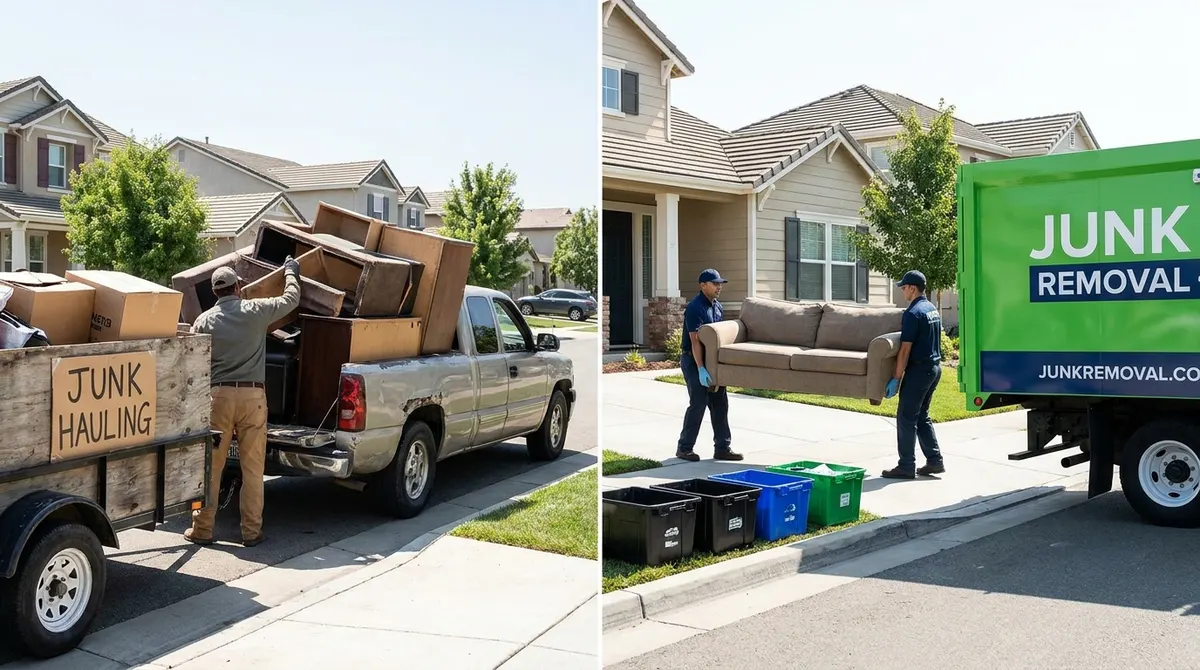
Junk hauling is the transport-and-disposal half; junk removal adds the crew that carries everything out. {{brand}} operates as full-service junk removal in {{city}}, {{state}} — items are lifted, loaded, hauled, and disposed of in one visit, priced by truck space.
| Service element | Junk hauling | Junk removal (full-service) |
|---|---|---|
| Who carries items out of the home | Customer — items must already be curbside or driveway-ready | Crew handles all lifting, stairs, and doorways |
| Truck and driver provided | Yes | Yes |
| Disposal and tipping fees included in quote | Usually yes | Usually yes |
| Typical single-item price range | $60–$125 curbside | $75–$150 including in-home pickup |
| Typical full-truckload price range | $350–$650 | $450–$750+ |
| How pricing is set | Load size or trip | Volume of truck space filled, plus item-specific disposal surcharges |
| Same-day availability | Common | Common |
| Best fit | A pile already staged outside | Basement, attic, garage, estate, or evicted-unit cleanouts |
Junk hauling vs. full-service junk removal: what each stage covers
Junk removal includes the labor of carrying items out of the building
Full-service junk removal covers the part most homeowners actually want handled: the lifting. A two-person crew walks the basement, spare bedroom, attic hatch, garage bay, or backyard shed, disassembles what needs disassembling, and carries every piece out to the truck. Stairs, tight hallways, and second-floor pickups are standard work, not add-ons. That labor is the reason full-service pricing sits above pure hauling. A treadmill in a finished basement, a sleeper sofa that will not turn the stair corner, or a garage packed shoulder-height are all jobs where the customer never touches the load.
Junk hauling covers transport and disposal after the items are already staged outside
Junk hauling is the narrower job: a truck arrives, the crew loads what is already at the curb, driveway, or alley, and the load goes to a transfer station, recycler, or scrap yard. The hauling price mostly reflects load volume plus the tipping fee paid at the gate. Homeowners who have already dragged everything outside sometimes pay less for hauling-only. The trade-off is real — the staging work, the stairs, and the risk of scuffed walls or a strained back stay with the customer.
Junk removal pricing is set by truck space filled, not by the hour
Volume pricing is the industry standard for junk removal. Crews quote by how much of the truck bed a load occupies — quarter, half, three-quarter, or full — after seeing the pile in person. Typical market ranges run roughly $150–$250 for a quarter truckload, $250–$400 for a half, and $450–$750 for a full load. Weight-heavy debris such as concrete, dirt, roofing shingles, or brick is quoted separately because disposal is billed by the ton. Hourly billing is uncommon, and quotes given sight-unseen over the phone are ballparks — the exact number is confirmed on a free on-site look before any work starts.
Junk removal and dumpster rental differ in timeline and driveway footprint
A dumpster sits in the driveway for several days and the homeowner fills it. Junk removal is a single appointment, often same-day or next-day, with no container left behind. Dumpster rentals typically carry a weight allowance with overage charged per ton, plus a permit if the container occupies a public street. Junk removal avoids both the permit question and the week-long eyesore, which matters on narrow streets, shared driveways, and in HOA neighborhoods with container restrictions. For one-and-done cleanouts, full-service junk removal in {{city}} is generally the faster path.
Junk removal handles appliances, mattresses, and electronics under separate disposal rules
Certain items cost more to dispose of than their volume suggests, and that is true for both hauling and removal. Refrigerators, freezers, and window AC units contain refrigerant that must be recovered by a certified technician, so a per-unit fee applies. Mattresses and box springs carry a recycling fee at many facilities. Televisions, monitors, and other e-waste route to electronics recyclers rather than the landfill. Tires, propane tanks, paint, solvents, and other household hazardous waste are excluded from standard truck loads and go to dedicated drop-off programs. Honest quotes list those surcharges up front instead of adding them after the truck is loaded.
Junk removal questions on r/junkremoval center on volume estimates and hidden add-ons
Two concerns come up repeatedly in paraphrased form on r/junkremoval. The first: homeowners describe being quoted one price by phone, then hearing a higher number once the crew sees the actual pile. The practical answer is volume pricing — a load is quoted on the truck-space fraction it fills, so an in-person look before loading is what makes the number firm. The second: people ask whether hauling-only is worth the savings. Dragging a full basement to the curb yourself typically saves a modest amount off a $450–$750 full-truckload job, which is why most callers choose the crew-does-everything option instead.
{{city}}, {{state}} specifics
Disposal cost is the local variable that moves junk removal pricing in {{city}}. Area transfer stations and landfills bill by the ton at the gate, so a load of construction debris, plaster, or soil prices differently from the same volume of furniture and cardboard. County-run facilities also set their own rules on mattresses, tires, appliances containing refrigerant, and household hazardous waste, which is why those items are quoted per unit rather than by volume. Access shapes the job as much as the pile does: older {{city}}