Local Junk Removal vs National Chains — Complete Guide
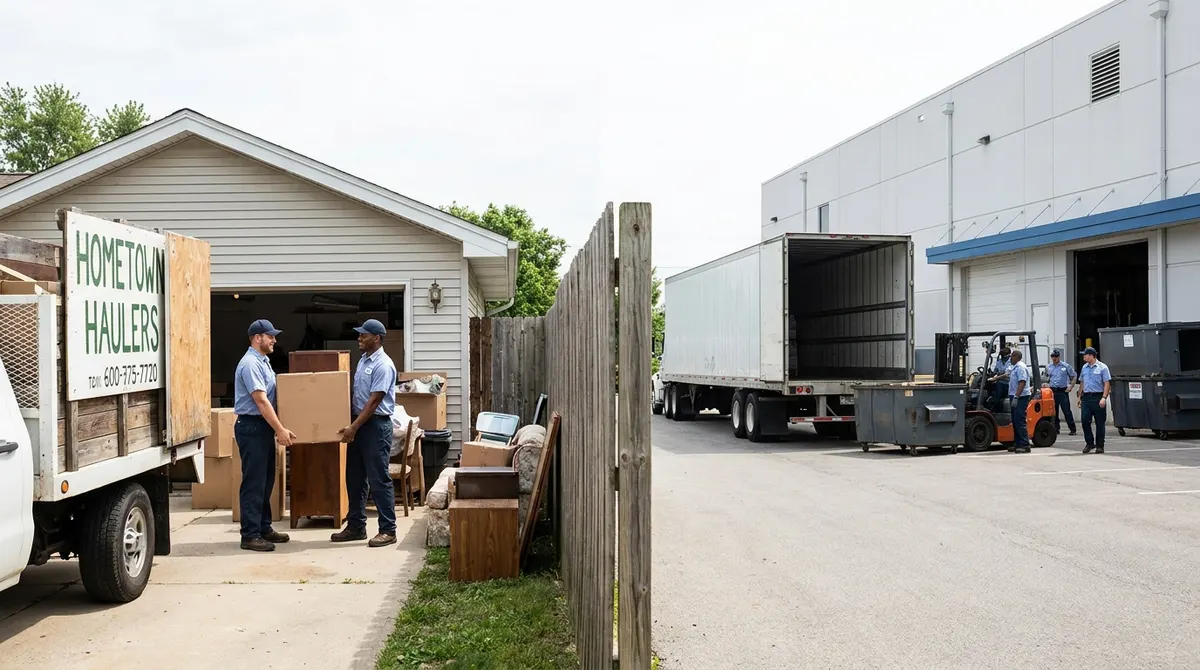
Local haulers and national junk removal chains sit in the same price range and both do the lifting for you; the real differences are scheduling flexibility, disposal routing and who answers the phone. Our crew quotes on site, free, before loading begins.
| Factor | Local independent hauler | National franchise chain |
|---|---|---|
| Pricing basis | Truck volume tiers, roughly $100–$800 depending on load | Truck volume tiers, roughly $100–$800 depending on load |
| Single-item pickup | Commonly $100–$200 including labor and disposal | Commonly $125–$225 including labor and disposal |
| Full truckload (15–18 cu yd) | Typically $500–$800 | Typically $550–$850 |
| Same-day availability | Often same or next day; smaller schedule, direct dispatch | Depends on franchise capacity that day |
| Who shows up | Owner or a small regular 2-person crew | Uniformed 2-person crew, staffing varies by location |
| Disposal routing | Nearest county transfer station, landfill or scrap yard | Same local facilities, corporate-tracked |
| Quote confirmation | On-site walkthrough before loading | On-site walkthrough before loading |
| Best fit | Access-tight jobs, odd hours, repeat property work | Multi-market or corporate accounts needing uniform paperwork |
Local independent haulers vs national junk removal franchises — typical comparison
Junk removal pricing uses truckload volume tiers at both local and national companies
Junk removal is priced by the fraction of the truck your items occupy, not by weight or by the hour, and that model is identical at independent haulers and national franchises. A standard junk truck holds about 15 to 18 cubic yards, which is roughly the volume of six to eight pickup truck beds. A quarter load generally runs $175–$275, a half load $300–$475, and a packed full truck $500–$800 in most markets. Labor, hauling and disposal fees are bundled into that number. Heavy debris such as concrete, dirt, roofing shingles or tile is the common exception, because it hits landfill weight limits before it fills the box, so it is usually quoted separately.
Local junk removal crews typically hold more same-day flexibility than franchise dispatch
Independent haulers run smaller schedules, which makes late-afternoon and same-day slots easier to fit. Calls placed before roughly 11 a.m. often get a same-day two-hour arrival window, and next-day service is common for larger cleanouts. National franchises book through a central or regional call center and slot you into whatever capacity that specific franchise has open, which can mean a two- to four-day wait during spring cleanout season and after storms. For a closing deadline, a tenant turnover or an inspection date, the shorter local dispatch chain is the practical advantage.
National junk removal chains offer standardized crews and multi-market coverage
National franchises are a strong fit when consistency across locations matters. They provide uniformed crews, online booking, standardized invoicing and coverage in dozens of metros, which property management companies and corporate accounts often require for expense reporting. Their trucks and processes look the same in every market. The tradeoff is less pricing latitude — a franchise crew follows a set rate card, while an owner-operator can adjust for an easy curbside load or a job that is already staged in the driveway.
Junk removal disposal costs at local transfer stations shape the final quote
Disposal is the largest hard cost inside any junk removal price. Municipal and county transfer stations charge tipping fees by the ton, commonly in the $50–$95 per ton range, with surcharges on mattresses, tires, appliances containing refrigerant and electronics. Haulers who sort loads — metal to a scrap yard, usable furniture to a donation partner, the remainder to the landfill — reduce tonnage and can quote tighter. Ask any company, local or national, which facilities they use; a specific answer is a reliable sign the operation is licensed to dump there.
Junk removal quotes are confirmed on site before loading, not locked in by phone
Phone and online estimates are ballparks at every junk removal company, because volume cannot be measured accurately from a description. The professional standard is an on-site walkthrough: the crew looks at the pile, states the price in writing, and only starts loading after approval, with no charge if the number is declined. Recurring complaints in r/junkremoval threads describe quotes that jumped once the truck arrived — paraphrasing the common thread, customers felt the phone figure and the driveway figure did not match. The safeguard is simple and worth asking for directly: a firm written price before a single item is picked up.
Choosing between local junk removal and a national chain comes down to access and job size
Small, awkward and access-limited jobs favor a local hauler: single-appliance removals, third-floor walkups, narrow alley access, garages that need sorting as they are emptied. Large multi-truck commercial clearouts and jobs spanning several cities favor a national chain's fleet capacity. Both handle furniture, appliances, mattresses, hot tubs, yard debris, construction debris, garage and estate cleanouts, and both do all carrying and loading. Hazardous materials — paint, solvents, fuel, asbestos, propane tanks — are excluded by both and route to a household hazardous waste facility.
Local market specifics that change your junk removal quote
Three local variables move the price more than the company's logo does. First, distance to the nearest transfer station or landfill — a hauler working within 10 to 15 minutes of a facility absorbs less drive time than one crossing a county line, and fuel plus tip fees are baked into the quote. Second, county-level disposal rules: many facilities charge separately for mattresses and box springs, refrigerant recovery on fridges, freezers and AC units, and tires, and electronics frequently must go to a designated e-waste site rather than general waste. Third, access — stairs, elevators, long carries from a back unit, HOA restrictions on dumpster placement and permit requirements for street-side containers all add labor. Peak demand also matters: spring cleanout months and end-of-month lease turnovers tighten schedules for both local haulers and franchises, so booking two or three days out secures a better window. Every one of these factors is settled during a free on-site walkthrough, which is why the on-site number is the one that counts.
Related questions
How much does junk removal cost per truckload?
A full 15–18 cubic yard truckload typically runs $500–$800, a half load $300–$475 and a quarter load $175–$275, with labor, hauling and disposal fees included.
Is junk removal cheaper than renting a dumpster?
Dumpster rentals often run $350–$600 for a week plus overweight fees, and you load it yourself. Full-service junk removal costs about the same for small to mid-size loads and includes all labor.
What items will junk removal companies not take?
Paint, solvents, fuel, propane tanks, asbestos, medical waste and some chemicals are excluded and must go to a household hazardous waste facility. Nearly everything else, including appliances and mattresses, is accepted.
Can junk removal be done the same day?
Same-day junk removal is commonly available when the call comes in before late morning, with a two-hour arrival window. Larger cleanouts are usually scheduled for the next day.
Do junk removal companies give exact prices over the phone?
Phone figures are ballpark ranges. The exact price is confirmed on site after the crew sees the volume and access, in writing, before any loading starts.