How Do You Dispose of an Old Water Heater? — Complete Guide
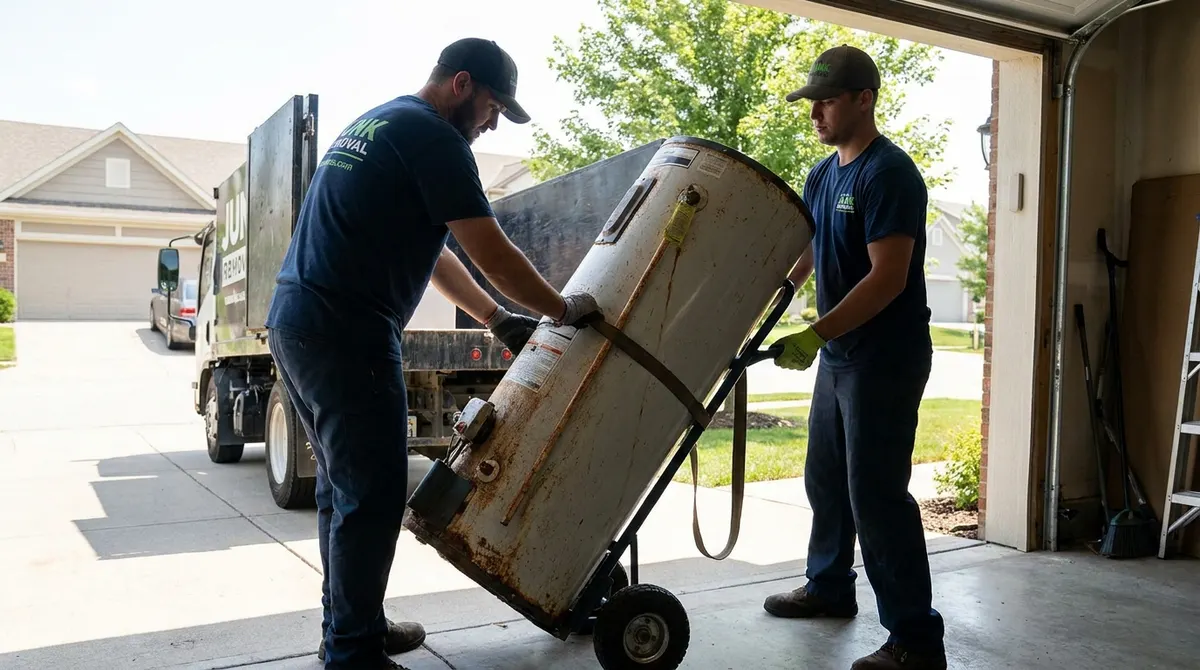
A drained water heater goes to a scrap metal recycler, a transfer station, or a haul-away crew — not the curb. Our team handles the disconnected tank, the stairs, and the recycling drop, with local pickup routes covering most neighborhoods same week.
| Disposal route | Typical cost, weight and requirements |
|---|---|
| Full-service junk removal pickup | $95–$225 per tank; crew drains-ready unit is carried out, loaded and recycled; no vehicle or dolly needed |
| Scrap metal yard (self-haul) | Small payout, often $5–$20 for a steel 40–50 gal tank; requires a truck, a helper, and a drained heater |
| Municipal transfer station / landfill | Commonly $10–$40 per appliance; hours limited, proof of residency sometimes required |
| Plumber haul-away with new install | Often $30–$100 added to the install invoice; only offered when the plumber replaces the unit |
| Curbside trash collection | Not accepted under most residential collection contracts; bulky metal appliances are excluded |
| Standard 40 gal gas tank | 120–150 lbs empty; adds about 330 lbs of water if not drained |
| Standard 50 gal electric tank | 140–170 lbs empty; two-person carry on stairs |
| Tankless unit | 30–60 lbs; wall-mounted, still recycled as scrap metal |
Water heater disposal options: weight, cost, and effort
Water heater disposal begins with shutting off the fuel supply and draining the tank
Gas heaters need the gas valve closed and the union disconnected; electric heaters need the breaker off and the wiring capped at the junction box. Cold-water inlet is shut next, then a garden hose runs from the drain valve to a floor drain or outside. A 50 gallon tank takes 15–30 minutes to empty and sheds roughly 400 pounds of water in the process. A drained tank is safe to tip and dolly; a full one is not. Sediment-heavy tanks drain slowly, and opening a hot-water tap upstairs speeds the flow by breaking the vacuum.
Water heater weight makes a two-person carry-out the standard for stairs and tight utility closets
Empty steel tanks run 120–170 pounds for common 40–50 gallon residential sizes, and 75 gallon or commercial units exceed 250 pounds. The load is tall, top-heavy, and awkward against basement stair rails and door frames. Appliance dollies with strap systems and stair-climber wheels are the normal tool. Most single-person removal attempts stall at the first stair turn, which is where wall damage and back injuries happen. Full-service crews price these carry-outs by distance and stair count rather than by tank size alone.
Water heater tanks are recyclable steel, which keeps them out of the landfill
The outer jacket, inner tank, and fittings are steel; the burner assembly and connectors contain copper and brass. Scrap yards accept drained tanks as light iron or shred steel, typically without removing the fiberglass or foam insulation. Payouts are modest — often **$5 to $20** at prevailing light-iron rates — because the insulation is dead weight. Recycling is still the preferred endpoint: a single 40 gallon heater diverts well over 100 pounds of metal, and reputable haulers route appliances to a scrap facility rather than a landfill by default.
Water heater removal cost is driven by carry distance, stairs, and whether the unit is already disconnected
Full-service pickup commonly lands between **$95 and $225** for one drained tank at ground level or up one flight of stairs. Prices climb for a second heater, a basement with a narrow bulkhead exit, or a unit still connected to gas and water lines that a licensed plumber should disconnect. Adding the heater to a larger load — old furnace, water softener, garage clear-out — usually lowers the per-item rate, because pricing follows truck space and labor time. These figures are ballparks; the exact number is confirmed in writing during a free on-site look.
Water heater disposal rules exclude curbside pickup in most residential collection contracts
Municipal haulers classify water heaters as bulky metal appliances, and standard collection carts and rear-loader trucks are not rated for them. Some cities run a bulk-item day or an appliance amnesty weekend with a per-item fee and a scheduling requirement. Leaving a tank at the curb without an approved appointment is the common trigger for a non-collection notice or a code citation for illegal dumping. Verifying the current bulk-item policy with the local solid waste department before setting anything out is the safe step.
Reddit threads on water heater disposal repeat two practical warnings
Homeowners on r/HomeImprovement frequently describe the same surprise: the tank felt manageable until they realized it had not fully drained, because sediment blocked the drain valve. The spec fact behind it — 40 gallons of water weighs about 330 pounds — explains why partial draining turns a 150 pound job into a 400 pound one. Threads on r/Plumbing repeat a second point: replacing plumbers will often haul the old unit, but standalone disposal is rarely part of their service, which leaves homeowners with a disconnected tank sitting in the basement. That gap is what appliance haul-away service exists to close.
Full-service water heater haul-away handles the lifting, the truck, and the recycling drop
Done-for-you removal means a two-person crew arrives with an appliance dolly and a truck, protects the stair treads and door frames, carries the drained tank out, sweeps the area, and delivers the unit to a scrap metal recycler. Same-day and next-day slots are common when a route has open capacity, and pickups are usually booked in two-hour arrival windows. Homeowners keep the plumbing disconnection with a licensed plumber and hand off everything after that. Pricing is quoted on-site before any work starts, so there is no guesswork once the crew sees the access route.