How Do You Get Rid of an Old Piano? — Complete Guide
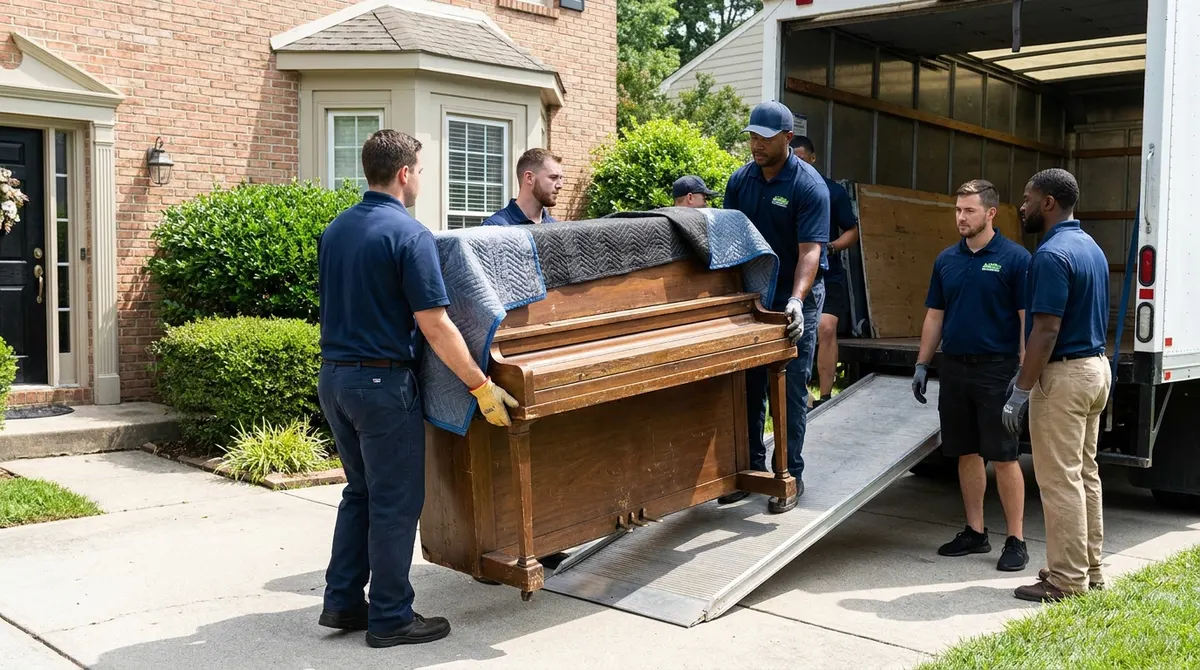
Old pianos come out fastest with a crew: plan on roughly $250-$600 for an upright and $450-$1,000+ for a grand, with the exact figure confirmed on a free on-site visit. {{business_name}} does the lifting, the stairwell work, and the disposal for {{city}}, {{state}} households.
| Piano type and typical weight | What removal usually involves | Typical market range |
|---|---|---|
| Spinet upright, 300-400 lbs | Two movers, dolly, straight ground-floor exit | $225-$450 |
| Console or studio upright, 350-600 lbs | Two to three movers, door jamb protection, ramp to truck | $275-$600 |
| Full-size / player upright, 500-800 lbs | Three movers, piano board, action often removed to cut weight | $400-$750 |
| Baby grand, 500-650 lbs | Legs and lyre detached, body strapped to a piano skid | $450-$800 |
| Grand or semi-concert grand, 700-1,200 lbs | Four movers, skid board, wide-path or door removal | $650-$1,200+ |
| Any piano, one flight of stairs | Controlled stair descent, extra crew member | Add $100-$250 |
| Any piano, basement or narrow turn | Slow descent, temporary railing or door removal | Add $150-$300 |
Piano type, typical weight, and market-range removal cost
Old piano removal starts with a weight estimate and a doorway measurement
Weight and exit path decide the job, not the piano's age. Spinets start near 300 lbs, console and studio uprights run 350-600 lbs, and grands range from about 500 lbs for a baby grand to 1,200 lbs for a semi-concert instrument. Crews measure the narrowest point on the path out — usually a doorway at 30-32 inches or a stair landing — before quoting. Uprights travel upright on a four-wheel dolly or piano board; grands are laid on their bass side on a padded skid after the legs and lyre are unbolted. A quick photo of the piano and the front door is often enough for a ballpark, and the exact price is confirmed on a free on-site visit.
Piano donation works only when the instrument still holds pitch
Schools, churches, and community theaters accept donated pianos selectively, and most decline instruments that no longer hold tune. Piano technicians commonly treat an old upright as uneconomical when needed repairs — pin block, soundboard cracks, or a full restringing — exceed roughly $1,500 to $2,500 on an instrument with little resale value. Pianos built before about 1900, or any piano stored in a damp basement or unheated garage, are the most likely to be refused. Donation also does not solve the moving problem: the donor is normally responsible for transport, which is the same lift a removal crew performs. Calling two or three potential recipients first is reasonable; when the answer is no, paid removal is the clean ending.
Curbside and bulk-trash programs almost never accept a piano
Municipal bulky-item collection is built for mattresses, couches, and appliances, and most programs cap items by weight or explicitly exclude pianos and organs. A piano left at the curb usually stays at the curb, and it can draw a code-enforcement notice for the property owner. Transfer stations and landfills generally do accept pianos as bulky waste, priced by weight at market rates in the range of roughly $50-$130 per ton plus a minimum gate fee. Getting the piano to that scale is the real cost — a pickup bed rarely handles a 600 lb upright safely. A hauling crew combines the lift, the truck, and the disposal fee into one price.
Piano removal cost is driven by stairs and path width, not by the keyboard
Two identical uprights can differ by $300 in price based purely on where they sit. A ground-floor living room with a straight shot to the driveway is the cheapest scenario. Each flight of stairs typically adds $100-$250, and a basement walk-up or a hard 90-degree landing turn adds $150-$300. Other price drivers include gravel or steep driveways that keep the truck far from the door, narrow interior doors that must be unpinned, and second-floor apartments without elevator access. Crews quote flat rates rather than hourly for heavy single items, so the number given on site is the number paid.