How Do You Dispose of a Treadmill or Exercise Equipment? — Complete Guide
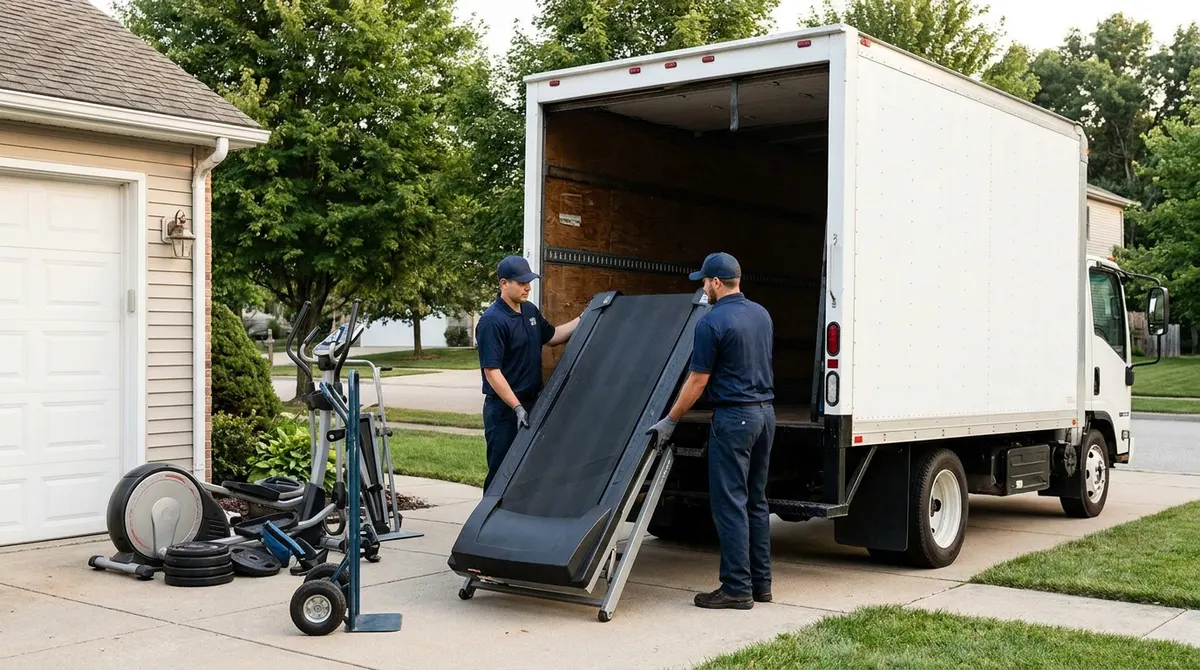
Treadmill disposal usually costs $100–$250 per machine, done for you. Rather than dragging a 250 lb deck up basement stairs, our local junk removal crew unplugs it, breaks it down, carries it out, and routes the steel and motor to a nearby scrap recycler.
| Equipment | Typical Weight | Ballpark Removal Range |
|---|---|---|
| Folding treadmill | 150–220 lbs | $100–$180 |
| Non-folding / commercial-grade treadmill | 250–400 lbs | $150–$275 |
| Elliptical trainer | 150–250 lbs | $110–$200 |
| Spin bike or upright exercise bike | 60–130 lbs | $85–$150 |
| Rowing machine | 60–90 lbs | $85–$140 |
| Multi-station home gym / cable machine | 300–500 lbs | $175–$350 |
| Weight bench plus plate or dumbbell set | 200–600 lbs total | $150–$350 |
| Full basement gym (3+ machines and weights) | 800–1,500 lbs | $300–$600 |
Exercise equipment weights and ballpark removal price ranges (confirmed on a free on-site visit)
Treadmill disposal begins with unplugging the unit and removing the safety key
A treadmill is disposed of in four steps: unplug the power cord, remove the safety key, fold and lock the deck if the frame allows it, and detach the console arms or handrails where bolted. Removing the console and side rails on a non-folding treadmill often cuts the carry width by 8–12 inches, which matters in stairwells and standard 30-inch doorways. Belts and decks are not recyclable curbside, but the steel frame, motor, flywheel, and electronics are separated at a scrap or e-waste facility. A crew handling the machine brings hand tools, straps, and a stair-capable dolly, so nothing gets disassembled by the homeowner.
Exercise equipment weight is the reason most curbside programs refuse treadmills
Municipal bulky-item programs commonly cap single items around 100–150 lbs and one to four items per collection, which places a 250–300 lb treadmill outside the accepted list in many service areas. Trash crews also decline items that cannot be lifted by two people or that contain motors and circuit boards. **Setting a treadmill at the curb without an approved bulky-item ticket can trigger a code citation in many municipalities.** The practical routes are a paid heavy-item pickup, a self-haul trip to a transfer station that charges by weight, or a scrap yard drop-off if the machine is fully stripped.
Treadmill removal pricing depends on stairs, access, and total item count
Single-item treadmill removal generally falls in the $100–$250 range, and a full basement gym with machines plus plates typically lands between $300 and $600. Three factors move the number: a flight of stairs, a long carry from a back bedroom or detached garage, and how much volume the load occupies in the truck. **Adding a second or third machine to the same visit usually costs less per item than booking two separate trips.** Prices are ballparks that reflect the local market; the exact figure is confirmed on a free on-site visit before work begins, and full-load pricing is outlined on the main junk removal service page.
Home gym recycling routes the steel frame, motor, and weight plates by material
A dismantled treadmill separates into three recyclable streams: steel and aluminum frame components, a DC motor with copper windings, and a console board handled as e-waste. Cast-iron weight plates and dumbbells are clean scrap and are among the highest-value items in a gym cleanout. Rubber belts, plastic shrouds, and foam grips are the portion that still goes to the landfill, which is typically a small share of a machine's total weight. **Scrap yards buy by the pound, so heavy iron plates and steel racks are the pieces most likely to be diverted rather than dumped.**
Exercise equipment donation applies only to working, reasonably current machines
Charities, schools, and gyms accept treadmills and ellipticals that power on, hold speed, and show no frayed belts or cracked decks. Most donation programs decline machines older than roughly 10 years, units with error codes, and anything missing a safety key or power cord, largely because of liability and repair cost. Free weights, benches, and racks are accepted far more often than motorized cardio equipment. **Donation centers rarely pick up heavy items themselves, so transport is usually the homeowner's responsibility.** A removal crew can drop a working machine at a donation site and haul the rest of the load in the same trip.
Same-day treadmill pickup covers the lift from a basement or second-floor room
Same-day and next-day heavy-item pickup is commonly available when a slot is open, and a single treadmill from a finished basement is typically a 20–40 minute job for a two-person crew. The service is done-for-you: the machine is disconnected, partially disassembled if needed, wrapped or padded at tight corners, carried out, loaded, and hauled. Floors and door casings are protected during the carry, and the removal area is swept before the crew leaves. Homeowners who prefer to disassemble and self-haul can rent a truck and pay transfer-station scale fees instead; the paid pickup exists for people who do not want to move 300 lbs up stairs.