How Do You Dispose of an Old Grill? — Complete Guide
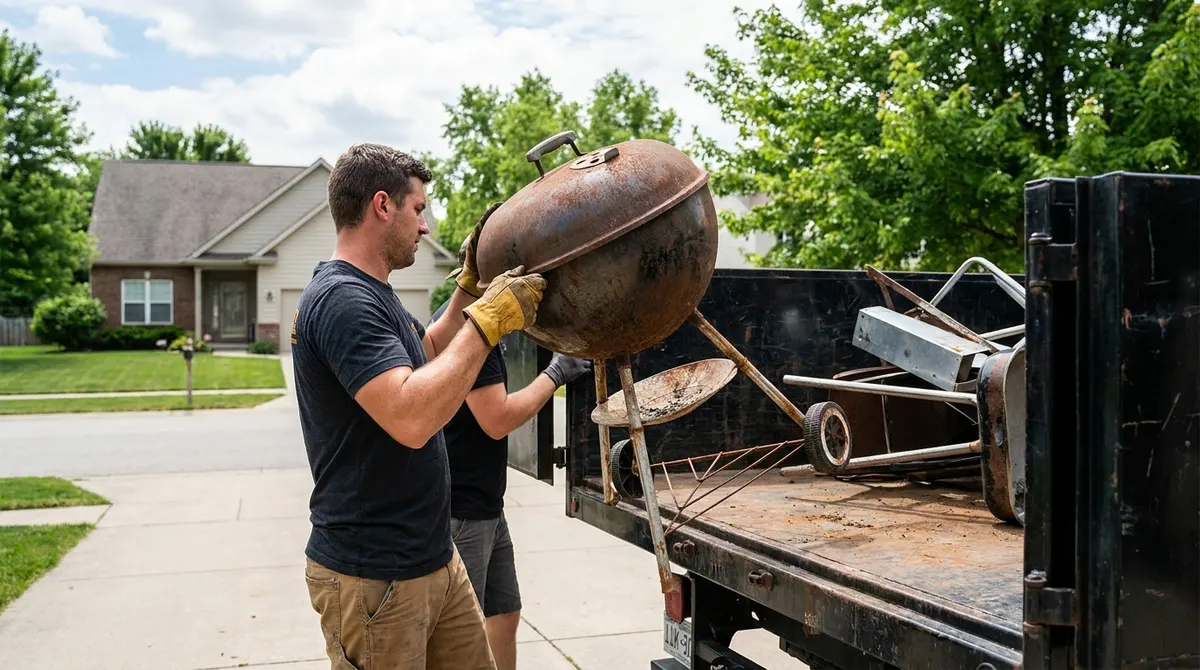
Old grills are disposed of in two parts: the propane tank goes to an exchange or hazardous waste site, and the steel body goes to scrap metal recycling. Our local junk removal team does the disconnect, lift, and hauling in one visit.
| Grill type | Typical weight | Correct disposal path | Typical full-service removal cost |
|---|---|---|---|
| Portable/tabletop propane grill | 20–40 lbs | Tank detached; body to scrap metal | $95–$135 (single-item minimum) |
| Standard 2–3 burner gas grill | 80–150 lbs | Tank detached; steel cart and firebox to scrap | $110–$175 |
| Large 4–6 burner stainless grill | 200–300 lbs | Two-person lift; stainless and cast iron to scrap | $150–$250 |
| Kettle or barrel charcoal grill | 15–70 lbs | Cooled ash bagged; steel body to scrap | $95–$135 |
| Kamado/ceramic cooker | 180–400 lbs | Two-person lift; ceramic to C&D, metal bands to scrap | $175–$300 |
| Built-in or island grill | Varies (plus masonry) | Cut-out and demo; metal to scrap, block to debris load | Quoted on site |
| Grill plus patio set or deck junk | Mixed load | Sorted at the yard; metal separated | $175–$400 by volume |
Grill types, typical weights, and disposal paths
Old grill disposal starts with detaching the propane tank as a separate item
The propane tank is the one part of a grill that cannot ride along with the rest of the metal. Full, partial, and even "empty" 20 lb tanks still hold residual vapor under pressure, so landfills, transfer stations, and haulers reject them in mixed loads. Three legal outlets exist: a cylinder exchange cage at a hardware or grocery retailer, a propane dealer that accepts old cylinders for recertification or scrapping, and a household hazardous waste facility or collection event. Close the valve, disconnect the regulator hose, and store the tank upright and outdoors until drop-off. Crews that remove grills routinely set the tank aside and note it for the customer rather than loading it.
Gas grill bodies are mostly scrap steel and get recycled instead of landfilled
A gas grill is a metal appliance in disguise. The cart, firebox, lid, side shelves, and burners are steel, stainless, aluminum, or cast iron, and scrap yards accept all of it. Roughly 70 to 90 percent of a typical gas grill by weight is recyclable metal. The non-metal remainder is small: plastic side tables, wheels, knobs, ignition wiring, and ceramic briquettes. Recycling is why a grill costs less to remove than a couch of the same bulk — the material has a scrap outlet rather than a per-ton landfill tipping fee. Homeowners who want to handle it themselves can load the body into a pickup and drop it at a scrap yard, which pays market rates by the pound; those rates fluctuate and rarely exceed pocket change on a single grill.
Charcoal grill removal requires ash that is fully cooled and bagged
Charcoal ash stays hot far longer than it looks. Embers can hold ignition temperature for 24 to 48 hours inside an insulated kettle or ceramic cooker, which is why haulers and transfer stations treat warm ash as a fire hazard in an enclosed truck body. The safe standard is to let ash sit 48 hours, or douse it with water, then seal it in a metal container before pickup day. Once the grill is cold and empty, the steel bowl, lid, legs, and grate go straight to scrap. Ash itself is not recyclable and belongs in regular household trash in a sealed bag.
Junk removal pricing for a single old grill sits at the minimum-load tier
Most junk removal pricing is volume-based, and one grill occupies a small fraction of a truck — so it prices at the company's single-item or minimum-load rate rather than by cubic yard. That minimum generally falls between $95 and $175 nationally, covering the labor, the truck, the disposal fee, and the metal recycling drop. Adding items in the same visit is where the value shifts: a grill plus a rusted patio set, a broken umbrella, and a stack of deck boards often lands in the $175 to $400 range while costing far less per item. These figures are honest market ballparks, not fixed quotes — the exact price is confirmed after a free on-site look at the grill's size, location, and access path.
Curbside and bulk trash pickup accept grills only under narrow conditions
Many municipal collection programs will take a grill, but almost never as a normal weekly setout. Common conditions include an advance appointment for bulk or large-item pickup, a strict limit on items per collection, a requirement that the propane tank be removed and shown as detached, and a weight or dimension cap that rules out large stainless units and kamados. Some programs exclude metal appliances entirely and direct residents to the scrap metal bay at the transfer station instead. Verifying the rule with the local solid waste department before dragging 150 pounds of steel to the curb prevents a tagged, rejected item sitting out for a week.
Heavy grills and kamado cookers need two-person lifting and a protected path
Weight, not bulk, is what makes grill removal go wrong. A six-burner stainless grill can reach 300 pounds, and a large ceramic kamado runs 180 to 400 pounds with a body that cracks if it is dropped or tipped. Anything over roughly 100 pounds is a two-person lift, and ceramic cookers should come out of the base or nest rather than being rolled. Back deck stairs, gravel side yards, gate widths under 36 inches, and second-story balconies all add labor. Crews plan the exit path first, use a dolly or straps on stairs, and lay protection over finished flooring and deck boards.