How Do You Dispose of Old Tires? — Complete Guide
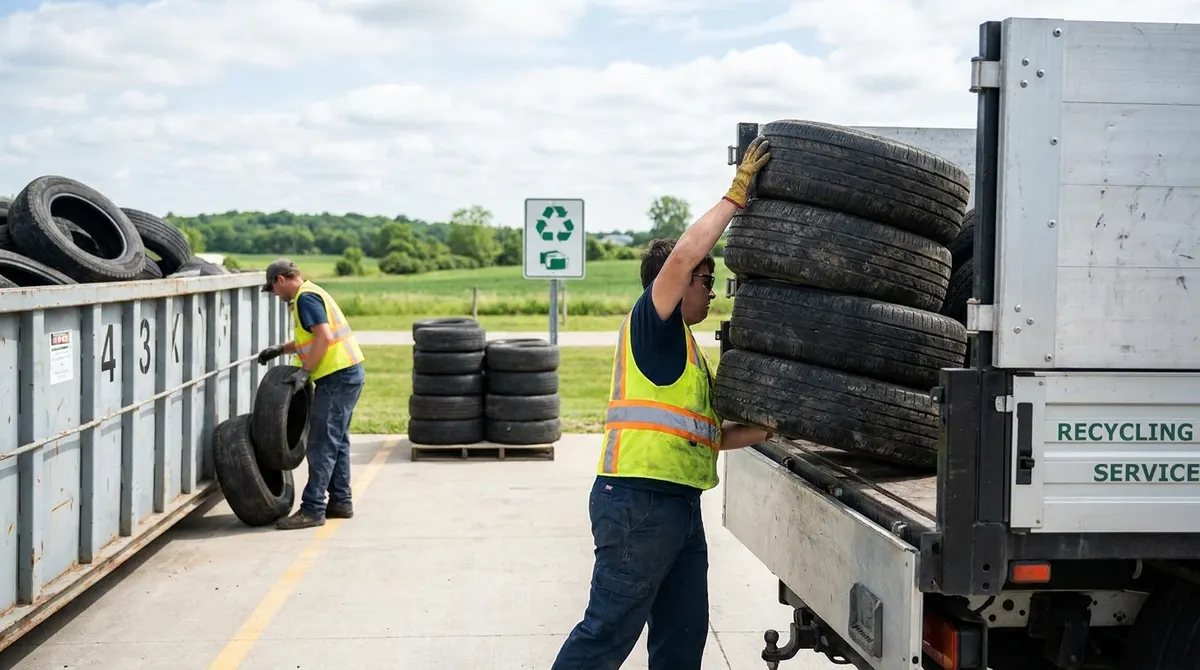
Old tires are disposed of through a tire retailer, a scrap-tire transfer station, or a full-service haul-away — not curbside trash. Our local junk removal team loads and hauls tires to permitted recyclers, with per-tire fees quoted up front and confirmed on a free on-site visit.
| Tire type | Typical disposal fee range (per tire) |
|---|---|
| Passenger car tire, off rim | $3 – $8 |
| Passenger car tire, still on rim | $5 – $12 |
| Light truck / SUV tire | $10 – $25 |
| Commercial truck tire (semi) | $20 – $45 |
| Tractor, skid steer, or ag tire | $30 – $100+ |
| Full-service pickup (crew loads and hauls) | $125 – $175 minimum, then per-tire or per-load |
Typical scrap tire disposal fee ranges by tire type (market ranges — exact pricing confirmed on site)
Scrap tire disposal starts with a landfill ban, not a trash can
Whole tires are prohibited from most municipal landfills and from curbside garbage collection. The reason is physical: buried tires trap air, float back to the surface, and hold water that breeds mosquitoes. Scrap tires are instead routed to permitted processors that shred them into tire-derived fuel, crumb rubber for athletic fields and playground surfacing, or rubberized asphalt feedstock. **Placing tires beside a curbside cart usually results in a non-collection tag, not a pickup.** Anyone with more than a handful of tires needs a disposal path that ends at a licensed recycler.
Tire retailer take-back handles small counts for a per-tire fee
Tire shops, auto service centers, and dealerships accept scrap tires because they already pay a hauler to empty their tire cage on a route schedule. Buying replacement tires almost always includes a disposal line item of roughly $3 to $8 per passenger tire. Drop-offs without a purchase are accepted at many shops for a similar fee, though counts are often capped at four to ten tires per visit. Shops charge more when a tire arrives mounted, because dismounting is labor. **Calling ahead confirms both the per-tire fee and the daily limit before loading a vehicle.**
Transfer stations and county collection events accept scrap tires with limits
County transfer stations and solid waste convenience centers commonly accept passenger tires for a posted per-tire charge, frequently in the $2 to $6 range, with a per-visit cap such as four or eight tires. Many counties also run seasonal amnesty or cleanup events where residents drop a limited number of tires at no charge or reduced charge. Rims are usually accepted separately as scrap metal. Proof of residency is often requested. These options fit a homeowner with a few tires and a truck, and they require hauling the load personally.
Junk removal pickup covers large tire piles and on-rim loads without lifting
Full-service junk removal is the practical route for tire counts that exceed shop and transfer station limits — barn cleanouts, rental property piles, shop closures, or fifty tires stacked behind a garage. A two-person crew loads from wherever the tires sit, including basements, tree lines, and mud, and delivers them to a permitted scrap tire processor. Pricing works as a minimum charge plus a per-tire or per-load rate, so a 10-tire pile and a 60-tire pile are quoted differently. **On-rim tires and tractor tires carry higher rates because of weight and processing cost.** Same-day service is often available when a truck is already routed nearby.
Illegal tire dumping carries fines that exceed disposal cost by a wide margin
Dumping tires on vacant land, in a ravine, or behind a business is an environmental violation in every state, and enforcement is common because tires are traceable to sizes, brands, and DOT codes. Penalties frequently start in the hundreds of dollars per tire and escalate with volume, plus cleanup cost billed back to the responsible party. Property owners who inherit a dumped pile are generally responsible for removing it. **Paying $5 to $15 per tire for legal disposal is dramatically cheaper than any citation.** A hauler that provides a receipt or disposal record creates documentation of lawful handling.
Tire recycling costs are driven by size, rim status, and count
Four variables set the price of tire disposal: tire diameter, whether the rim is still mounted, total quantity, and access to the pile. Passenger tires off rims are the cheapest unit to move. Tires still on steel or alloy rims cost more per unit unless the rims stay for scrap metal recovery. Volume works in the customer's favor per tire — a 40-tire job usually prices lower per tire than a 6-tire job because one trip covers both. Foam-filled, ag, and off-road tires are the highest-cost category, since some processors charge by weight.
Reddit tire disposal threads flag surprise fees and shop refusals
Paraphrasing a recurring complaint in r/junkremoval and r/MechanicAdvice: people show up at a tire shop with eight tires from a project car, get turned away or quoted far more than expected, and end up storing the tires for months. A second paraphrased concern from r/HomeImprovement is the assumption that bulk trash day covers tires, which it typically does not. **Both problems come down to a limit, not a price** — most shops cap drop-offs at a small daily count. A scheduled haul-away removes the count limit entirely and settles the fee before the truck arrives.
Local specifics
Scrap tire rules are set at the state level and administered locally, so three details are worth confirming before any tire job: whether the county transfer station charges per tire or by weight, what the per-visit tire cap is, and whether a seasonal amnesty collection event is scheduled. Most states fund tire recycling through a small fee collected at the point of new tire sale, which is why retailers accept scrap tires as part of routine business. Rural properties in this market tend to generate the largest piles — old barns, equipment sheds, and long-held acreage often hide 30 to 100 tires under brush, including tractor and implement tires that no drop-off site will take by the trunkload. Access is the real cost variable on those jobs: a pile at the end of a gravel two-track takes longer to clear than a stack in a paved driveway. On-site visits are free, and the quote accounts for tire count, rim status, and how far the crew walks each tire to the truck.
Related questions
Can old tires go in a dumpster rental?
Most dumpster rental agreements prohibit tires and charge a per-tire penalty, often $25 to $75 each, if tires are found in the load. Tires need a separate scrap tire route.
How much does it cost to remove tires from a property?
Full-service tire removal generally starts at a $125 to $175 minimum, then prices per tire or per load. Larger piles cost less per tire because one trip covers the whole job.
Do tires need to be off the rim for disposal?
Off-rim tires cost less to dispose of, but mounted tires are accepted. Rims are handled as scrap metal, which sometimes offsets part of the disposal charge.
What happens to recycled tires?
Scrap tires are shredded into tire-derived fuel, crumb rubber for turf fields and playground surfacing, rubberized asphalt, and molded products such as mats and mulch.
How many tires can be dropped off at a transfer station at once?
Per-visit caps of four to eight passenger tires are common, with residency proof requested. Counts above the cap are better handled by a scheduled haul-away.