Junk Removal in Naperville: What You Need to Know — Complete Guide
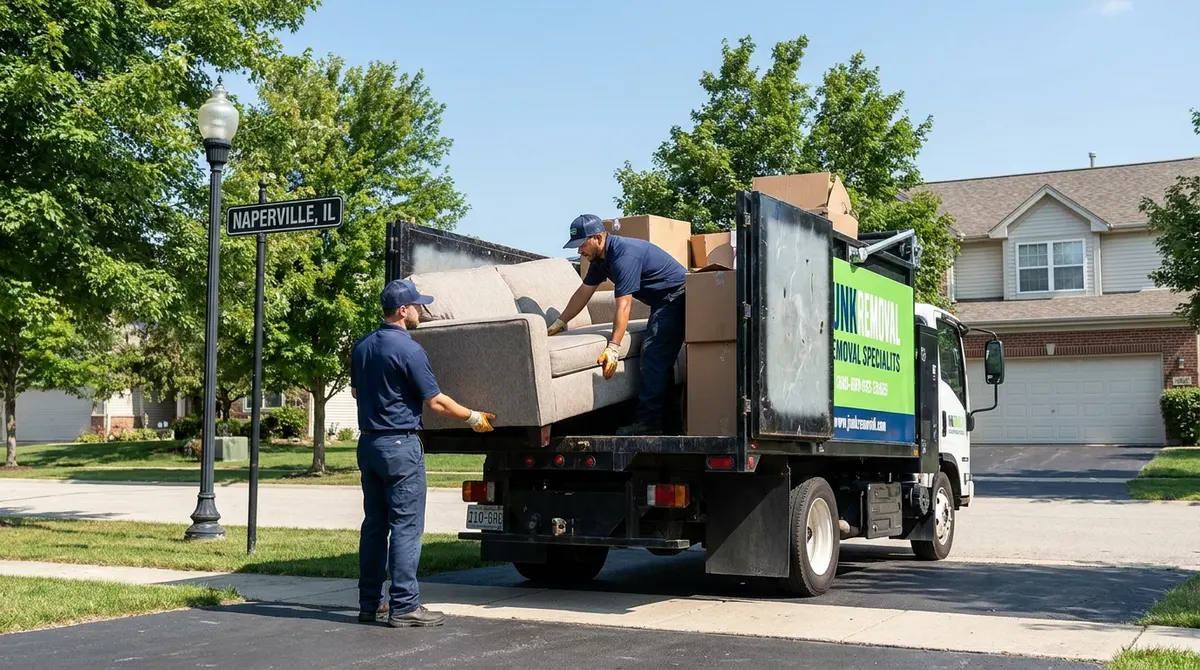
Junk removal in Naperville is priced by truck volume — roughly $150–$250 for a quarter load up to $500–$700+ for a full truck — and the crew does the lifting. Our Naperville team works both the older streets near the Riverwalk and the newer subdivisions south of 75th Street.
| Load size | Approximate volume | Naperville price range | What that usually looks like |
|---|---|---|---|
| Single item | 1–2 cubic yards | $75–$150 | One sofa, one treadmill, one refrigerator, or a mattress set |
| Quarter truck | 3–5 cubic yards | $150–$250 | A cleared-out spare bedroom or a one-car garage bay |
| Half truck | 7–9 cubic yards | $300–$450 | A finished basement rec room or a full two-car garage |
| Three-quarter truck | 11–13 cubic yards | $400–$575 | Whole-basement cleanout with shelving and old furniture |
| Full truck | 15–18 cubic yards | $500–$700+ | Estate cleanout, downsizing move, or a gutted rental unit |
| Appliance with refrigerant | Counted as single item | $95–$175 | Refrigerator, freezer, or window A/C requiring refrigerant handling |
Typical junk removal load sizes and Naperville price ranges (ballpark — confirmed on a free on-site visit)
Junk removal in Naperville is priced by truck volume, not by the hour
Junk removal companies quote by how much space a load takes up in the truck bed. A standard junk removal truck holds 15–18 cubic yards, and the price scale moves in quarters of that truck: quarter load, half load, three-quarter load, full load. Labor, dump fees, and disposal are folded into the volume price, so a crew spending 90 minutes carrying boxes up basement stairs costs the same as a crew that spends 20 minutes on a curbside pile of equal size. Two charges sit outside the volume grid in most of DuPage County: appliances holding refrigerant, and heavy dense material like concrete, dirt, roofing shingles, or tile, which is billed by weight because it maxes out axle limits long before it fills the bed. Ask for the volume price and the disposal surcharges in the same sentence — that is the honest total.
Junk removal crews carry items out of Naperville basements, attics, and second-floor units
Full-service junk removal means the homeowner points and the crew lifts. Nothing needs to be dragged to the curb, disassembled, or staged in the driveway ahead of time. That matters in Naperville's housing stock: the 1920s–1950s homes around the Historic District and North Central College often have narrow stair turns, low basement headroom, and alley-only access, while the 1990s and 2000s subdivisions like White Eagle, Tall Grass, and Ashbury pair deep finished basements with long driveways. Crews take apart bed frames, sectionals, and shelving units in place when a doorway is too tight, then sweep the floor before leaving. Downtown Naperville condo buildings usually require a reserved elevator window and a certificate of insurance on file with management, so a building cleanout should be booked a few days out rather than same-day.
Junk removal appointments in Naperville often run same-day when a truck is already in DuPage County
Same-day junk removal in Naperville is realistic on most weekdays because trucks are already routed along Ogden Avenue (Route 34), Route 59, and the Diehl Road corridor near I-88. Booking a two-hour arrival window and getting a phone call when the truck is 20–30 minutes out is standard practice. Monday mornings and the first weekend after a holiday are the hardest slots to fill, and end-of-month move-out weekends around the Route 59 apartment corridor book out fastest. Realtors and estate attorneys working a closing deadline should schedule 3–5 days ahead so the cleanout is done before the final walkthrough.
Junk removal excludes household hazardous waste, which Naperville routes to Fort Hill Drive
Junk removal trucks cannot legally accept paint, solvents, motor oil, pesticides, pool chemicals, propane tanks, gasoline, or fluorescent tubes. Naperville residents have an unusual advantage here: the city hosts a permanent Household Hazardous Waste collection facility on Fort Hill Drive that accepts these materials from Illinois residents at no charge on weekends. Hours and accepted-item lists change seasonally, so residents should confirm before loading the car. Latex paint is not hazardous once fully hardened — dry it out with cat litter or a hardener, leave the lid off, and it can ride in the junk truck with the rest of the load. Tires, car batteries, and medical sharps also stay off the truck and go to their own drop-off streams.