Attic Cleanout: Cost and Process — Complete Guide
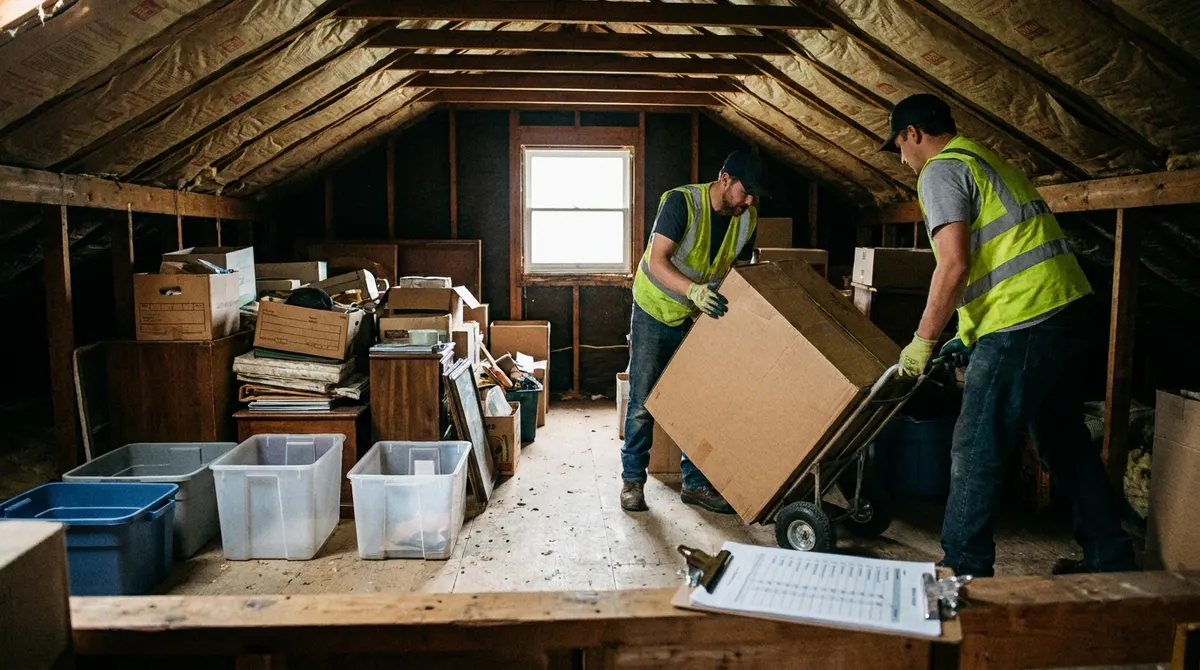
Attic cleanouts in {city} generally land between $250 and $800, with packed or full attics running higher. {brand} sends a crew that does all the climbing, lifting, and hauling — no bags carried down by the homeowner, no dump run afterward.
| Attic load size | Typical price range |
|---|---|
| Single-item or small pile (a few boxes, one mattress, holiday bins) — about 1/8 truck | $120 – $220 |
| Light attic (10–20 boxes, a chair, luggage) — about 1/4 truck | $250 – $400 |
| Average attic (stored furniture, boxes, old bedding) — about 1/2 truck | $400 – $650 |
| Full attic (decades of storage, wall-to-wall) — 3/4 to full truck | $650 – $950 |
| Estate or long-term hoard attic — multiple truckloads | $1,200 – $2,500+ |
| Attic plus loose insulation removal (add-on labor) | $1.00 – $2.50 per sq ft |
Attic cleanout cost by load size (market-range estimates, confirmed on site)
Attic cleanout pricing is measured by truck volume, not by the hour
Junk removal for attics is priced on the fraction of the truck the load fills once it is stacked at the curb. A standard removal truck holds roughly 15 cubic yards, which is about the volume of six to eight pickup-truck beds. A quarter-truck attic load — call it 15 to 20 banker boxes plus a chair and two suitcases — sits in the $250 to $400 window in most markets. A wall-to-wall attic that fills three-quarters of the truck lands closer to $650 to $950. Volume pricing protects the customer on attic work specifically, because attic labor is slow: every item travels down a ladder one armful at a time, and an hourly meter would punish the homeowner for that. **Attic access difficulty is quoted into the price up front rather than billed as a surprise.** Stairs to a third floor, a narrow hatch, or a scuttle opening under 22 by 30 inches can add $50 to $150 in labor.
Attic cleanout crews handle pull-down ladder, hatch, and knee-wall access themselves
A two-person crew brings its own lighting, dust masks, knee boards, and hand trucks, and works from the existing pull-down ladder or hatch. Crews walk on joists and decking, not on insulation, to avoid crushing R-value or cracking the ceiling drywall below. Items too wide for the hatch — a disassembled bed frame, an old console TV, a fiberboard wardrobe — get broken down inside the attic and passed through in pieces. Knee-wall storage spaces behind finished bonus rooms are reachable and commonly cleared on the same visit. **Homeowners are not asked to carry anything down; the lifting, the ladder trips, and the disposal are all part of the job.** Floors and stair treads get covered or swept on the way out.
Attic cleanout follows a five-stage process completed in one visit
Stage one is the free on-site look: the crew opens the hatch, photographs the load, and gives a firm price before touching anything. Stage two is the keep-or-go pass, where the homeowner points out anything staying — Christmas bins, family photos, a cedar chest — and those items are set aside, not removed. Stage three is extraction: boxes and furniture come down and are staged in the garage or driveway. Stage four is the sort — donatable furniture, clothing, and household goods go to a charity or reuse outlet, and metal, cardboard, and e-waste are separated for recycling. Stage five is sweep-out and haul-off, leaving bare decking and an empty truck bay. Most standard attics move through all five stages in two to four hours.
Attic cleanout items that require separate handling before removal
Several attic materials are not standard junk removal loads and are quoted or referred separately. Loose gray-brown vermiculite insulation, common in homes built before 1990, may contain asbestos and should be tested by a lab and removed by a licensed abatement contractor — not disturbed by a junk crew. Old fiberglass batts and blown cellulose are removable but are priced as insulation labor by the square foot, not as boxed junk. Paint, solvents, pesticides, and pool chemicals stored in the attic go to a household hazardous waste facility and are usually left for the homeowner to drop off or handled as a separate line item. Propane cylinders, ammunition, and fuel cans are excluded outright. **Rodent-contaminated material is bagged and sealed in the attic before it comes down through the house.**
Attic cleanout concerns raised on Reddit line up with the volume-pricing model
Homeowners on r/junkremoval regularly paraphrase the same worry: that a quote given over the phone will double once the crew sees how packed the attic actually is. The volume model is the answer to that — the binding number comes after the hatch is open and the load is visible, which is why the on-site look is free and happens before work starts. A recurring thread on r/HomeImprovement makes a different point: people underestimate the sheer trip count, with one poster describing an attic that looked like 'a few boxes' and turned into 40 ladder trips. That matches the field numbers — an average attic fills roughly half a 15-cubic-yard truck, and a two-person crew averages two to four hours on it.
Attic cleanout scheduling and same-day availability for {city} homeowners
Attic work is scheduled in arrival windows rather than exact minutes, because the job before it can run long. Same-day and next-day slots are commonly available, and mid-week mornings are the easiest to book. Summer attic work starts early: attic temperatures in an unvented roof cavity can run 30 to 50 degrees above outdoor air by early afternoon, so crews front-load hot-weather jobs before 11 a.m. Real estate deadlines, estate settlements, and insulation contractors who need a clear deck are the three most common reasons for a rush booking. Junk removal covers the cleanout and haul-off; the free estimate confirms the exact figure before any item leaves the attic.
{city}, {state} specifics
Attic cleanout economics in {city} are driven by three local factors. First, transfer station tipping fees in and around {county} generally fall in the $50 to $95 per ton range for mixed household waste, and that fee is already built into a volume quote — a full attic load of boxes, bedding, and pressed-wood furniture commonly weighs 900 to 1,600 pounds. Second, municipal bulk pickup in most {state} jurisdictions caps out at a small number of items per set-out and excludes construction debris and insulation, which is why full attics are handled by private haulers instead. Third, older {city} housing stock matters: homes built before 1990 are the ones most likely to hold vermiculite insulation or knob-and-tube wiring in the attic, and both change the scope. Vermiculite is referred out for testing and licensed abatement; exposed wiring means crews work around it rather than shifting anything on top of it. Anything donatable — dressers, lamps, sealed housewares — is routed to local reuse outlets before disposal is considered.
Related questions
How much does a garage cleanout cost?
Garage cleanouts typically run $300 to $900 depending on how much of the truck the load fills, with single-bay garages at the low end and packed two-car garages at the high end.
Will junk removal crews take old insulation?
Loose fiberglass and cellulose insulation is removable and priced by the square foot, roughly $1.00 to $2.50. Suspected asbestos-containing vermiculite is referred to a licensed abatement contractor instead.
How long does a whole-house cleanout take?
Most whole-house cleanouts take one to two full days and two to five truckloads, depending on square footage and how much furniture stays behind.