Retail Store Cleanout — Complete Guide
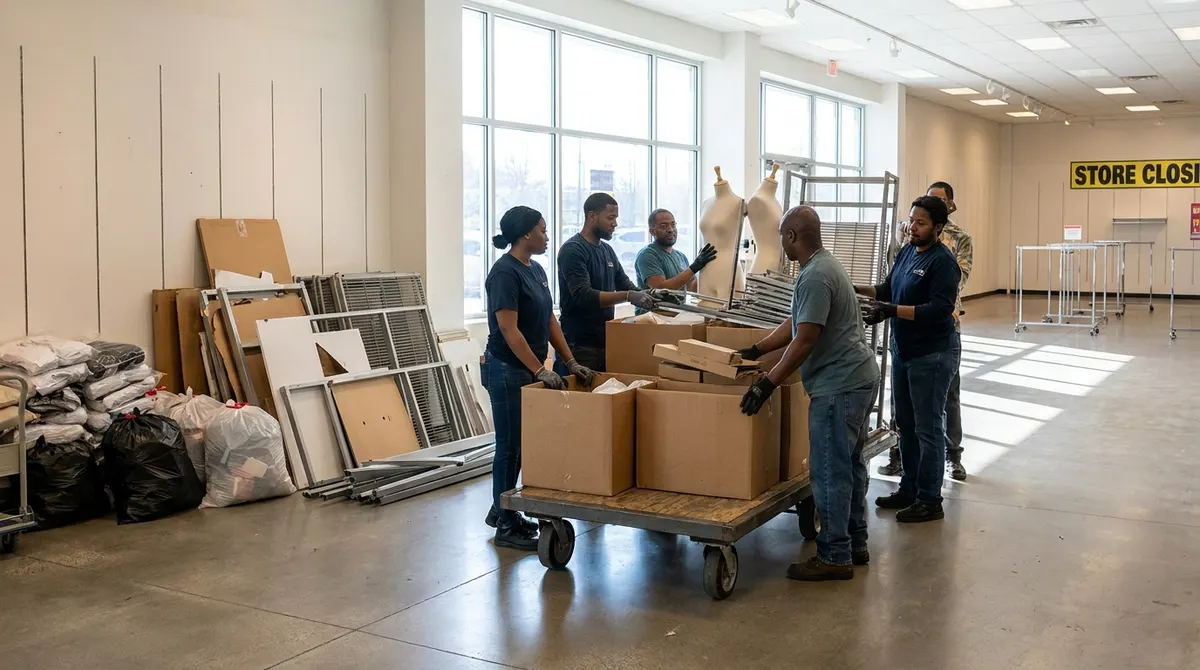
Retail cleanout costs are driven by truckload volume and fixture labor, with most mid-size stores landing between $900 and $2,500. Our team performs the full removal — shelving, counters, stockroom, and back-of-house — on the lease deadline local landlords actually enforce.
| Store size / type | Typical truckload volume | Market-range cost (confirmed on site) |
|---|---|---|
| Kiosk or mall inline unit (under 800 sq ft) | 1/4 to 1/2 truck | $250 – $500 |
| Boutique or salon (800 – 1,200 sq ft) | 1/2 to 1 truck | $450 – $900 |
| Mid-size store (2,000 – 4,000 sq ft) | 1 to 3 truckloads | $900 – $2,500 |
| Large retail / former grocery (5,000 – 10,000 sq ft) | 3 to 6 truckloads | $2,000 – $6,000 |
| Big-box or anchor space (10,000+ sq ft) | 6+ truckloads, multi-day | $3,000 – $12,000+ |
| Stockroom or back-of-house only | 1/2 to 1 truck | $300 – $750 |
| Fixture-only removal (gondolas, slatwall, racks) | 1 to 2 truckloads | $500 – $1,400 |
Retail store cleanout: floor area, typical volume, and market-range cost
Retail store cleanout pricing is set by truckload volume, not hourly billing
Junk removal companies price retail cleanouts by how much space the debris fills in an enclosed truck, then add labor for fixtures that must be unbolted or cut down. A standard removal truck holds roughly 15 cubic yards, which is about the same footprint as six pickup-truck beds stacked level. A single truckload of retail debris commonly falls in the $400 to $700 range in most markets. Volume-based quotes matter to a store owner because the number stops moving once the truck count is agreed on — a crew that hits an unexpected 30 feet of bolted shelving does not restart the clock. Heavy or awkward categories carry separate line items: safes, walk-in cooler panels, commercial mop sinks, and CRT security monitors are the four that most often add cost. Ask for the quote in truckloads plus itemized adders, and the invoice becomes predictable.
Retail cleanout timelines are built backward from the lease-surrender date
Most commercial leases require the tenant to return the unit in broom-clean condition by the final day of the term, and landlords hold the security deposit until that condition is met. A practical schedule books the cleanout 5 to 7 days before surrender, which leaves room for a second visit if the stockroom hides more than the walkthrough showed. Single-truckload boutiques are usually finished in 2 to 4 hours. A 3,000 sq ft store with full gondola runs takes most of a working day. Big-box spaces run 2 to 4 days with a multi-person crew and repeat dump trips. Same-day service is often available for smaller units when a closing date moves up unexpectedly. Booking early also protects the fixture resale window — buyers pay for shelving that is still standing and stop paying once it is a pile.
Retail fixtures — gondola shelving, slatwall, and checkout counters — create most of the volume
The sales floor, not the trash, is what fills the trucks. Gondola shelving is bolted at the base and comes apart into uprights, base decks, and shelves; a 40-foot double-sided run typically fills close to a full truckload on its own. Slatwall is screwed into studs and often pulls drywall with it, so plan for patching or negotiate the condition in writing with the landlord first. Other common loads include checkout counters and cash wraps, four-way and two-way clothing racks, mannequins and torsos, glass display cases, wall mirrors, backroom steel shelving, rolling stock carts, pallet debris, hangers by the thousand, and dead signage. Refrigerated cases and coolers require separate handling because of the sealed refrigerant. Counting your linear feet of shelving before you call gets you a far tighter quote.
Retail store cleanout crews handle the disassembly, loading, and broom-clean sweep
Full-service means the store owner points and the crew carries. Workers bring hand tools, impact drivers, dollies, floor protection, and shrink wrap; they break down fixtures, carry loads to the truck, and sweep the sales floor and stockroom before leaving. Nobody on staff lifts a shelf, and no employee rents a box truck on a Saturday. That distinction is the reason retail managers hire out this work — an in-house cleanout ties up payroll, risks a back injury on a bolted gondola upright, and usually still ends in paying for disposal at a transfer station. A done-for-you cleanout consolidates labor, transport, and tipping into one quoted figure with a scheduled window.
Retail cleanout material splits into resale, recycling, and landfill streams
Retail debris separates cleanly into three streams, and the split lowers total disposal weight. Fixtures in working condition — gondolas, glass cases, racks, and slatwall panels — hold resale value to secondhand fixture dealers and to independent retailers opening nearby. Steel shelving, aluminum rack tubing, and copper wiring go to scrap metal buyers. Cardboard and pallet wood recycle. Electronics such as POS terminals, monitors, and receipt printers route to e-waste handlers rather than the landfill. What remains is generally damaged laminate, drywall from slatwall removal, foam, and mixed trash. Unsold inventory can often be donated to a local nonprofit, and a legitimate receipt supports a write-off — a point worth raising with your accountant before the truck is loaded.
Retail cleanout scheduling works around loading docks, mall hours, and after-hours access
Access decides the labor hours more than the pile size does. A ground-floor unit with a rear roll-up door and dedicated dock is the fastest scenario. A mall inline space that requires a long push down a service corridor to a shared dock can add hours to the same load. Second-floor space with only a passenger elevator is slower again, and freight elevators usually need a reserved window from building management. Enclosed centers commonly restrict trucking to before-open or after-close hours, so night and early-morning work is standard on retail jobs. Reserve the dock and the elevator when you book the cleanout, and confirm whether the property manager requires a certificate of insurance on file before crews arrive.