How Do You Dispose of a Propane Tank? — Complete Guide
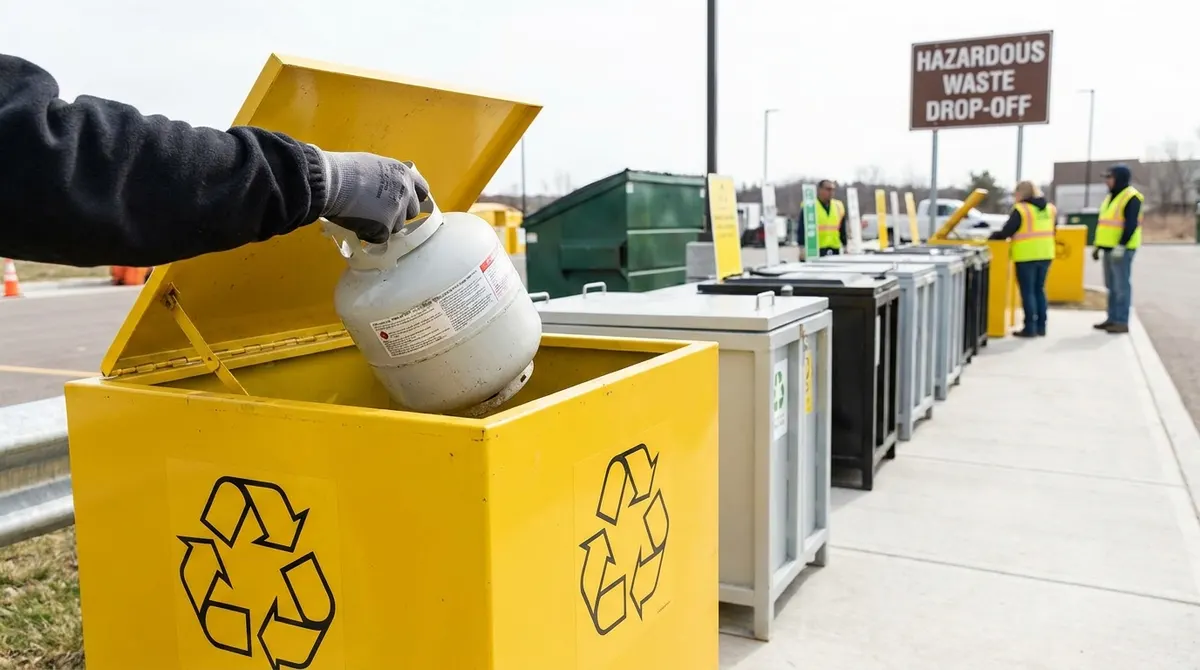
Propane tanks go to an exchange cage, a propane dealer, a hazardous waste facility, or a hauling crew — never the trash bin. Our junk removal team hauls grill cylinders, camp canisters, and large tanks with the rest of a garage cleanout in one stop.
| Tank type / size | Accepted disposal path and typical cost |
|---|---|
| 1 lb camping canister (Coleman-style) | Household hazardous waste drop-off, or puncture-and-recycle at facilities that allow it. Drop-off is usually free for residents; hauled with a load, expect a small per-item handling fee. |
| 20 lb grill tank (standard BBQ) | Exchange cage at a hardware store, gas station, or big-box retailer when buying a refill; propane dealer take-back; HHW facility. Junk removal pickup commonly $10–$40 per cylinder inside a minimum load. |
| 30–40 lb RV / forklift cylinder | Licensed propane dealer for purge and valve removal, then scrap metal. Dealer purge fees commonly $10–$30 per tank. |
| 100 lb cylinder | Propane dealer or supplier take-back; must be purged before scrap. Heavy at roughly 170 lb full — two-person lift or crew pickup. |
| 120–500 gallon residential tank | Removal by the propane supplier that owns or leases it, or a licensed hauler. Leased tanks are collected by the gas company at no purchase cost to the homeowner. |
| Rusted, expired, or unmarked tank (no valid date stamp) | Refused by most exchange cages. Route to HHW facility or hazardous-handling junk removal pickup. |
| Minimum junk removal load including tanks | About $95–$175 in most markets; small truckload with other garage items about $175–$350. Confirmed on site. |
Propane tank types, disposal path, and typical cost range
Propane tank disposal starts with reading the collar stamp and checking the valve
Every DOT-approved propane cylinder carries a manufacture date stamped into the metal collar around the valve. A 20 lb grill tank is requalified 12 years after that date, then every 5 or 10 years depending on the inspection method. A tank past its date is still exchangeable at most cages, because the retailer requalifies or scraps it — but it will not be refilled. Look at the valve too: a modern OPD valve has a triangular handwheel, and older round-handle tanks were phased out of refilling in 2002. Count the tanks, note the collar dates, and photograph the valve handles before making calls. Those three details decide which of the four disposal paths applies.
Propane tanks are banned from curbside carts and compactor trucks
**Municipal trash haulers reject propane cylinders because a tank with residual gas can ignite or rupture inside a compactor blade.** Sanitation departments and private haulers publish this restriction, and transfer station scale operators routinely turn back loads with cylinders visible in them. The same restriction covers 1 lb camping canisters, which are small enough to hide in a bag of yard debris and are a documented cause of collection truck fires. A cylinder left at the curb is usually tagged and left behind, and the tank stays the homeowner's problem for another week.
Propane exchange cages are the fastest route for a standard 20 lb grill tank
Hardware stores, grocery chains, gas stations, and home centers with a locked steel exchange cage out front accept an old 20 lb cylinder when a full one is purchased. The swap price is the refill price — commonly $20–$30 for the gas — and the old shell goes back to the distributor for requalification or scrap. Exchange only works for the standard 20 lb size with an intact OPD valve. Cages will not take 1 lb canisters, 100 lb cylinders, tanks with a sheared collar, or a cylinder with no legible stamp.
Propane dealers purge and de-valve cylinders so the steel can be scrapped
Scrap metal yards accept propane cylinders only after the valve is removed and the shell is open — proof the tank cannot hold pressure. **Removing a propane valve is a licensed-dealer job, not a DIY job**, because the threads hold liquid propane and a wrench-and-hope attempt vents fuel at the operator's face. Local propane suppliers, forklift gas dealers, and RV service shops handle purging, often for roughly $10–$30 per tank. Once purged and de-valved, a 20 lb shell is ordinary steel scrap worth a few dollars by weight.
Household hazardous waste facilities take the tanks the cages refuse
County and municipal household hazardous waste programs accept propane cylinders from residents, usually free and usually by appointment or on scheduled collection days. HHW sites are the correct destination for 1 lb camping canisters, rusted spares, unmarked tanks, and cylinders inherited with a house. Facilities cap quantities — a common limit is a handful of cylinders per household visit — and they require the tanks upright and untaped in the trunk or bed, not loose in a cabin. Hours are limited, which is the practical catch: many programs open one or two days a week.
Junk removal crews haul propane tanks as part of a garage or estate cleanout
Done-for-you pickup exists for the situation the free options do not solve: five old grill tanks, a dead mower, paint cans, and shelving all sitting in one garage bay with no truck and no appointment slot. A crew sorts the load, transports cylinders upright and secured, and routes them to a dealer or hazardous waste facility instead of the landfill. Pricing is by volume — **roughly $95–$175 for a minimum load and $175–$350 for a small truckload** in most markets — plus a common $10–$40 hazardous-handling charge per cylinder. Every figure here is a ballpark, and the exact number is confirmed during a free on-site look before anything moves. Same-day slots are often available when the crew is already routing nearby.
Propane tank complaints on Reddit center on refused loads and stuck valves
Homeowners in r/junkremoval threads describe hauling a pickup bed of cylinders to a transfer station and being turned around at the gate, then driving to three retailers before finding a cage that took an out-of-date tank. Contributors in r/HomeImprovement repeatedly warn against unscrewing a propane valve with a pipe wrench to "empty" the tank for scrap. Both concerns track the spec: **a cylinder marked empty still holds residual propane vapor under pressure until a licensed dealer purges it.** Planning the destination before loading the truck is what prevents the wasted trip.