How Do Foreclosure Property Cleanouts Work? — Complete Guide
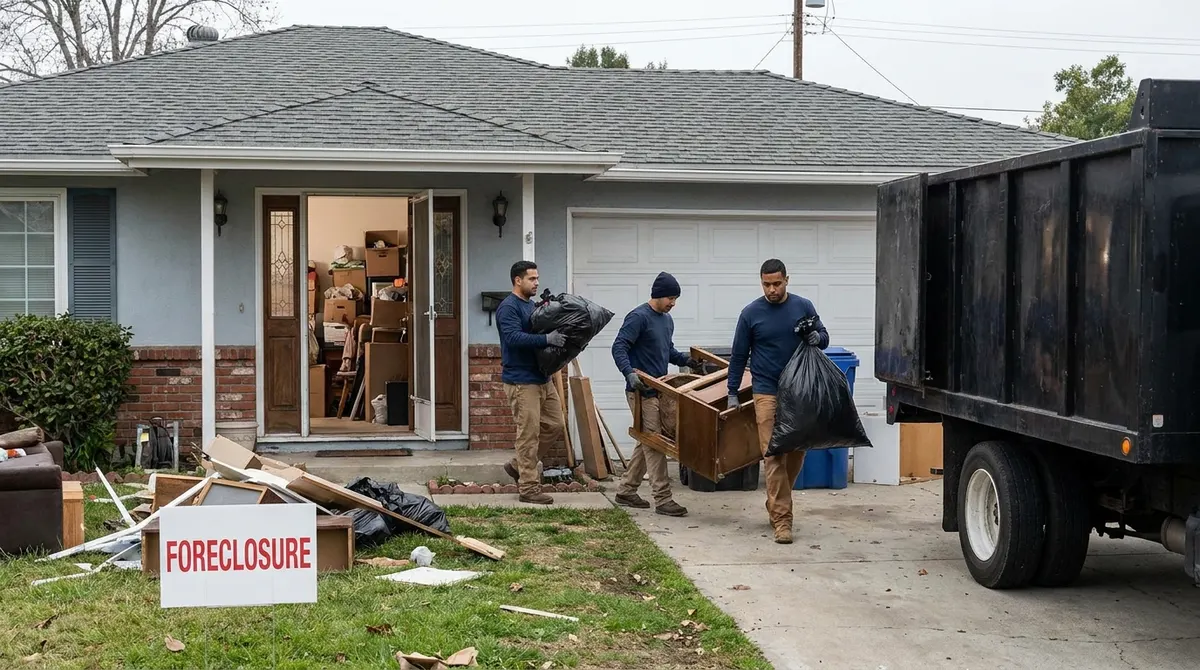
Foreclosure cleanouts are done-for-you removal: a crew clears every room, loads the truck, and leaves the house broom-swept for the lender or listing agent. [Brand] handles foreclosure and REO cleanouts across [City] and the surrounding [County] County area, usually inside one scheduled visit.
| Property / load size | Typical ballpark range |
|---|---|
| Partial cleanout — 1–3 rooms, roughly 1/4 truck | $180–$350 |
| Small condo or 1-bedroom apartment, 1/2 truck | $350–$650 |
| 2-bedroom house, 1 full truckload | $600–$1,100 |
| 3-bedroom house plus garage, 1.5–2 truckloads | $900–$2,500 |
| 4+ bedroom house, basement and shed, 3+ truckloads | $2,000–$4,500 |
| Hoarding-level or heavy-debris property | $3,000–$6,000+ |
| Add-on items (fridge, freezer, A/C with refrigerant) | $35–$75 each |
| Add-on items (mattress, box spring, tire) | $20–$45 each |
Foreclosure cleanout ballpark ranges by property size (market ranges — confirmed on a free on-site walkthrough)
Foreclosure cleanouts begin with a photo walkthrough that goes into the lender file
Step one is a walkthrough of every room, closet, garage, attic, basement, shed and yard, with photos taken before anything is touched. Banks, asset managers and REO agents almost always require dated before-and-after images to release payment, so the photo set is part of the job rather than a courtesy. During that same walk the crew counts the volume — how many pickup-truck loads of furniture, bagged trash, mattresses and appliances are actually in the building — and flags special-handling items such as paint cans, propane tanks, car batteries and loose tires that landfills refuse in mixed loads. **The walkthrough is where the price is set, and it takes about 15–30 minutes on a typical single-family home.**
Foreclosure cleanout pricing is set by truck volume, not by an hourly labor rate
Junk removal on a foreclosure is priced by how much space the debris fills in the truck, measured in fractions of a load. A standard dump-body junk truck holds roughly 15–18 cubic yards, or about six pickup-truck beds. A stripped 2-bedroom house with furniture left behind commonly fills one full truck at $600–$1,100; a lived-in 3-bedroom with a packed garage runs $900–$2,500 across one and a half to two loads. Volume pricing includes the labor, the stairs, the tailgate loading and the disposal fee, which is why it does not climb when a stuck sofa or a nailed-down bunk bed slows the crew down. Hourly quotes are the exception and usually appear only on court-ordered eviction standbys.
Foreclosure cleanouts wait on the personal-property hold before anything is hauled
Abandoned belongings are not automatically trash. Most states set a notice-and-storage window — commonly in the 10 to 30 day range — after the sale or the writ of possession, during which the former occupant may reclaim personal property. Removal is scheduled after that window closes, or after the lender, attorney or sheriff's deputy confirms the property is legally released. **Crews take direction from the lender, asset manager or attorney of record, never from a neighbor or a former tenant at the door.** Documents, photo albums, prescription bottles and firearms found mid-cleanout are set aside and reported rather than tossed, because those items generate liability claims faster than any other category.
Foreclosure cleanout crews sort the load into disposal, scrap, and donation streams
A loaded truck is rarely one destination. Metal — water heaters, bed frames, washers, dryers, grills — goes to a scrap yard. Sealed, unstained furniture and working small appliances go to a donation partner when the condition passes inspection. The rest goes to a transfer station or landfill, where tipping is billed by weight at roughly $40–$110 per ton depending on the facility. Refrigerators and window air conditioners require refrigerant recovery and carry their own $35–$75 line item. **Diverting scrap and donations lowers the weight going over the scale, which is the single biggest variable cost in a foreclosure cleanout.** Paint, solvents, pesticides and motor oil are pulled out and routed to a household hazardous waste site.
Foreclosure cleanouts end with a broom-swept, photo-documented, list-ready property
The finish line for a lender is a property that can be photographed for MLS or handed to a contractor. That means all debris removed, floors swept, sinks and tubs emptied, closets and cabinets opened and cleared, exterior debris and overgrowth piles hauled, and after-photos taken from the same angles as the before set. Deep cleaning, carpet removal, mold remediation, lock changes and lawn service are separate trades and priced separately. **Most single-family foreclosure cleanouts are completed in one 3–6 hour visit, and same-day or next-day slots are often available when the debris volume is known in advance.** Larger estates and hoarding conditions are scheduled across two or three days.
Foreclosure cleanout complaints on Reddit trace back to unmeasured volume and unclear authority
Investors on r/realestateinvesting frequently paraphrase the same regret: they budgeted for one truckload from listing photos and got billed for three after the basement and crawlspace were opened. Measuring volume on-site, not from photos, prevents that gap. Posters in r/JunkRemoval raise the other recurring issue — crews arriving before the personal-property hold expires and being turned away, or worse, hauling items a former occupant later claims. Confirming written authorization from the lender or attorney before the truck rolls resolves both. Volume verified in person plus written authorization on file is why a documented walkthrough is standard on foreclosure work.