How Do You Dispose of Yard Waste and Brush? — Complete Guide
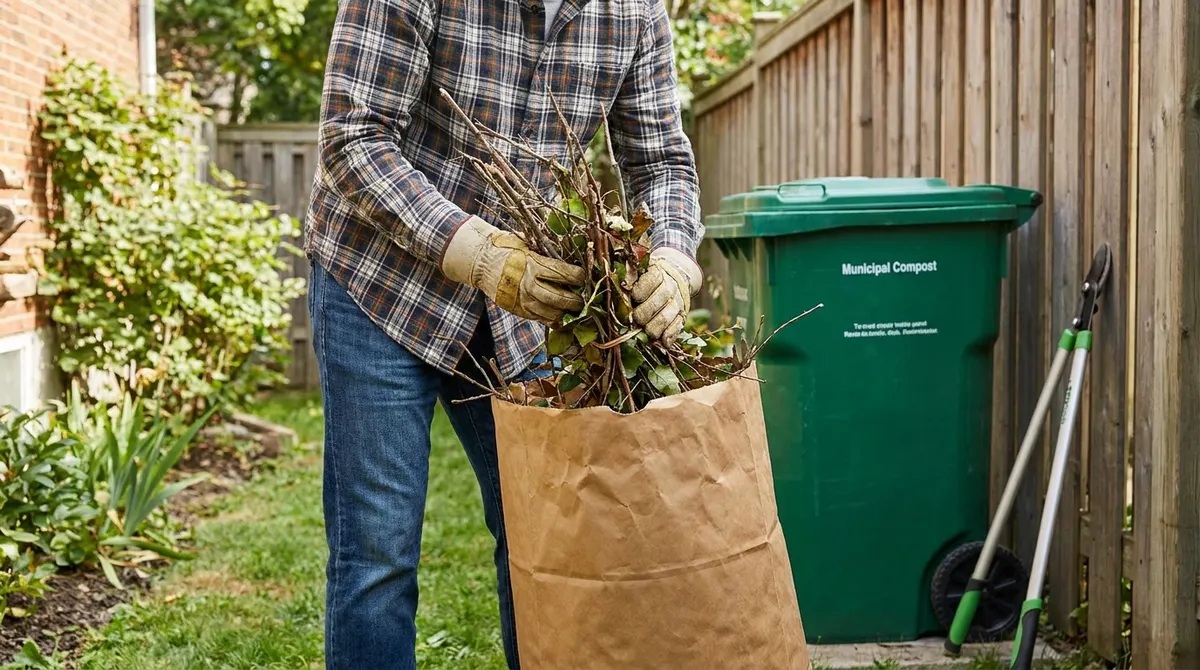
Yard waste and brush go curbside, to a green-waste site, or into a hauling truck — and crew-loaded pickup runs roughly $150 to $650 by volume. Our local hauling crew loads storm limbs, hedge trimmings, and full tear-out piles the same day, so homeowners never touch a branch.
| Load size (crew-loaded) | What it typically holds and the ballpark price |
|---|---|
| Minimum / small pile | One pickup-bed pile — about 15 to 20 contractor bags of leaves, or a single hedge trimming, roughly 4 to 6 feet across. Ballpark $95–$175. |
| Quarter truck (about 4 cubic yards) | A day's worth of pruning from 3 to 5 shrubs, or 2 to 3 medium limbs cut to 6-foot lengths. Ballpark $150–$250. |
| Half truck (about 7–8 cubic yards) | A hedge row tear-out, a small tree's canopy after a storm, or 40-plus bags of leaves and grass. Ballpark $250–$400. |
| Full truck (about 15 cubic yards) | A full backyard clearing, overgrown fence line, or storm pile mounded above a 6-foot fence. Ballpark $450–$650. |
| Multiple truckloads | Lot clearing, bamboo or vine removal, and years of accumulated brush piles. Priced per truck at the same volume rates. |
| Mixed loads (brush plus junk) | Brush combined with an old grill, fence panels, or a broken swing set — quoted as one volume, no separate trip needed. |
Brush and yard waste loads: what fits, what it weighs, and market-range pricing
Yard waste disposal starts with what curbside trucks will legally accept
Curbside yard waste collection is the cheapest disposal route and also the most restricted. Most municipal programs accept grass, leaves, and small trimmings only in paper yard bags or reusable containers, and accept brush only when it is cut into bundles under about 4 feet long, tied with twine, and kept under roughly 50 pounds per bundle. Limb diameter caps of 4 to 6 inches are common, and stumps, root balls, sod, dirt, and treated lumber are almost always excluded. Bag or bundle count per pickup is usually capped between 6 and 20. A homeowner with a 30-bundle storm pile therefore faces four or five weeks of staged sets at the curb — which is the exact point where crew hauling becomes the practical option. Verify limits with the local public works or solid waste department before cutting anything to length.
Brush disposal at a green-waste facility is priced by the yard or ton, not per trip
Green-waste and compost facilities accept clean, unmixed brush and yard debris and charge a tipping fee. Typical market rates run about $10 to $40 per cubic yard, or roughly $30 to $75 per ton, with minimum charges applied to small loads. Facilities reject loads contaminated with plastic bags, dimensional lumber, fence wire, trash, or dirt, and a rejected load usually still incurs the minimum fee. Self-hauling means the homeowner supplies the truck or trailer, a tarp, the loading labor, and two or more round trips for anything past a quarter truckload — plus fuel and the facility's weekday-only hours. **Self-haul makes sense for one small tarp of trimmings; it stops making sense at about half a truckload.**
Yard waste and brush hauling is quoted by truck volume with the loading included
Crew-loaded brush removal is priced on how much space the debris occupies in the truck after it is loaded and compacted, not on bag count or weight. That single number covers the dragging, the loading, the raking of leftover leaf litter, the transport, and the tipping fee at the disposal site. Long limbs get cut down on site so they pack tighter, which is why a 10-foot pile of loose branches often prices out lower than a homeowner expects — loose brush is mostly air. **Every price quoted before a look at the pile is a ballpark; the exact figure is confirmed in writing during a free on-site visit, before any loading begins.** Piles behind gates, up slopes, or past a long carry may sit at the higher end of a volume band because the walk adds labor time.
Storm debris and brush piles are handled same-day when the pile is already down
Same-day brush pickup is realistic for material already on the ground: cut limbs, hedge trimmings, leaf bags, uprooted shrubs, and pulled vines. A two-person crew typically clears a half-truck brush pile in 30 to 60 minutes. What slows a job down is standing wood — live trees, hanging limbs, and stumps still in the ground require a tree service or stump grinder first, and hauling crews do not climb or fell trees. **Cut it, drop it, leave it in a pile, and the haul-off happens the same day in most cases.** After a wind event, call volume spikes for two to three weeks and same-day slots fill by mid-morning, so early calls get the earlier windows.
Yard waste hauling is the paid alternative homeowners choose over 12 weekends of bundling
Homeowners on r/landscaping regularly describe the same trap, paraphrased: they cut everything down in one satisfying weekend, then discover the city takes six bundles at a time and the pile now needs three months to disappear. Contributors on r/HomeImprovement raise a second concern — hauling brush in a personal SUV or half-ton bed, where 4 cubic yards of wet green waste can run 800 to 1,200 pounds and scratched interiors and sagging suspensions follow. Both concerns land on the same spec: a 15-cubic-yard dump-body truck moves in one trip what a pickup moves in five, and the crew's hands do the loading. Full-service hauling is the trade of $150 to $650 for a cleared yard today instead of a staged curb pile all season.
Brush, sod, dirt, and stumps are disposed of on separate streams
Not everything from a yard goes to the same place, and separating it correctly protects the quote. Clean brush, leaves, grass, and trimmings go to compost or grinding for mulch. Sod, dirt, rock, and concrete are heavy materials billed by weight at aggregate or C&D facilities and are quoted separately from brush volume. Stumps and root balls need grinding or a heavy-material facility and often require equipment access. Treated lumber, pressure-treated fence panels, and railroad ties are construction debris, not yard waste, and are landfilled rather than composted. Mixed piles are the most common surprise on a yard cleanup — old fence pickets, a rusted wheelbarrow, and bagged trash buried in the brush all change the disposal route. Point them out during the walkthrough and the quote absorbs them in one load.