Shed Removal and Demolition: Cost and Process — Complete Guide
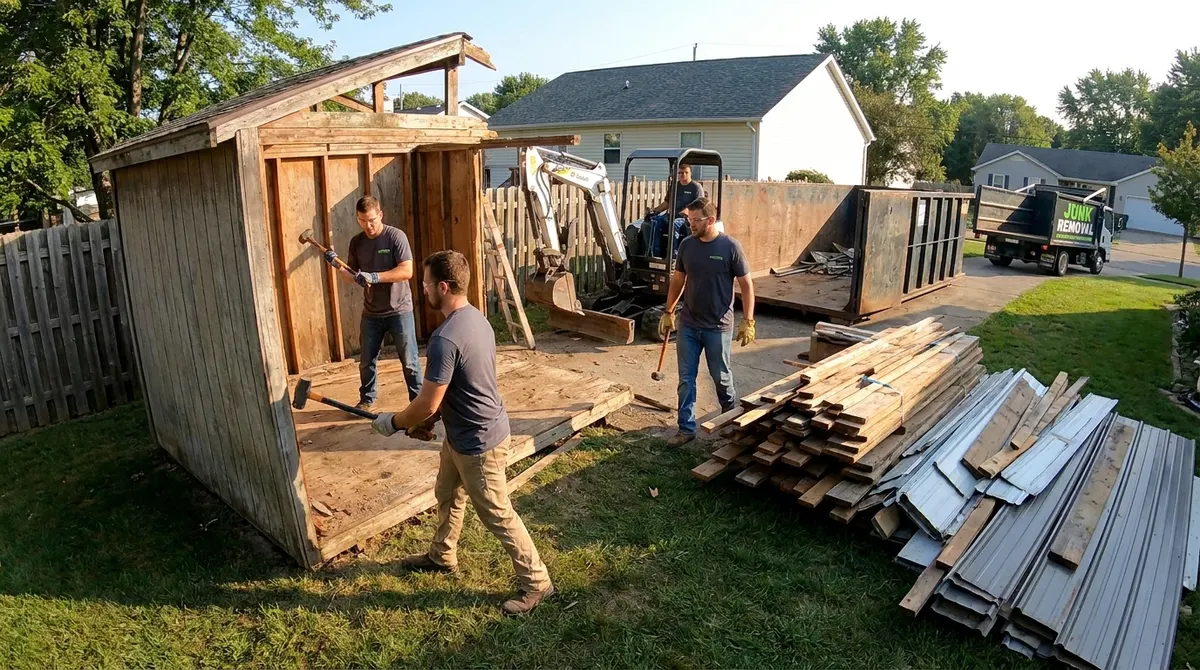
Shed demolition and haul-away generally falls between $300 and $1,800, driven by footprint, roofing material, and whether a slab stays or goes. Our crew does the teardown, the lifting, and the disposal run, and confirms the exact number during a free on-site look at the shed.
| Shed type and size | Typical all-in range (demolition + haul-away) |
|---|---|
| Metal or resin shed, 6x8 to 8x10 | $250 – $550 |
| Wood shed, 6x8 (single door, no floor slab) | $300 – $600 |
| Wood shed, 8x10 with shingled roof | $400 – $800 |
| Wood shed, 10x12 with loft or plywood floor | $600 – $1,200 |
| Barn-style or two-door shed, 12x16 | $900 – $1,800 |
| Add-on: 4-inch concrete slab breakout and removal | +$300 – $900 |
| Add-on: shed packed with stored junk (tools, tires, paint cans) | +$100 – $400 |
| Add-on: no truck access, all debris hand-carried 100+ feet | +$75 – $250 |
| Suspected asbestos siding or transite panels | Abatement quote required before any demolition |
Shed removal and demolition — typical market cost ranges by size and material (ballpark; exact price confirmed on site)
Shed demolition cost tracks four measurable variables, not a flat fee
Shed demolition pricing is built from four things a crew can measure on arrival: footprint in square feet, wall and roof material, what sits under the shed, and how far debris must travel to the truck. A 6x8 metal shed is 48 square feet of thin panel that collapses into a stack roughly the size of a hall closet. A 12x16 barn-style shed is 192 square feet with rafters, plywood sheathing, and often two or three layers of asphalt shingles — that single roof can weigh more than the walls. Shingles and pressure-treated lumber are heavy and are billed by disposal weight, which is why two sheds with the same footprint can quote $200 apart. Anchoring matters too: a shed set on gravel or 4x4 skids lifts free, while a shed bolted to a poured slab requires the slab decision to be made before the quote is final.
Shed removal process runs four stages inside a single crew visit
Stage one is clear-out: everything stored inside comes out first, including shelving, paint cans, tires, and lawn equipment, because demolishing a loaded shed mixes household hazardous waste into clean debris. Stage two is deconstruction from the top down — roofing pulled, then rafters, then wall panels, then the floor deck — which keeps the walls standing as bracing until the roof load is off. Stage three is load-out, with wood and metal separated on the truck so scrap metal, roofing, and treated lumber go to the correct destination. Stage four is site cleanup: nails and screws swept or magnet-rolled, skids removed, and the footprint raked level. Homeowners do not need to be present for the teardown, only for the walkthrough at the start and the sign-off at the end.
Shed demolition permits usually trigger above 120 square feet or on a permanent foundation
Most municipalities exempt small accessory structures from permitting, and the common exemption line sits at 100 to 200 square feet, with 120 square feet the most frequently used threshold. Sheds under that size, on skids or gravel, are usually removable with no paperwork. A demolition permit is more likely when the shed exceeds the local exemption, sits on a poured foundation, carries electrical service, or was originally permitted as a structure. Any shed with a run of electrical conduit needs the circuit killed at the panel and the line disconnected by a qualified electrician before demolition begins. Sheds built before roughly 1980 occasionally have cement-asbestos siding panels; those panels are not demolished on a standard job and require a certified abatement contractor first.
Shed debris is handled as construction and demolition waste, not curbside trash
Torn-down shed material is classified as C&D debris — lumber, shingles, plywood, siding, and metal — and transfer stations charge it by the ton, separate from household waste. That distinction is the reason curbside pickup will not take a shed and the reason a demolition quote includes a disposal line. A typical 8x10 wood shed with a shingled roof yields roughly 1,500 to 2,500 pounds of debris, which fills about a third to a half of a standard removal truck. Scrap metal roofing, metal shed panels, and old aluminum window frames are pulled out and recycled rather than landfilled. Usable items found during clear-out, such as intact hand tools or a working mower, can be routed to donation when a local partner accepts them.
Shed removal timelines land at two to five hours for standard backyard structures
A metal or resin shed under 80 square feet is typically down and gone in 60 to 120 minutes. An 8x10 to 10x12 wood shed averages two to four hours with a two-person crew. A 12x16 barn-style shed, or any shed with a loft, usually runs four to six hours and may push into a second truck load. Concrete slab removal is the one add-on that changes the schedule meaningfully: breaking, loading, and hauling a 4-inch slab adds two to four hours and significant weight, and thicker or rebar-reinforced slabs are quoted separately after inspection. Same-day service is often available for standard sheds when the clear-out is done and truck access is open.
Shed demolition DIY comparison: the honest math homeowners run
A recurring thread in r/HomeImprovement, paraphrased: homeowners report the teardown itself is the easy half, and the disposal is where the weekend disappears — multiple dump runs, per-ton C&D fees, and a pickup bed that holds a fraction of a shingled roof. That matches the numbers: an 8x10 shed produces 1,500 to 2,500 pounds of debris, which is four to six half-ton pickup loads plus tipping fees at each drop. Contributors in r/junkremoval, paraphrased again, note that the surprise cost is almost always the slab, not the shed. A done-for-you demolition consolidates teardown, load-out, disposal fees, and nail cleanup into one quoted number, with the crew supplying the labor, tools, and truck capacity.