Commercial Office Cleanout: What to Know — Complete Guide
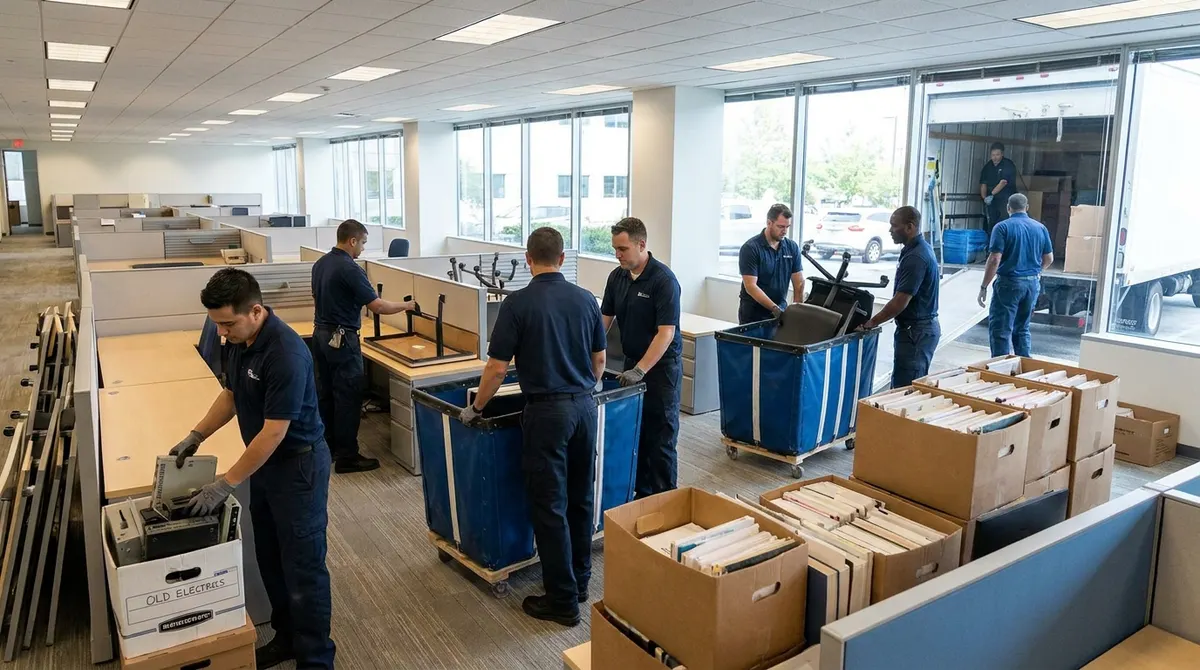
A commercial office cleanout is priced by truckload volume — roughly $350–$900 partial, $1,200–$3,500+ for a full suite — with the crew doing the disassembly and carry-out. {{brand}} handles office, suite and warehouse-office clearouts across {{city}} and greater {{county}}.
| Office size / scope | Typical volume removed | Market-range cost |
|---|---|---|
| Single private office or break room (desk, chairs, file cabinets, small fridge) | 3–5 cubic yards | $250–$450 |
| Small suite, 800–1,200 sq ft (6–10 workstations, files, printers) | 8–14 cubic yards | $450–$900 |
| Mid-size floor, 2,000–3,500 sq ft (20–35 workstations, cubicles, conference furniture) | 18–35 cubic yards (1–2 truckloads) | $1,100–$2,400 |
| Full suite, 4,000–5,000+ sq ft cleared to broom-clean | 35–60 cubic yards (2–4 truckloads) | $2,200–$3,500+ |
| Cubicle systems only (panels, worksurfaces, pedestals) | Priced per station | $45–$120 per workstation |
| File and record purge (banker boxes, empty lateral cabinets) | Priced per pallet / cabinet | $25–$60 per cabinet |
| After-hours or weekend labor premium | Same volumes | Typically 10–25% above weekday rate |
Office cleanout size, typical volume and market-range cost in {{city}}, {{state}}
Office cleanout pricing is measured by truckload volume, not by the hour
Commercial junk removal is quoted on how much space the load occupies in the truck. A standard removal truck or dump trailer holds 15–18 cubic yards, which is roughly the contents of a 10-workstation suite once cubicle panels are broken down and stacked flat. A quarter load is generally $250–$450, a half load $450–$700, and a full load $550–$850 in most markets. Hourly labor billing appears mainly on jobs where volume is small but the carry is long — a fourth-floor walk-up, a loading dock 300 feet from the suite door. Volume pricing protects a business owner from paying for slow access: if the freight elevator is tied up for 40 minutes, the load size — and the price — does not change. Weight matters on dense material. Sixty banker boxes of paper can weigh 1,800 lb while occupying only 5 cubic yards, and disposal yards bill by the ton, so paper-heavy purges are sometimes quoted separately from furniture.
Office building managers require a certificate of insurance before a cleanout crew gets keys
Most multi-tenant office buildings will not release freight elevator access without a certificate of insurance (COI) naming the building owner and property manager as additional insured. Property managers commonly ask for general liability and workers' compensation coverage listed on that certificate, and the request typically needs 24–72 hours of lead time to process. Ask the removal company for the COI early — it is the single most common reason an office cleanout gets pushed a week. Building rules that show up alongside the COI request include masonite or ram board floor protection in lobbies and corridors, wall protection in the freight elevator, a reserved elevator window (often 90 minutes to 4 hours), and dock check-in with the security desk. A crew that has already worked in the building usually has the paperwork on file, which shortens scheduling. Tenants breaking a lease should also confirm what the landlord counts as broom-clean, since carpet, tack strips, low-voltage cabling and anchored shelving are frequently the tenant's responsibility and belong on the removal list.
Office furniture cleanouts split into resale, recycling and landfill streams at the yard
Office material separates into predictable streams. Steel desks, lateral files, metal cubicle frames and server racks go to scrap metal recycling. Clean paper from file purges goes to paper recycling by the ton. Laminate casegoods, cubicle fabric panels and worn task chairs usually go to the landfill because there is almost no aftermarket for them. Newer or brand-name conference tables, height-adjustable desks and Aeron-class chairs sometimes divert to a used-office-furniture buyer or a nonprofit, and confirmed diversion can reduce disposal tonnage on the invoice. Ask for the honest answer on resale value before planning around it: most cubicle systems more than ten years old have no resale market and are priced purely as disposal volume. Electronics — monitors, CPUs, copiers, UPS batteries — are handled as e-waste at a separate facility with its own per-unit or per-pound fees, and CRT monitors still carry a surcharge in most regions.
Office data security is handled before the cleanout crew arrives, not during it
Records with client data, HR files or medical information should be shredded or wiped under a documented chain of custody before a junk removal crew touches the cabinets. The practical sequence: a certified shredding or IT asset disposition vendor processes the sensitive material and issues a certificate of destruction, then the removal crew clears the emptied cabinets, empty boxes, dead hardware shells and the rest of the office. Hard drives should be pulled and destroyed separately from the machine chassis when a compliance policy requires it. On a discussion in r/sysadmin about closing a small office, several IT admins pushed back on letting any general hauler carry off drives — the consistent advice was to keep drive destruction with a vendor that issues serial-numbered documentation. That maps to how the pricing works too: removing 30 empty lateral file cabinets is a volume job at roughly $25–$60 per cabinet, while destroying the contents is a specialty service billed by the pound or box.