Eviction and Tenant Cleanout: A Landlord Guide — Complete Guide
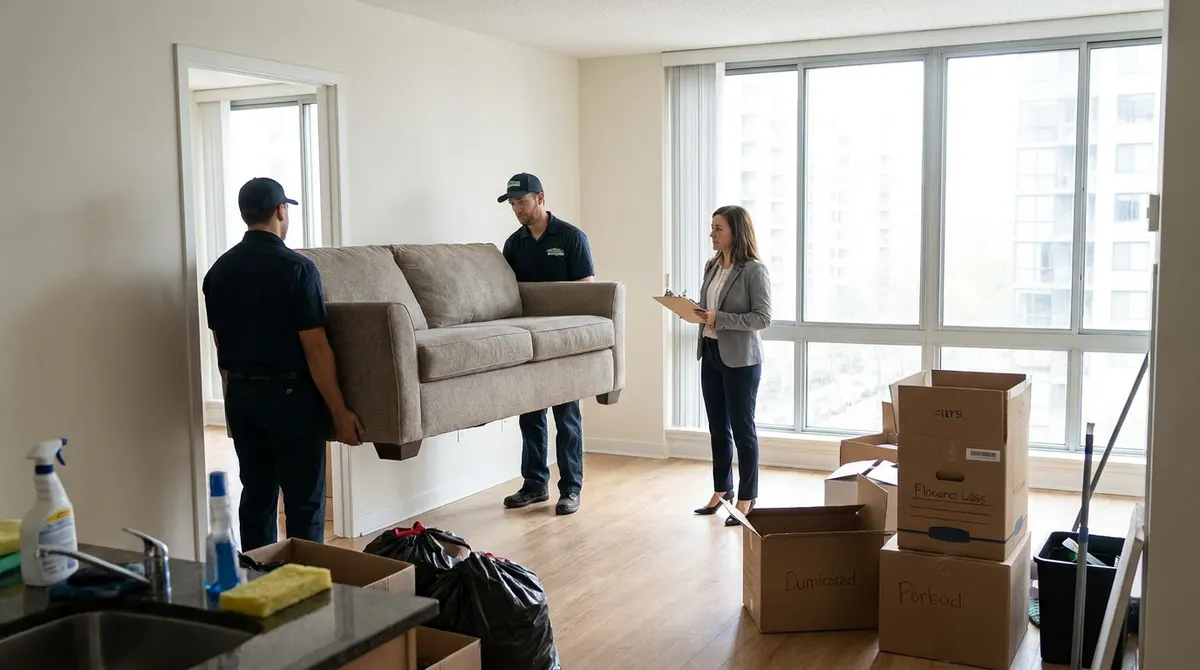
Eviction cleanouts are volume-priced, generally $200–$1,600 per unit depending on size, and our crew handles the lifting, stairs, and disposal so the unit can be re-listed the same week. Exact pricing is confirmed on a free on-site walkthrough of the property.
| Unit / load size | Typical cost range and truck volume |
|---|---|
| Single room, garage bay, or storage unit | $200–$400 — about 1/4 truck load |
| Studio or 1-bedroom apartment | $350–$650 — 1/4 to 1/2 truck load |
| 2-bedroom apartment or duplex side | $500–$900 — 1/2 to 3/4 truck load |
| 3-bedroom single-family rental | $800–$1,600 — 1 to 1.5 truck loads |
| Hoarding-condition or fully furnished abandonment | $1,500–$3,500+ — 2 to 4 truck loads |
| Add-on items with separate disposal fees | Mattress $25–$45 each, refrigerator/AC $35–$75 each, tires $10–$25 each |
Typical full-service eviction and tenant cleanout ballparks by unit size (market ranges; exact price confirmed on site)
Eviction cleanouts start after the abandoned-property hold period ends
Most states require a landlord to store a tenant's remaining personal property for a set window — commonly 10 to 30 days — and to send written notice before disposing of it. The safest sequence is: sheriff or constable completes the lockout, the landlord photographs and inventories every room, the statutory hold runs, then the cleanout crew hauls. Landlords who need the unit emptied immediately often have the crew separate obvious trash and spoiled food on day one and hold boxed personal items in a garage or storage unit until the window closes. Photograph each room before anything is touched; date-stamped photos are the record that protects the security-deposit deduction if the former tenant disputes the charge.
Tenant cleanout pricing is set by truck volume, not by the hour
Junk removal is quoted by the fraction of the truck the debris fills. A standard truck holds roughly 15 to 18 cubic yards, or about 12 to 15 pickup loads. A one-bedroom unit with a couch, mattress, dresser, TV, and 20 bags of loose debris usually lands at a half load. A three-bedroom house left fully furnished usually needs a full load or more. Volume pricing works in a landlord's favor on an eviction because labor time is unpredictable — third-floor walk-ups, narrow stair turns, and packed closets do not raise a volume price the way they raise an hourly one. Ask for the price as a fraction of the truck plus named add-on fees, so the invoice matches the walkthrough.
Eviction cleanout crews handle the lifting, stairs, and loading in one visit
A two-person crew arrives with a truck, dollies, straps, and hand tools. The crew disassembles bed frames, carries out sofas and appliances, bags loose debris, pulls tacked-down carpet when requested, and brooms the floor before leaving. Landlords do not need to bag, stage, or move anything to the curb. Typical on-site time is 2 to 5 hours for a single-family rental and 1 to 3 hours for an apartment. Contractor debris left behind by a tenant — a disassembled deck, drywall scraps, buckets of paint — can usually ride in the same load, though wet paint, solvents, fuel, and pressurized tanks are handled through household hazardous-waste programs instead.
Tenant cleanout debris splits into landfill, donation, and metal recycling loads
Roughly a third of what comes out of an average tenant cleanout is still usable. Sofas in sound condition, dressers, dining sets, working small appliances, and sealed household goods go to donation intake when a receiving charity has space and the items are clean and dry. Metal — bed frames, grills, water heaters, exercise equipment, appliance shells — goes to a scrap yard. Mattresses, upholstered furniture with staining, particleboard furniture, and mixed bagged debris go to the transfer station. Refrigerators and window air conditioners require refrigerant recovery by a certified technician before the shell is scrapped, which is why sealed-system appliances carry a per-item fee on nearly every quote.
Landlord turnaround improves when the cleanout is booked before the lockout date
Vacancy cost, not haul cost, is the expensive line item on an eviction. A unit renting at $1,400 a month loses about $46 a day standing empty. Booking the cleanout for the morning after the scheduled lockout means paint, flooring, and cleaning crews can start the following day instead of waiting on a truck. Same-day and next-day slots are commonly available midweek; Monday and Friday fill first. Landlords managing several doors often keep a standing arrangement so the crew can be dispatched on 24 hours' notice with a lockbox code and a photo of the unit.
Landlord forums flag two recurring eviction cleanout problems
Paraphrasing a common thread on r/Landlord: owners report that the real budget-breaker is not the furniture but the sheer count of trash bags and the sealed-system appliances nobody priced in. That tracks with how quotes are built — a refrigerator, a window AC unit, and three mattresses can add $150–$250 in per-item disposal on top of the volume price. Landlords on r/realestateinvesting also describe underestimating hoarding-condition units by roughly half; a unit that looks like one truck load from the doorway is frequently two once closets, the attic, and the garage are opened. Both problems disappear with a walkthrough quote where the crew opens every door before naming a number.