Should a Junk Removal Company Be Licensed and Insured? — Complete Guide
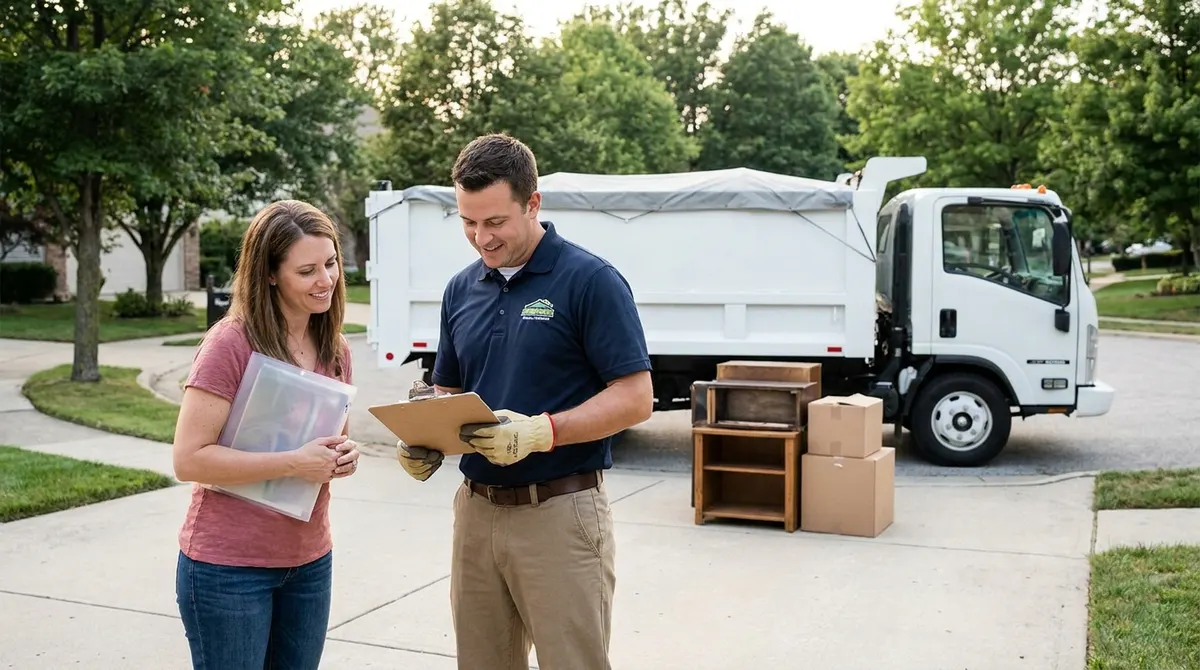
Yes — hire insured, properly registered junk removal crews only. Our local team loads furniture, appliances, garage and estate cleanout debris, carries everything out, and disposes at licensed facilities. Volume pricing is a ballpark; the exact figure is confirmed on a free on-site visit.
| Credential | What it protects | How a homeowner verifies it |
|---|---|---|
| General liability insurance | Damage to walls, stair rails, flooring, doorframes and driveways during the carry-out | Ask for a certificate of insurance (COI) emailed direct from the agency; typical limit is $1M per occurrence |
| Workers' compensation | Injury to a hauler lifting a 300 lb sofa or a chest freezer on your property | Request the policy number on the COI; sole operators are sometimes exempt by state rule |
| Business registration / DBA | Confirms the company legally exists and can be pursued for a claim | Search the Secretary of State business registry by company name |
| Solid-waste hauler permit or license | Confirms the truck can legally transport and tip debris in the county | Ask which transfer station or landfill they use, and whether the county requires hauler registration |
| Auto/commercial vehicle coverage | Damage caused by the truck in a driveway, alley or parking garage | Listed as a separate line on the same certificate of insurance |
| Disposal receipt or weight ticket | Proof the load reached a licensed facility instead of a roadside dump | Ask for the scale ticket after a large cleanout |
Credentials to verify before hiring a junk removal company
Junk removal insurance covers damage caused while the crew carries items out
General liability insurance is the credential that matters most on the day of a pickup, because almost all junk removal damage happens in transit through the house. Two haulers walking a sleeper sofa down a turn in the stairs, a treadmill through a laundry doorway, or a 400 lb safe across hardwood are the moments that scuff drywall, split a stair rail, or gouge a floor. **A certificate of insurance with a $1,000,000 per-occurrence limit is the standard commercial policy in the junk hauling trade**, and any established company can have its agency email that certificate to a customer in a few minutes. Homeowners should read the certificate rather than accept a verbal "we're fully insured" — check that the company name on the policy matches the name on the estimate and that the policy dates cover the scheduled pickup date. Uninsured haulers shift that repair cost onto the homeowner, who then files against their own policy and absorbs the deductible.
Junk removal licensing rules are set by the state and county, not by a national license
No federal junk removal license exists. Licensing is layered: a state-level business registration or DBA filing, a state sales-and-use or service tax registration in states that tax hauling, and in many counties a solid-waste hauler permit or transfer station account. Some cities add a commercial vehicle decal for trucks over a set gross weight. **A legitimate junk removal company can name the transfer station or landfill it tips at and explain how it is registered to haul there.** Vague answers about disposal are the useful signal — companies that cannot name a facility are often dumping on private lots or in commercial dumpsters they do not pay for, and illegal dumping citations have been traced back to homeowners who paid for the pickup. Verification takes about five minutes: search the business name in the Secretary of State registry, then ask the dispatcher which facility receives the load.
Junk removal workers' compensation keeps a crew injury off the homeowner's policy
Workers' compensation is the credential most homeowners forget to ask about, and it carries the largest dollar exposure. Junk removal is heavy manual work — hot water heaters, upright pianos, cast iron tubs, riding mowers, and 60 lb boxes of tile carried down basement stairs. When an uninsured worker is hurt on private property, the claim frequently lands on the property owner's homeowners insurance. Insured companies list workers' compensation as a separate line on the certificate of insurance. Sole operators are exempt from carrying it in several states, which is legal but worth knowing before a one-person outfit takes on a 4,000 lb hoarding cleanout alone. **Two-person insured crews handle stair carries and appliance removals that one uninsured worker should not attempt**, which is a practical reason full-service pricing sits above day-labor rates.
Junk removal pricing for licensed, insured full-service crews runs by truck volume
Licensed and insured haulers price by how much of the truck a load fills, because disposal is billed by weight and volume at the facility. Market ranges: $75–$175 for a single item like a mattress, recliner or refrigerator; $150–$275 for a quarter truckload; $300–$450 for a half load; and $550–$800 for a full 15–20 cubic yard truckload, roughly six to eight pickup-truck beds. Surcharges are normal and disclosed up front for appliances containing refrigerant, tires, mattresses, paint, and pianos, because those items carry per-item fees at the transfer station. Long carries, third-floor walk-ups and full basement clear-outs add labor time. **These figures are ballparks — the exact price is confirmed on a free on-site visit**, since a garage that looks half full in photos often measures out closer to a three-quarter load once the crew counts what is stacked behind the door.