Mattress Disposal And Removal — Complete Guide
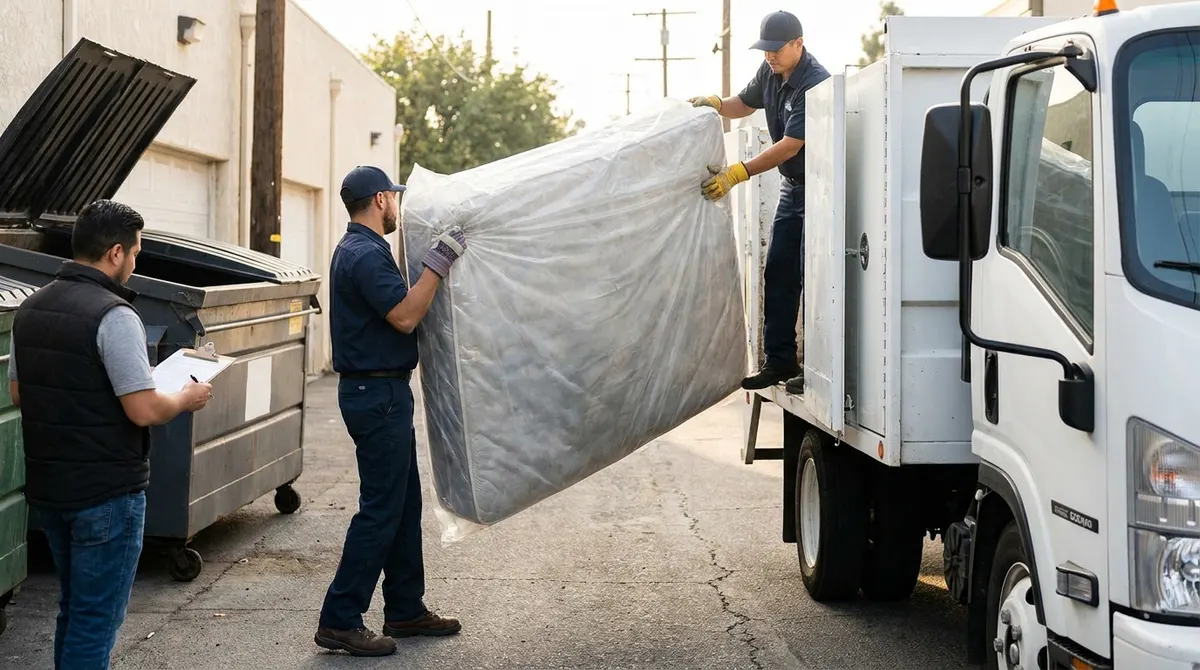
Mattress disposal and removal costs about $75 to $150 per piece with a crew doing the lifting, or $10 to $40 through a municipal bulk sticker if you can wait for the route date. Our haulers carry mattresses down stairs and out narrow hallways so you never touch the piece.
| Route or item | Typical cost range |
|---|---|
| Single mattress, hauler pickup (crew loads) | $75 – $150 |
| Mattress + box spring set, hauler pickup | $100 – $200 |
| Full bedroom set (mattress, box spring, frame, headboard) | $200 – $400 |
| Municipal bulk item sticker, curbside | $10 – $40 per piece |
| Self-haul to transfer station or mattress recycling facility | $15 – $40 per mattress + minimum load fee |
| Retailer haul-away with new mattress delivery | $0 – $50, delivery day only |
| Charity donation pickup (used mattress) | Usually declined; free when accepted |
Typical mattress disposal and removal costs by route and item count
Mattress disposal fees exist because mattresses cost handlers labor, not landfill space
A mattress weighs 50 to 120 pounds and cannot be compacted in a standard trash truck — the steel innerspring wraps around compactor blades and jams the auger. Landfills and transfer stations therefore separate mattresses into a hand-sorted pile and charge a per-piece fee of roughly $15 to $40 on top of the tipping rate. Haulers pass that fee through and add the labor of a two-person carry-out, which is why a mattress shows up as its own line item rather than folding into a load price. A memory foam mattress avoids the innerspring problem but is bulky and low-density, so it eats truck space the same way.
Curbside mattress pickup requires a sealed encasement bag in most cities
Most sanitation departments require any mattress or box spring set at the curb to be sealed in a plastic mattress encasement bag, taped closed, before the truck will take it. Crews leave unbagged mattresses behind and tag them. Encasement bags sell for $8 to $20 at hardware stores and moving suppliers in king, queen, and twin sizes. Bulk pickup also runs on a schedule — many cities collect bulk items every other week, monthly, or by appointment only, and cap the number of pieces per household per year. A mattress that sits in the rain for three days before the route date absorbs water, gains 30-plus pounds, and gets rejected as a soaked item.
Mattress recycling recovers steel, foam and wood from most of the unit by weight
A mattress recycling facility cuts the cover open, pulls the steel innerspring for scrap metal, strips foam and fiber padding for carpet underlay, and breaks the box spring frame down into wood chips. Operators commonly report recovering the large majority of a mattress by weight this way. Four states — California, Connecticut, Rhode Island and Oregon — run mattress stewardship programs funded by a recycling fee added at purchase, and those programs accept mattresses at designated drop-off sites at no charge to residents. Outside those states, recycling access depends on whether a private facility operates within driving distance, and per-piece fees still apply.
Used mattress donation is declined by most charities on sanitation grounds
Charity resale is the cheapest disposal route and the least available one. Salvation Army donation policy varies by location, and many local intake centers decline used mattresses outright; Habitat ReStores and thrift chains generally do the same. Some states prohibit reselling a used mattress unless it has been sanitized and re-tagged by a licensed renovator. Call the specific intake location before loading anything. Where a mattress is accepted, it must be clean, dry, stain-free, tear-free and under roughly 10 years old. Anything with visible staining, a broken frame, sagging edges or an odor is a disposal item, not a donation.
Bed bug mattresses must be sealed before any crew touches the piece
A mattress with bed bugs is legal to dispose of, but it has to be encased and taped shut in the bedroom — not dragged down a hallway first — so insects do not shed along the route. Slashing the cover or spray-painting "BED BUGS" on it discourages scavengers from pulling it off the curb. Tell the hauler on the phone. Crews handling an infested mattress bag it in place, avoid setting it against clean furniture, and keep it separated in the truck. Heavily stained mattresses follow the same rule: recycling facilities reject them for contamination, so they route to landfill instead.