A Spring-Cleaning Junk Removal Checklist — Complete Guide
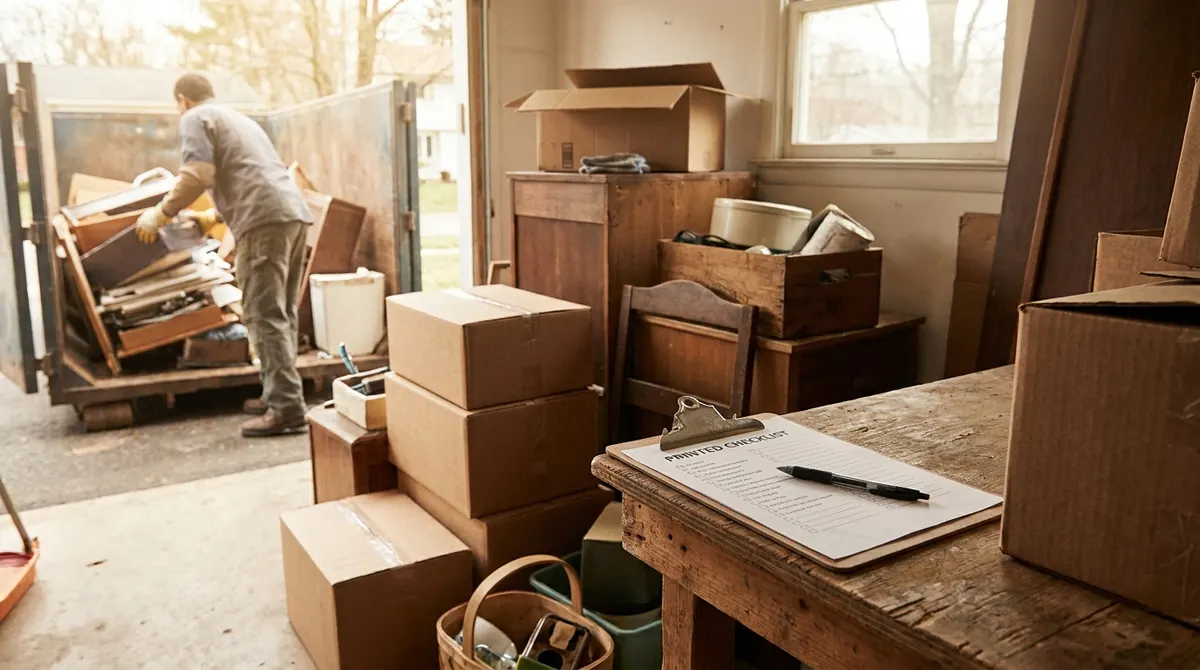
Spring cleaning junk removal is priced by truck volume — roughly $150 for a quarter load to $800 for a full truck — and our local crew does the carrying, including basement stairs and detached garages. The checklist below sorts a house in the order that produces the biggest single pickup.
| Load size (truck volume) | What it typically holds | Typical cost range |
|---|---|---|
| Single item | One couch, one mattress, or one appliance | $75 – $150 |
| Quarter truck (~4 cu yd) | Closet purge plus 10–15 bags and boxes | $150 – $250 |
| Half truck (~7–8 cu yd) | Two-car garage sweep: bikes, shelving, paint-free clutter | $300 – $450 |
| Three-quarter truck (~11 cu yd) | Finished basement cleanout with furniture and carpet | $425 – $650 |
| Full truck (~15 cu yd) | Whole-house spring cleanout or estate-style clearing | $550 – $800 |
| Add-on disposal fees | Mattress, box spring, fridge/AC (refrigerant), CRT TV, tires | $25 – $75 each |
Spring-cleaning load sizes, what typically fits, and market-range cost
Spring-cleaning junk removal works fastest when the garage is cleared first
The garage holds the largest and heaviest items in most homes, so clearing it first frees staging space for everything else. Pull out broken shelving, rusted tools, dead lawnmowers, bike frames, empty planters, cracked storage totes and the stack of cardboard saved "just in case." Count the items that have not been touched since the previous spring — those are the haul pile. A two-car garage sweep usually fills a half truck, roughly 7 to 8 cubic yards, and prices in the $300 to $450 range. Gas-powered equipment must be drained of fuel and oil before it rides in the truck, and propane tanks are handled separately at an exchange point rather than in a general junk load.
A basement and crawlspace cleanout produces the heaviest spring loads
Basements collect water-damaged furniture, sagging cardboard, old carpet rolls, exercise equipment and the second refrigerator that stopped cooling years ago. Weight and stair access, not item count, are what slow a basement job. A finished-basement cleanout with a sectional, a treadmill and 20 boxes commonly reaches three-quarters of a truck, roughly $425 to $650. Crews carry items up the stairs, so nothing needs to be dragged to the driveway ahead of the appointment. Anything with visible mold should stay bagged in 3-mil plastic until the truck arrives to keep spores out of the rest of the house.
Junk removal pricing is measured by truck volume, not by the number of items
Volume is the unit of measure. A standard junk removal truck bed holds about 15 cubic yards — roughly the space of six pickup-truck loads — and the charge reflects the fraction of that bed a load fills. Ten light bags of clothing cost less than three dressers because the dressers eat more cubic feet. This is why breaking down bed frames, collapsing boxes and stacking patio furniture before pickup often drops the load one bracket, saving $100 or more. Weight matters only for dense material such as concrete, brick, dirt, roofing shingles and tile, which is quoted separately because of landfill scale charges.
Mattresses, appliances and electronics carry separate spring disposal fees
Certain items cannot enter a general waste stream and are billed individually on top of the load price. Mattresses and box springs typically add $25 to $60 each because they go to a recycling facility that separates foam, fabric and steel. Refrigerators, freezers, window air conditioners and dehumidifiers require certified refrigerant recovery, generally $30 to $75. CRT televisions and older monitors run about $25 to $50 due to leaded glass. Tires are usually $10 to $25 apiece. Latex and oil-based paint, motor oil, pesticides, pool chemicals and car batteries are household hazardous waste and belong at a designated collection event rather than in a junk truck.
Spring yard debris rides in the same load as indoor junk
Yard cleanup and interior clutter can be combined into one pickup, which is cheaper than booking two appointments. Typical spring yard items include collapsed patio furniture, torn gazebo canopies, cracked kiddie pools, old grills with the propane removed, rotted fence panels, broken pots and split garden hoses. Bagged leaves, branches and grass clippings are accepted in most markets but are sometimes routed to a separate yard-waste facility with its own tipping charge. Pressure-treated lumber, railroad ties and painted deck boards cannot be composted and are disposed of as construction debris.
Closet and paperwork purges finish the checklist with the smallest loads
Closets, kids' rooms and home offices are the last stop because they produce volume-light, decision-heavy piles. Sort clothing into wearable and worn-out: wearable goes to a donation center, worn-out textiles fill bags that compress well in the truck. Broken laptops, printers, tangled cables, expired car seats, cracked toy bins and warped bookcases go to the haul pile. Documents with account numbers should be shredded rather than tossed loose. A closet-and-office purge usually lands at a quarter truck, roughly $150 to $250, and pairs well with a garage load booked the same visit.
Spring junk removal crews handle the lifting, the stairs and the sweep-up
The done-for-you version of this checklist means two crew members enter the home, carry every flagged item out, load the truck and broom-sweep the space they emptied. No curbside staging, no rental truck, no dump run, no lifting a treadmill up basement stairs. Same-day pickup is often available when a slot is open, and March through May is the busiest stretch of the year, so morning windows fill first. An exact price is confirmed on site — the crew walks the pile, quotes the volume bracket in writing, and work begins only after the number is approved.
Junk removal donation sorting keeps usable items out of the landfill
Sorting before pickup shrinks the load and redirects usable goods. Furniture in structurally sound condition, working small appliances, tools, books and clean housewares are commonly accepted by local donation centers, and metal — appliance shells, bed frames, filing cabinets, cast-iron radiators — has scrap value that recyclers accept year-round. Stained upholstery, cracked plastics, particleboard furniture and recalled cribs or car seats are rejected by nearly every charity, so those items belong in the haul pile from the start. Asking a crew to divert donatable items is standard practice and requires only a marked pile.
Junk removal discussions on Reddit flag stair carries and vague quotes
Homeowners in r/junkremoval threads repeatedly describe the same frustration, paraphrased: the phone estimate sounded fine until the crew saw a third-floor walk-up or a load of tile, and the price moved. The spec fact behind it is simple — volume-based pricing is honest, but flight-of-stairs access and dense debris such as tile, concrete and shingles are separate line items in nearly every market. Another recurring theme from r/CleaningTips, paraphrased: people underestimate how much space a spring purge occupies. A single-car garage plus one bedroom routinely exceeds 7 cubic yards, which is why the half-truck bracket, $300 to $450, is the most common spring booking.